

AI is putting middle management on trial.
The cost story writes itself. When execution is the expensive part, anything that sits close to execution starts to look like overhead once software can do more of it.
Klarna ran the play first. Between 2022 and 2024, they eliminated about 700 customer service roles, replaced them with an AI assistant built with OpenAI, and cut headcount from roughly 5,500 to 3,400.
In May 2025, CEO Sebastian Siemiatkowski reversed publicly. His own words: we went too far. His diagnosis: cost had been treated as the predominant evaluation factor, and the result was lower quality and eroded trust. The company is now rehiring humans for customer service.
The narrative continued anyway. In April 2025, Shopify CEO Tobi Lütke issued a memo requiring teams to demonstrate why AI couldn’t do the job before requesting new headcount. The wave of AI-driven layoffs continued through the year. A January 2026 Harvard Business Review survey of 1,006 global executives found companies are cutting based on what AI promises, not what it has demonstrated.
Klarna’s AI worked. The cost model didn’t.
Most org cost models can see headcount, cycle time, throughput, and output per person. They measure the labor needed to produce work. They struggle to measure the judgment needed to keep work coherent.
That blind spot mattered less when execution was slow and costly.
A bad campaign brief still created waste, but the waste moved slowly. Drafts took time. Handoffs took time. There were checkpoints where someone could notice the mistake.
AI strips out many of those checkpoints.
A weak decision can now become a dozen assets, six workflows, three customer segments, and a week of cross-functional cleanup before anyone can name what went wrong.
That’s the change. Execution gets cheaper, so the cost of judgment goes up.
We’ve seen this kind of mistake before. In the early internet era, many companies treated the web as cheaper distribution. Catalogs moved online. Storefronts became websites. Transactions moved to the browser.
The tech worked.
But the firms that saw only distribution missed what else shifted at the same time: information, attention, trust, and access.
AI is doing something similar to organizational work. It cuts the cost of execution, and it changes how errors spread.
Call that price the Judgment Premium, and every decision pays it.
It shows up in three forms: Leverage, Coordination, and Context. Together, these replace the old execution bill.
Let’s go through each one.
The First Premium: Leverage
Cheap execution increases the consequence of every decision.
Expensive execution acted as a buffer. A wrong call got caught somewhere along the way (in a draft review, a budget meeting, a designer pushing back on a brief) by someone whose job included catching it. The decision had time to be wrong before it became real. Cheap execution removes that buffer.
Decisions spread at the speed of the system, and reach scale before anyone has time to notice they were wrong.
On a Wednesday afternoon, Maya, a senior brand marketer at a mid-market SaaS company, finalizes the brief for the company’s Q2 campaign. The positioning angle is one line in the document:
Position the product as the fastest path to ROI for finance teams under pressure.
She runs the brief through her agent stack. The system was built over the previous quarter and is now standard for campaign rollout. By Thursday morning, the assets are ready: forty-eight pieces across the funnel. Paid social variants, email sequences, landing page copy, sales enablement decks, partner co-marketing kits, two video scripts, retargeting ads, a webinar registration flow.
She reviews the outputs.
Everything is on-brand. Every asset uses the positioning line from the brief. Voice is consistent across formats. The email sequence flows into the landing page, which flows into the sales deck. Nothing contradicts anything. The system did what it was built to do.
She signs off and sends the package up for executive review.
The VP of Marketing opens the deck Friday morning. She gets to slide three and stops. She reads it again. Then she opens the email sequence, then the landing page copy, then the paid social variants.
Then she calls Maya.
The angle is wrong. Finance teams under pressure aren’t buying for speed-to-ROI right now. They’re buying for defensibility under audit. The campaign is selling the product on the wrong axis. Every asset is selling on the wrong axis. Everything is internally consistent and externally wrong about what the buyer is trying to solve.
The agents didn’t make a mistake. They executed the decision as designed, forty-eight times.
The cost is in unwinding them: the paid spend already deployed, the sales team already trained on the wrong narrative, the partner kits already shipped, the landing page already indexed, the email already sent to the segment that opens within the first six hours.
Maya is good at her job. The brief was clear. The system worked. The decision was wrong, and the system gave it full force.
A decision used to be the cheap part of the chain — a line in a brief, a paragraph in a doc, an angle picked in a meeting. The work that followed was where the cost lived, and where errors got caught.
Once output is cheap, the decision is the chain, and consequences scale faster than the work.
The Second Premium: Coordination
Cheap execution and slow decision rights produce a gap.
The Coordination Premium opens up inside it.
Output stops being scarce as execution gets cheap. More campaigns, more analyses, more automated decisions running in parallel across more surfaces. By the usual scorecards it looks like progress: more shipped with fewer people.
Maya’s campaign didn’t live in a vacuum. The positioning angle she picked became a constraint on sales enablement, which became a constraint on the customer success playbook, which became a constraint on how the deal desk talked about pricing. One team’s deliverable becomes the next team’s starting condition. When she shipped one campaign, three other teams had a new shape to match. When she shipped forty-eight assets, they had forty-eight.
Five things produced instead of one isn’t five units of work. It’s five new things everyone else has to stay consistent with. Multiply that across teams, and the sync load rises faster than output.
You can watch it land in the calendar. Reviews stack. Standing meetings appear where ad-hoc check-ins used to be enough. Decisions take longer because the group required to make them is larger and harder to assemble. Execution speeds up. Decision speed slows down. Meetings stop being where decisions happen and become where the lack of decisions gets managed.
Async hides the cost because it never shows up as a four-hour block. It shows up as a decision stretched across two days of messages, more readers, more “just looping in,” more partial answers, no clean end. The bill is the same. Same total cost, paid in installments.
Process tweaks help at the edges. Better templates, tighter agendas to reduce friction. They don’t fix the mismatch: fast execution running on slow, vague decision rights.
The org pays it in time, in attention, and in calls that stall while the system tries to figure out who can make them.
The Third Premium: Context
Some decisions travel with the context that produced them. Most don’t.
The Context Premium is what gets paid in the gap.
The category owner of consumer AI tried to give its agents extensive guidance and watched the doc rot.
Ryan Lopopolo, a Member of Technical Staff at OpenAI, described how his team tried to get Codex agents to write production code at volume with minimal human touch. They started with one comprehensive doc — a single AGENTS.md file holding every constraint, convention, and architectural rule.
It failed fast, for reasons they could name. Context is a scarce resource. Too much guidance becomes non-guidance. It rots instantly.
What replaced it was a different operating model. The team’s job became designing environments, specifying intent, and building feedback loops. They shipped about a million lines of code in roughly six weeks, written end-to-end by the agents themselves. Context had become a design problem.
The Codex case is compact: one team, one platform, one set of agents. The general case is messier: hundreds of decisions a day across hundreds of people and thousands of agent processes. The dependency is the same. With one person deciding and executing, the context can stay in their head — why they chose this, what they ruled out, what the next decision will need to account for. Once the work is split across people and agents, that context has to travel. Once it doesn’t, downstream decisions get made without the information that made the original call correct.
The Premium shows up as rework, as outputs that look fine until they hit the world, as people and agents matching patterns nearby instead of navigating toward the goal. The speed you gained from cheap execution gets eaten by cleanup.
Every organization has a layer that’s supposed to keep this from happening. Sometimes it’s a team. Sometimes a function. Sometimes scattered across roles that don’t recognize they’re doing the same job. In most companies it isn’t designed at all. It exists as leftovers — meetings, escalations, unwritten rules people carry in their heads.
Call it the judgment layer.
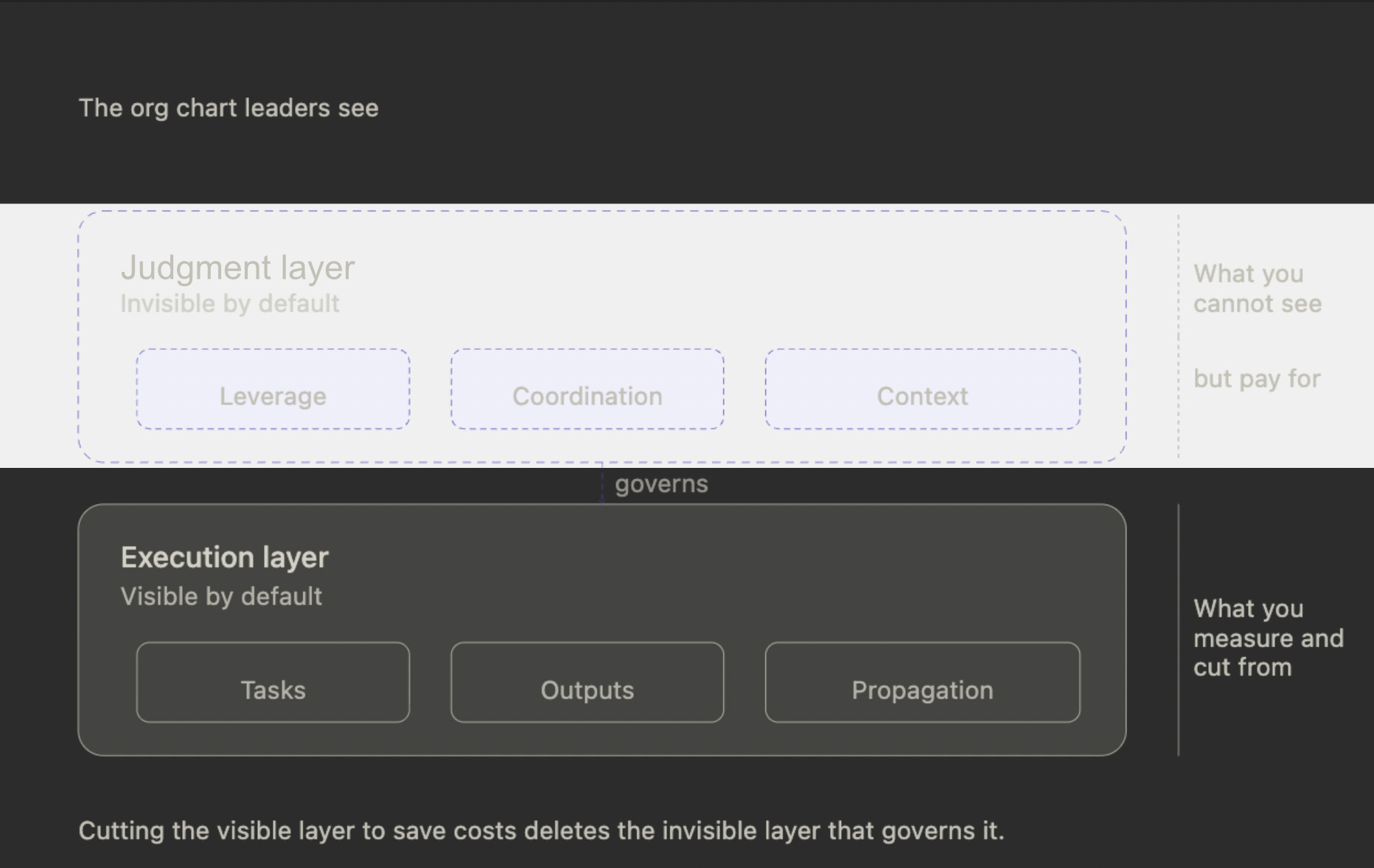
It makes context usable, intent operable, feedback designable. Until recently, it was tangled up with execution oversight that AI can now take on. It was also doing context translation, intent specification, and feedback design, work the rest of the org isn’t usually set up to do.
Cut it without a replacement and the premium spikes.
Three Constraints of the Judgment Layer
A judgment layer appears when the organization enforces constraints on how decisions get made, scaled, and handed off.
Designing those constraints is Decision Architecture.
A working judgment layer has three constraints. Each names a forbidden state. If the system allows that state, the layer doesn’t exist in practice.
1. Constrain leverage
Every decision needs explicit criteria before it can scale. Cheap execution turns undefined calls into output before anyone can interrogate them, so amplification has to gate on definition. Keep ambiguity where it’s cheap to revise: in the decision. Don’t let it leak into execution, where it spreads at full fidelity to whatever the system can reach.
Ambiguity is allowed. Leverage is gated.
Forbidden state: no undefined decision is allowed to multiply.
2. Constrain coordination
Decisions resolve at their origin. Escalation as the default path is the Coordination Premium accumulating in real time — each “let’s loop in” adds another thread, another meeting, another dependency. The system starts managing decisions instead of making them.
A decision either resolves at its origin or it surfaces a design flaw: missing authority, missing information, missing criteria, missing boundaries. Escalation isn’t banned. It’s a signal.
Forbidden state: upward dependency as the default.
3. Constrain context
Context must exist independent of the individuals making decisions. Every decision that “needs the original person in the room” is a decision the org can’t scale. Every decision that requires re-explaining the environment pays twice: once to decide, once to rebuild the context around it. Context has to be portable, embedded in the environment where the decision happens, reachable by every person and every agent operating there.
Personal context doesn’t scale. Portable context does.
Forbidden state: context that lives only in someone’s head.
These constraints don’t belong to one department. They cut across positioning, process, performance, and people. They change how decisions travel, how authority is shaped, how work is evaluated, and how the environment is built.
The work is to apply these constraints deliberately, find where each forbidden state still exists, and redesign until the system truly can’t enter it.
The next Klarna-style reversal is coming.
Most companies running the play won’t see the bill until they’re inside it.
The premium doesn’t disappear when the layer is cut. It moves upstream — to executives whose calendars were already full, who absorb the cost in time spent preparing teams, training someone into the bridge role, eating the lost context middle management was holding. That work doesn’t go away because the layer did.
The cuts assume the present will be the future. The past keeps showing otherwise. Cost-cutting bets on a world that won’t stand still.
The better work is to ask what new problems the org can take on now. The reframe pushes the work from value delivery and capture to value creation. Those who move with you justify their seat. Those who don’t make themselves visible, and any remaining cuts get made on a different axis than headcount.
The price of execution went to zero.
The price of judgment just moved into every decision you make.
P.S. This builds on prior pieces: The Decision Architecture Manifesto (the bigger frame), and The Context Pyramid (the structure), Design The Judgment That Transfers (the application), and Execution is Free. Judgment Decides Everything. (the reality).