

Thursday, 1 p.m.
Someone is explaining why the decision made on Monday doesn’t work in the field.
You made that call on Monday because you had the full picture. Market position. The deal on the table. It took you three seconds because you’d been carrying that context for six months. The decision felt clean.
But there was a constraint your team doesn’t know about yet.
By Thursday, that missing detail matters. A weird case shows up, the kind that only breaks things when the constraint exists. Someone follows the script. The script is missing a page. So you’re back in the same room.
Now you replay the week. Where did it drop?

Maybe it was Slack. Maybe it was a decision you made at 9 a.m. and unknowingly remade at 3 p.m.
This isn’t a communication issue or a speed issue. The people in this meeting can do the work.
The judgment that lived in your head on Monday never made it into the room by Thursday.
The meeting keeps coming back because your judgment didn’t travel.
The decision made it into the room. The six months behind it didn’t.
That gap is context debt: the judgment you’re carrying that never made it to the team. Every fast call that stays in your head adds to it.
Holding context in your head feels like speed. You see the situation, spot the pattern, decide. Three seconds because of six months.
That speed is real—and it’s locked to you.
Each quick decision leaves a deposit.
One undocumented call is fixable. You can patch it later.
A team that knows the script but not the thinking behind it can still get by. They’ll follow steps, copy past wins, and hope the next case looks like the last one.
But when one person’s head holds every non-obvious call in the company, the deposits don’t get cleared. They stack.
Thursday at 1 p.m. is what it looks like when that limit hits the field. The company moves at the pace you can personally carry. When you’re not in the room, the room guesses.
You can see this problem in five levels. Each level fails in a different way, and each one caps the company at a different size.
The Context Pyramid
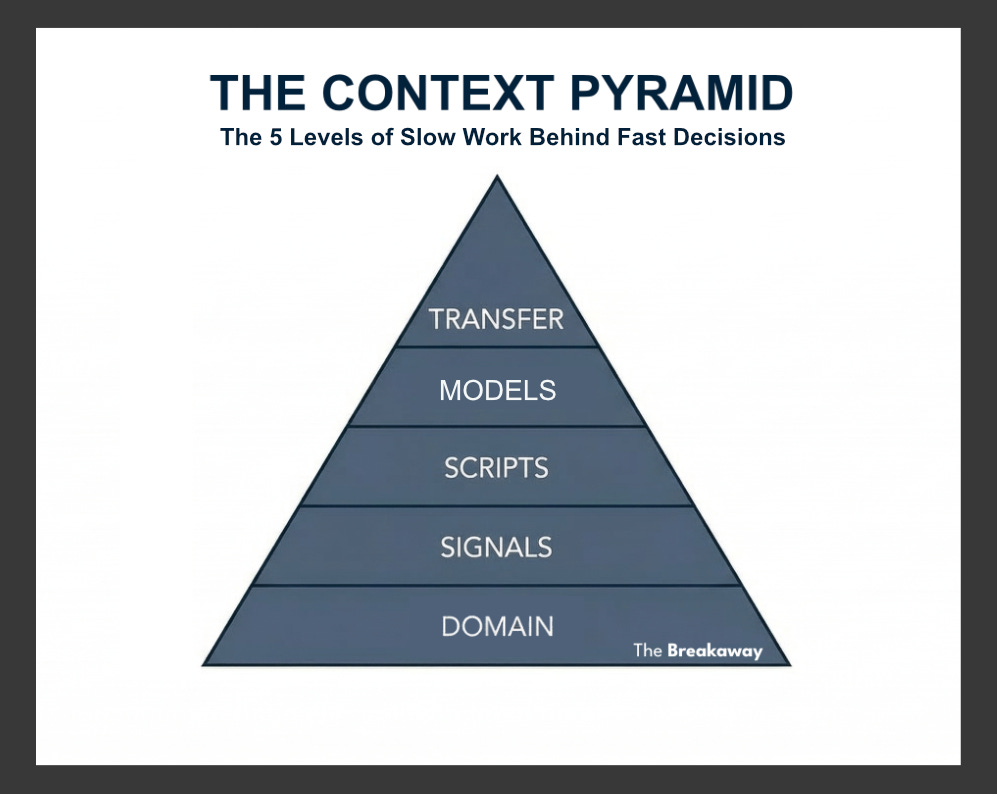
Domain: You've named the container. You know what terrain you're reading, specifically enough to distinguish a signal from noise. Each domain builds its own pyramid.
Signals: You can say what you’re noticing—what you watch for, and what it tends to mean. You stop the meeting on one detail everyone else skimmed past.
Scripts: You have a repeatable play you can point to when this case shows up. A teammate can run it without you—and knows when to pause.
Models: ou can build the structure that resolves competing scripts—which one leads, which one limits, and when those roles swap. The play breaks and you can name what you're protecting, what you're giving up, and what would flip the call.
Transfer: You can take someone else’s thinking apart and rebuild it with them until decisions stop routing back through you. Next week, they handle the new version without you—and can explain why.
These levels aren’t a ranking. They measure how far your thinking can travel.
It starts in fog. Someone asks what to do next and there’s nothing to point to. No read. No signal. No play. You’re guessing.
Then you get a couple calls right. You start to trust the feel. A read in your body, with nothing you can hand to someone else. Fog and intuition aren’t levels. They’re conditions inside whatever domain you’re reading.
After a few wins, it starts to look like speed.
But it’s speed with a catch. When you’re in the room, things move. When you’re not, they stall. Your team starts running on stop-and-go.
Keeping things moving takes a different kind of effort: putting your thinking into something other people can carry.
So it’s in the room even when you’re not.
Level 1: Domain
The pyramid doesn’t start when you get your first clear read. It starts when you decide what you’re reading.
Domain is the container. It sets the walls of the pyramid. Each domain has its own signals, its own scripts, its own form of judgment.
Fog and intuition live inside domains. They’re conditions, not levels. You can carry fog in a domain after twenty years, or have a sharp read in one you entered six months ago. Where you start on the pyramid isn’t determined by time inside the domain. It’s determined by how clearly you’ve named what you’re building in.
That’s the first act of slow work: getting the container right.
Sales is often too broad to generate a signal. “I want to get better at sales” is a direction: it tells you where you’re headed, not what to look at when you get there. The narrowing question is: what about sales? “B2B enterprise CRM sales” is a domain. Bounded enough to tell you what signals to watch for, which scripts have been tested, what breaks when a play meets the wrong case.
The step up from Domain isn’t more experience. It’s deciding what domain that experience belongs to. Specifically enough to start naming what you notice.
Level 2: Signals
Now you can name what you notice. You can point to the tell, not just the outcome. You catch shifts early and can make small moves before you’re locked in.
Signals help you stay light on your feet. They don’t justify a big bet on their own. If you treat a signal like a full story, you’ll commit too early and pay for it.
Signals don’t travel far on their own. The step up is to write them down in plain language: what you watch for, what it usually means, and what you do when you see it.
Level 3: Scripts
This is the first level where other people can run the move without you.
A script is a repeatable play with steps, inputs, and a default decision path.
Sometimes it’s written. Sometimes everyone “knows it” but it still lives in one person’s head.
Scripts are valuable because they keep work moving when you’re not present. They also create a new problem: they work until they don’t.
The edge case is the test. The script hits something it wasn’t built for. The failure mode is running it anyway, because it’s the only thing available.
The step up is to mark the boundary: when the play applies, when it doesn’t, and what triggers escalation.
Level 4: Models
Scripts compress what you know inside one domain, and models are what you build when domains collide.
A sales script says: close faster. Ops says: don’t overpromise. Marketing says: make the claim bigger. Each one works in its own lane. Put them in the same meeting and you get three answers to one question.
A model is the structure that resolves that clash. It explains which script leads, which one limits it, and when those roles swap.
You don’t build one model. You build a set. One for pricing, where sales and finance pull against each other. One for hiring, where speed fights culture. One for product calls, where customer signal runs into engineering capacity. Each model is a field-tested way to settle a specific kind of conflict.
That’s why models are hard to hire for. You can hear someone’s scripts in an interview. Ask what they’d do and you get their playbook. Models only show up under pressure, in new situations where multiple domains demand different things at once. The rare person you’re trying to find is the rainmaker: someone who has built enough of these models that the resolution happens as reflex, not math.
It’s also why senior people can’t always explain their calls. The conflict and resolution can happen faster than words. The mind gets the output, not the steps.
When you’re in the room, decisions move because the model is present. When you’re not, work stalls, detours, or returns in a Thursday meeting. The answer traveled; the model didn’t.
The step up is to make the model portable. Share more than the call: name the scripts in conflict, say which one won, and why. State the constraint that broke the tie, and the condition that would have flipped it. That’s what someone else needs to build their own models—and handle the next version without you.
Level 5: Transfer
Transfer is when the logic stops running through you.
Not “I told them what to do.” “They can think through the next one without me.”
This is the slowest work, and it pays the furthest forward.Each person you help build Models doesn't just carry the answer into the next room. They carry the reasoning. The scripts. The constraint set. The call they can make without you because they’ve seen you make it enough to know why.
When someone makes a mistake, can you see where the thinking broke? The missed constraint. The wrong assumption. The tradeoff they never weighed. Then can you rebuild that part with them? Not the answer. The logic underneath it. So the next decision changes.
Correcting the answer fixes today. Rebuilding the reasoning fixes the pattern.
But Transfer isn’t the top of a single pyramid. It’s the bridge to what’s next.
When judgment becomes portable, it does two things at once: it confirms you’ve built something real in this domain, and it tells you where to build next. You don’t transfer into thin air. The question that opens after Transfer is always: what domain does this judgment need to enter?
Lateral transfer moves at the same altitude: same complexity level, different terrain. The judgment you built with first-time homebuyers about emotionally-driven financial decisions moves to first-time investors. The frame holds. The signals are different.
Vertical transfer elevates in the same domain: from transactional pattern recognition to market cycle reading.
Either way, you’re not done. You’re at the start of a new container.
The step up from Transfer isn’t more time in the current domain. It’s naming the next one specifically enough to start building in it.
Climbing the pyramid is a practice you repeat.
It grows the way fluency grows.
You notice something you usually carry in silence, you name it, you give it a shape, and you do it again next week.
The first limit is willingness.
To combat that, keep a short set of questions in play long enough to get honest answers:
What do I keep turning over in my head?
What do I keep explaining to people who should already know it?
What shows up across different rooms, different quarters, different people?
What do I assume everyone sees that clearly disappears when I leave?
Those are your raw material. The judgment you’re already carrying. The parts of the job other people can’t reach yet.
The hard part is that your most valuable judgment often goes dark.
After you’ve made the same read a hundred times, it stops feeling like judgment. It feels like obvious. The pattern fires before you name it. The call lands before you track the logic. That’s why it feels fast. The faster it feels, the deeper it’s buried. What looks like instinct is often compressed experience that never got words.
The “obvious-to-you” layer is the hidden layer. Pulling it into the open is the first job.
Skip it, and the breakage shows up higher up the pyramid.
Scripts without the thinking behind them are brittle. They run clean until the edge case shows up, then they snap. The person running the play can’t adapt it, because they don’t know what it was built to protect.
Judgment that never gets rebuilt through Transfer stays trapped with you. Problems get solved when you’re present. The loop returns when you leave. Thursday ends when the logic travels without you.
Each level becomes the footing for the next. You climb in order.
In practice, the slow work shows up as small moments:
A call you make, plus the reasoning that led to it.
A play you write down instead of carrying for another quarter.
A decision you walk someone through instead of dropping the verdict.
A pattern you name out loud so someone else can start watching for it.
These moments don’t feel like building. They feel like stopping in a day that already feels packed. Most of them add fifteen minutes you think you don’t have.
That’s the constraint: stopping long enough to give your thinking a form, instead of spending it again.
If you stay in motion, you keep spending context. Calls route back to you. Decisions wait for you. You move fast and you become the pinch point.
If you pause at the right moments, judgment starts traveling. The room keeps moving when you’re gone.
The slow work is what makes everything else move.
You can start tomorrow with a tool you already have.
Not because it does the thinking for you. Because it keeps the question on the table when you’d normally move on.
You’ve felt this before. You’re walking someone through a decision, and halfway through you hear yourself say something you didn’t know you knew. You didn’t plan it. The act of explaining pulled it out.
Use the tool the same way. Treat it like a room where you’re the one doing the explaining—and the explaining is the work.
Start a sentence. Let it press you to finish it. Say the half-formed version. Let it reflect it back with the holes showing. Try again. That back-and-forth is the practice.
Use it as a mirror. Bring rough thinking. Ask it to hold the other end while you shape it into something you could hand to someone else.
How to Practice the Context levels
You can read the pyramid and nod along.

Or you can practice it tomorrow.
Pick a real decision you made this week and push it up one level. Use an AI chat as a practice partner. Not to think for you—just to keep asking until your reasoning is out in the open.
Open a new chat. Choose one decision. Start at the level your last Thursday meeting points to. Then run the prompt for that level.
Each level of the pyramid has a different kind of practice:
Domain
Name what you're building in. Specifically enough that you know what signals belong inside it, and what you're not trying to read.
Domain Prompt:
Signals
Take a recent signal and say what it means, not just what happened. “Revenue dipped” is a fact. The signal is what that fact points to for this quarter, this team, this customer. Let the tool ask the follow-up you usually skip.
Signals Prompt:
You are a thinking partner who helps turn observations into meaning. Your job is not to interpret for someone. It's to hold the question open until the interpretation surfaces from the inside.

PROMPT QUESTIONS
"Think of something you've noticed recently — a shift, a pattern, a moment that felt significant but you haven't fully processed.
Describe what you observed. Just the facts. What happened?"
After they respond:
"Now say what it means. Not what happened — what it points to. For this situation, this team, this quarter. What does that observation tell you?"

RESPONSE LOGIC
If they produce both the observation and a clean interpretation — specific, directional, actionable:
Say: "That's not just a signal — that's the beginning of a script. You're past Level 2. Take it to Level 3."
If they have the observation but the interpretation is vague, general, or restates the fact:
Reflect what they gave back and say: "That's what happened. Now say what it means. Finish this:
'When I see ___, it usually means ___, so the move is ___.' "

Press to complete all three parts. If the middle part won't come — the meaning behind the observation — that's where thinking is still sitting at the surface. Press there specifically.
If the third part won't come — the move:

Say: "The observation is clear. The meaning is clear. The move is what turns a signal into something someone else can use. What do you do when you see this?"
When all three parts hold, reflect the complete signal back in one sentence — observation, meaning, move.
That's the output — a signal with enough shape to become a script.

Don't advance until all three parts hold without prompting.
Scripts
Walk through a play you run often. Lay out the steps. Then ask why each step exists. The “why” is usually where the judgment is hiding. A play travels better when the thinking behind it travels with it.
Scripts Prompt:
You are a thinking partner who helps turn repeatable moves into transferable plays. Your job is not to evaluate the play. It's to find where the thinking behind it is still hidden — and press until it surfaces.

PROMPT QUESTIONS
"Think of a move you run regularly — something you do the same way because it works. Walk through it. What are the steps?"
After they respond:
"Now for each step — why does that step exist? What is it protecting against, or setting up?"
After they respond:
"Where does this play break? What's the case it wasn't built for — and what happens when someone runs it anyway?"

RESPONSE LOGIC
If they can walk through the steps, explain the reasoning behind each one, and name the edge case clearly:
Say: "That's not just a script — that's a play with judgment built in. You're past Level 3. Take it to Level 4."

If they can walk through the steps but the reasoning behind them is thin or assumed:
Reflect the steps back and say: "The play is clear. The thinking behind it isn't traveling yet. For each step, finish this:
'This step exists because ___. Without it, ___.' "

Press through every step. The step where that sentence won't complete — that's where the judgment is hiding.
If they can explain the reasoning but can't name the edge case:

Say: "Every script has a boundary — the case it wasn't built for. Describe the situation where someone runs this play and it breaks. What's different about that case?"
If the edge case still won't come, press here:
'This play assumes ___. When that assumption is wrong, the play ___.' "
When steps, reasoning, and edge case all hold:

Reflect the complete play back in this form —
"The play: [steps]
The thinking behind it: [why each step exists]
Where it applies: [the condition]
Where it breaks: [the edge case]
What triggers a different call: [the escalation]"

That's the output — a script with enough structure to become part of a playbook.

Don't advance until all three layers hold without prompting.
Models
Tell the story of a recent call. What did you notice? What did you weigh? What did you rule out? What did you decide? Keep going until the logic holds together without you patching it mid-sentence. If you’re still patching it, the reasoning is still stuck in your head.
