

Knowledge was power when execution was expensive.
For my parents, it shaped the future they came to America to build.
They arrived from the Caribbean with the kind of work ethic you only learn when the margin for error is thin. My father spent his working years as an electrician. He was steady, respected, and he could fix what other people couldn’t.
Still, when he talked about the future, he talked about school.
My father understood something simple: the highest-paid work was not the work that required the most effort. It was the work that required the rarest kind of know-how.
You could be the best electrician in town and still be treated like you were doing “a trade.” You could be an average doctor and still be called “Doctor.”
For decades, knowledge was scarce. You had to earn it, borrow it, apprentice for it, or pay for it. Then you had to apply it, which meant doing the work yourself or paying someone who could.
Knowing and doing were tied together. If you had the knowledge, you usually had the authority to act on it. If you did not, you could not. So “knowledge is power” was not a motivational poster. It was a description of the bottleneck.
The person who could diagnose a problem, structure a plan, design a system, or architect a solution had control because carrying those ideas into the world was hard.
For nearly fifty years, that bet paid off.
Education became the ladder. Degrees became the filter. Credentials became the signal. If you could get into the knowledge layer, you got access to better work, better money, and a better seat at the table.
Then the scarcity started moving.
When the internet arrived, what you knew began to matter less than whether you could find what you needed.
Knowledge stopped being locked inside institutions and started living in public.
It also started a pattern that would keep repeating: each wave made a former advantage easier to copy.
First, access.
Once, you needed the right school, the right mentors, the right books, the right city. Now a teenager can learn almost anything with a search bar.
Then, distribution.
Once, you needed a publisher, a network, a marketing budget, an editor, shelf space. Now anyone with a smartphone can run a media empire.
Now, application—the layer collapsing as we speak.
A year ago we called it prompts. Now we call it agents. Next year we’ll call it something else. The label keeps changing because the surface keeps changing. The form is not the point. What matters is that the execution layer is being absorbed.
Work that once demanded years of practice now starts with a prompt: draft this, summarize that, build the plan.
Every time a layer gets cheap, people insist it still separates them. It still exists. It just stops separating you.
When access opened up, people clung to distribution. When distribution opened up, they clung to execution. It’s hard to admit that the thing you are good at is no longer rare.
So the question isn’t “what is hard today?”
It’s “what stays rare even when tools get better?”
What “knowledge is power” hid was a deeper dependency: someone still had to decide what knowledge was for. The person with real power was never the one who could produce output fastest. It was the one who could decide what output mattered.
Give two people the same knowledge and the same tools, and you still don’t get the same result.
The difference is not what they know. It’s what they decide to do with it.
Judgment was always the separator. Execution was just expensive enough to hide it.
When you hear “judgment,” you probably hear instinct. Or taste.
That’s convenient because it lets you treat judgment like personality.
It’s not. Judgment has structure.
Look at your calendar. Pick a meeting where real decisions need to get made for the business to move.
Now ask: if someone on your team had to run this meeting without you, what would they need to know?
Most answers stop at the surface. They need the agenda. The background. The context.
It’s not wrong, just incomplete.
Domain. What is this meeting actually about? Not the title on the invite. The real purpose. What’s at stake? What does the business need out of this conversation? What decision needs to be made, and what will change as a result? If a person can’t name the domain in plain language, they can’t run the meeting.
Signals. What should they watch for? What matters in the conversation and what’s noise? What phrases tell you the real issue is hiding? What shifts in tone indicate a problem that won’t show up in the notes? Signals are where judgment starts. A meeting can look productive and still be a waste if it’s missing the signal that points to the real constraint.
Scripts. If pricing pushback comes up, what do we say? If they ask about timeline, what do we commit to and what do we refuse? If the conversation goes sideways, what principle do we fall back on to reset it? Scripts are not canned lines. They are repeatable responses to recurring pressure. They keep you from inventing your stance in real time.
Model. What are we optimizing for? How do these pieces connect? What would change your mind about the whole approach? The model is the reason your choices look consistent. It’s the logic beneath the logic.
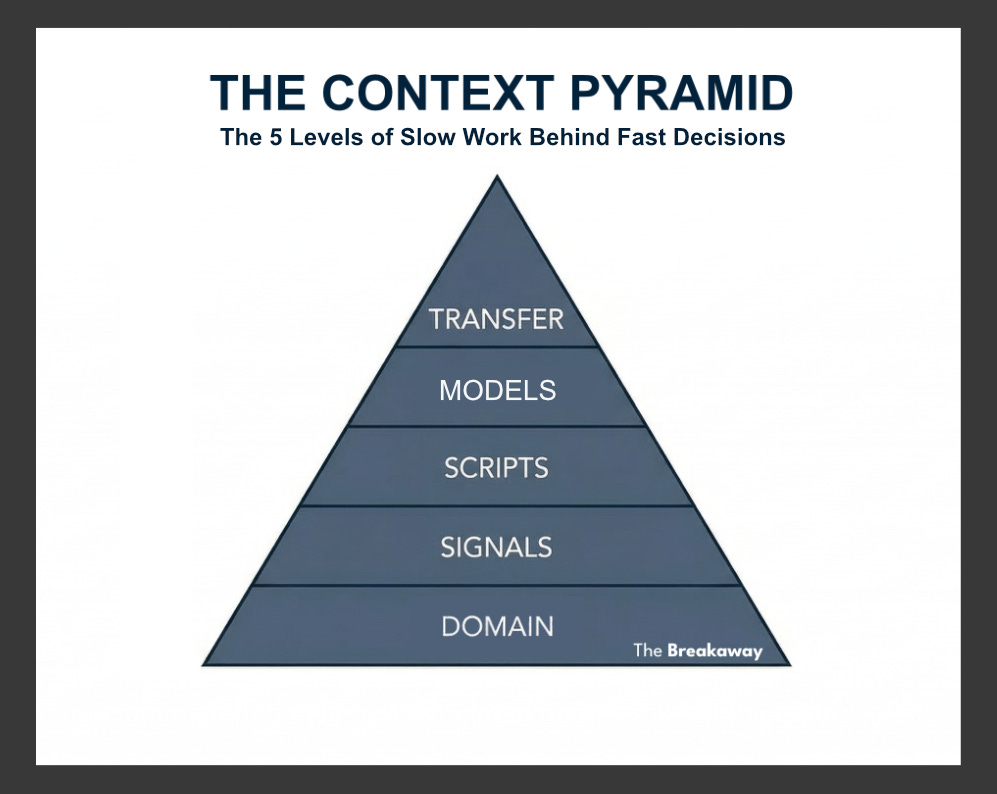

Most leaders stall inside that stack.
They can name the domain. That’s table stakes. Signals get hazier. You might feel what matters, but could you write it down for someone else? Scripts live in your gut. The model often isn’t written anywhere. It’s the thing you operate from but haven’t externalized.
It’s where your judgment stops being transferable and starts being trapped.
This is not just a leadership issue. It’s the same problem you hit when you delegate important work and it comes back technically done but strategically wrong. Same problem you face when you hand work to an AI agent.
The tool can generate output, but it cannot decide what matters unless you supply the judgment layer.
Wherever you stalled is exactly where your organization depends on you.
If your team needs you for every signal call, you’re the bottleneck.
If your model lives only in your head, the company can’t scale past your presence.
Designing judgment means turning private instinct into portable decision logic. It means giving someone enough to act without checking with you every five minutes. Not copying you, but extending the logic beyond you.
In practice, you stop asking, “Did they do the work?” You start asking, “Did they have what they needed to make the call?”
So you begin to write the decision logic down. What context does someone need to act without you in the room? What is the default stance, and what are the red lines? What would make us change direction? Write that down. Not as a manifesto. As working notes.
Once you do, something shifts. Delegation improves. Teams move faster. AI tools get sharper because they’re no longer guessing what you mean. You stop being the person who has to be in every room and start being the person who designed what happens in the room.
Every leader eventually says they want systems. Repeatable processes. Clear handoffs. Fewer fires.
That desire is right. The mistake is thinking systems come first. They are downstream of judgment.
You can’t build a process for a decision you haven’t made explicit. You can’t train a team on standards you haven’t named. You can’t automate a workflow if you don’t know what “good” looks like.
Every system in a business rests on a set of choices someone made about what matters. What to measure. What to reward. What to do when conditions change. If that judgment was never pulled out of someone’s head and made visible, the system is fragile. It runs as long as the world behaves. Then something unexpected happens and it breaks. Not because the process is bad, but because the decision logic is missing.
A familiar version looks like this. A team builds a process that works in the “normal” case. It looks clean on a slide. It looks tight in a doc. Then a weird customer shows up, or the market shifts, or the product changes, and suddenly nobody knows what to do because the process doesn’t say what to do when the rules conflict.
That gap isn’t a process gap. It’s a judgment gap.
When you design the judgment layer, you’re building the foundation every system depends on. Domain clarity. A signal library. Scripts that match your stance. Models that explain what you’re optimizing for. That base gets stronger over time.
Better tools don’t replace it. They multiply it. As models improve, the value of your judgment base goes up, not down, because the tool can carry more of your logic into more places.
That’s what compounding looks like here: not a one-time AI strategy, but a growing base of decision logic that keeps working as conditions change.
That leaves one advantage that was always there.
Knowledge was power because it came fused with execution, and execution was expensive.
That’s no longer true.
Execution is cheap. Output is cheap. The power didn’t shift. It was revealed.
It was always in the ability to decide what to do, in what order, toward what end, and how those decisions get made when you are not in the room.
Agents, prompts, whatever comes next are surface forms. The requirement underneath them does not change.
Knowledge was power. Now judgment is.
P.S. This builds on prior pieces: The Decision Architecture Manifesto (the bigger frame), and The Context Pyramid (the structure), and Design The Judgment That Transfers (the application).