

You’re on vacation for the week.
While you’re offline, a real decision shows up: chase a new customer segment or go deeper with the one you have.
Nobody wants to bug you, so the team meets.
Marketing pushes expansion. Sales wants whatever closes fastest. Product argues for focus.
Everyone says the same words—opportunity, risk, priority. 90 minutes later, they punt: “Let’s wait until they’re back.”
When you get back, you see at the top of your inbox:
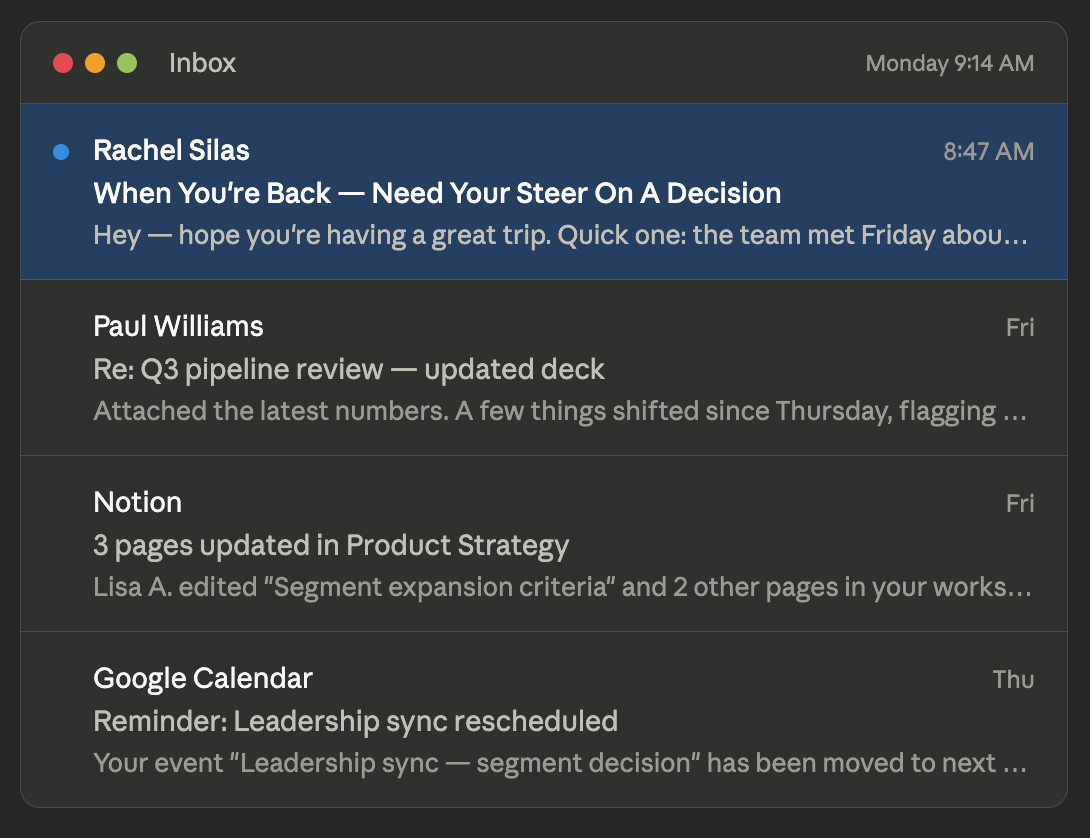
“When You’re Back — Need Your Steer On A Decision”
Everyone in that room is sharp, motivated, and stuck for the same reason: judgment lives in one person’s head, and that person isn’t here.
The question is whether it has to.
Everyone says judgment matters. Few can show where it comes from.
Ask a leadership team what they want more of and you’ll hear it fast: “better judgment.”
Then ask what judgment is made of.
Most people can’t point to it. They point to the person.
They talk about judgment like it’s a trait—something you either have or don’t.
“We need better judgment on this team.” Full stop. Because if it’s a trait, there’s nothing to build.
So decisions get pulled toward the person with the reputation. The rest of the org waits for the call.
Or they hide behind scripts.
“Talk to customers.”
“Get everyone on the same page.”
Useful moves, but not the call itself. Scripts tell you what to do. They do not tell you what matters.
Results get confused with reasoning.
“They have great judgment because it worked out.”
At the outcome level, luck looks exactly the same.
And when they feel stuck, they turn up the volume.
More experiments.
More meetings.
More decks.
Activity goes up; signal doesn’t.
Every bad hire starts with a good feeling.
A leader interviews a candidate and says, “I’ve got a good feeling about this one.”
Ask what drove that feeling and you get hand-waving.
Which moments mattered?
What was weighted heavily, and what barely counted?
What would have disqualified them on the spot?
Months later, the hire doesn’t work out. The postmortem lands on “we need to tighten the process.”
So the company adds steps. Or the leader personally vets every candidate.
Either way, the thing that failed never gets named. The reasoning stays hidden.
Judgment is invisible because people treat it as a personality trait.
Judgment begins with context in a domain.
When people say someone “has good judgment,” they usually mean: in this situation, in this kind of work, they notice the right things and choose well.
You can usually spot three kinds of domains.
1) Implicit everyday domain
These are the domains you use without naming them.
“Good judge of character” is a classic example.
A good judge of character has a working model for how people behave in groups—and what “ethical” looks like when nobody’s watching.
The signals aren’t mysterious:
Do they do what they say?
Are they consistent across time and pressure?
Do their actions match their words?
You’ve been using domain judgment your whole life. You just didn’t label it.
2) Named professional domain
Now you name the work: sales, product, hiring, finance.
But naming it isn’t enough. You still have to narrow it.
“I want to get better at sales” is too broad. Sales to whom?
B2C real estate and B2B enterprise software don’t run on the same cues. Different buyers, different risks, different clocks.
Once you specify the domain, the signals get sharper:
Do you have the customer’s attention?
Is trust building?
Do you understand the problem the way they do?
And sometimes the miss isn’t inside sales at all.
You can close well and still sell to the wrong customer. Leads pour in, churn stays high. Or you close plenty of deals but leave money on the table each time.
The sale can work while the business doesn’t.
3) System domain
At this level, the domain isn’t just a job label. It’s a system with parts.
Your business model is a domain. So is your hiring engine. So is your onboarding flow.
Tool like the Lean Canvas — nine boxes on a one-page business model — draws the boundary: what belongs, what doesn’t, and what questions you have to answer.
Once you see that, familiar tools look different. They’re not answers. They’re domain definitions.
I’ll use the Lean Canvas as the running example, because it makes the idea visible.
A domain tells you which signals matter—and which don’t.
Every domain produces more data than you can use. The Lean Canvas makes that visible: nine boxes, but at any given moment only some of them change the next move.
Signals depend on the outcome you need. Start there and work backward.
If you skip that step, you end up tracking whatever feels urgent: the loud metric, the latest comment, the thing that spikes your anxiety.
The same domain can surface different signals depending on the result you need.
In the “judge of character” domain, charisma and first impressions feel useful.
They’re often noise.
If the outcome is “Can I trust this person to do what they say in a group?”, the signals that matter are the ones that hold after the charm wears off.
Sales works the same way. If the outcome is retention, the signal isn’t “how many people said yes.” It’s what they do after they pay.
Twenty yeses can be the wrong answer
A team runs twenty customer interviews.
They keep hearing: “I’d use this.”
They come back with “demand validated.”
They ship.
Customers even buy.
Then usage stays flat. Retention is weak.
They treated purchase intent as the signal. But the outcome they needed was ongoing use.
The signal that mattered was behavior: did people come back, did it become part of their week, did it keep solving a real job.
Get the signal wrong and you’ll optimize the wrong outcome.
Seeing the right signal is the first half. The second half is knowing what to do when you see it.
Scripts make decisions. Models make judgment transferable.
A script is a repeatable move.
On the Lean Canvas, every box has one: talk to customers about a problem, define a segment, list what they use today, set a price, decide what you won’t build.
Run those steps and you raise your floor. You don’t start from zero every time.
But scripts have a ceiling. They tell you what to do next until they don’t. A model shows you how the system works, so you can reroute.
If you treat the canvas like a checklist, you’ll fill every box and feel productive. It can still be dead. A living canvas has pull. What you learn in one box changes what you write in the others.
You don’t have to start at “Problem.” Start where you actually know something. If you’ve lived the pain up close, start with the problem. If you know the market, start with what people already buy. If you have a distribution edge, start with the channel you already own. Different entry points, same canvas.
The skill is tracing what one box implies about the other boxes.
One script, five boxes
The “Existing Alternatives” domain starts with a simple script: research what’s already out there. If you stop there, you get a list of competitors and a few bullets.
A model sees further.
Existing alternatives point to the customer: who is using these today.
They point to the problem: what these options fail to solve.
They point to early adopters: who complains, hacks around, or switches first.
They point to revenue: what people already pay, and what “normal” prices feel like.
One research move, five boxes changed.
That’s the jump from scripts in isolation to a working model.
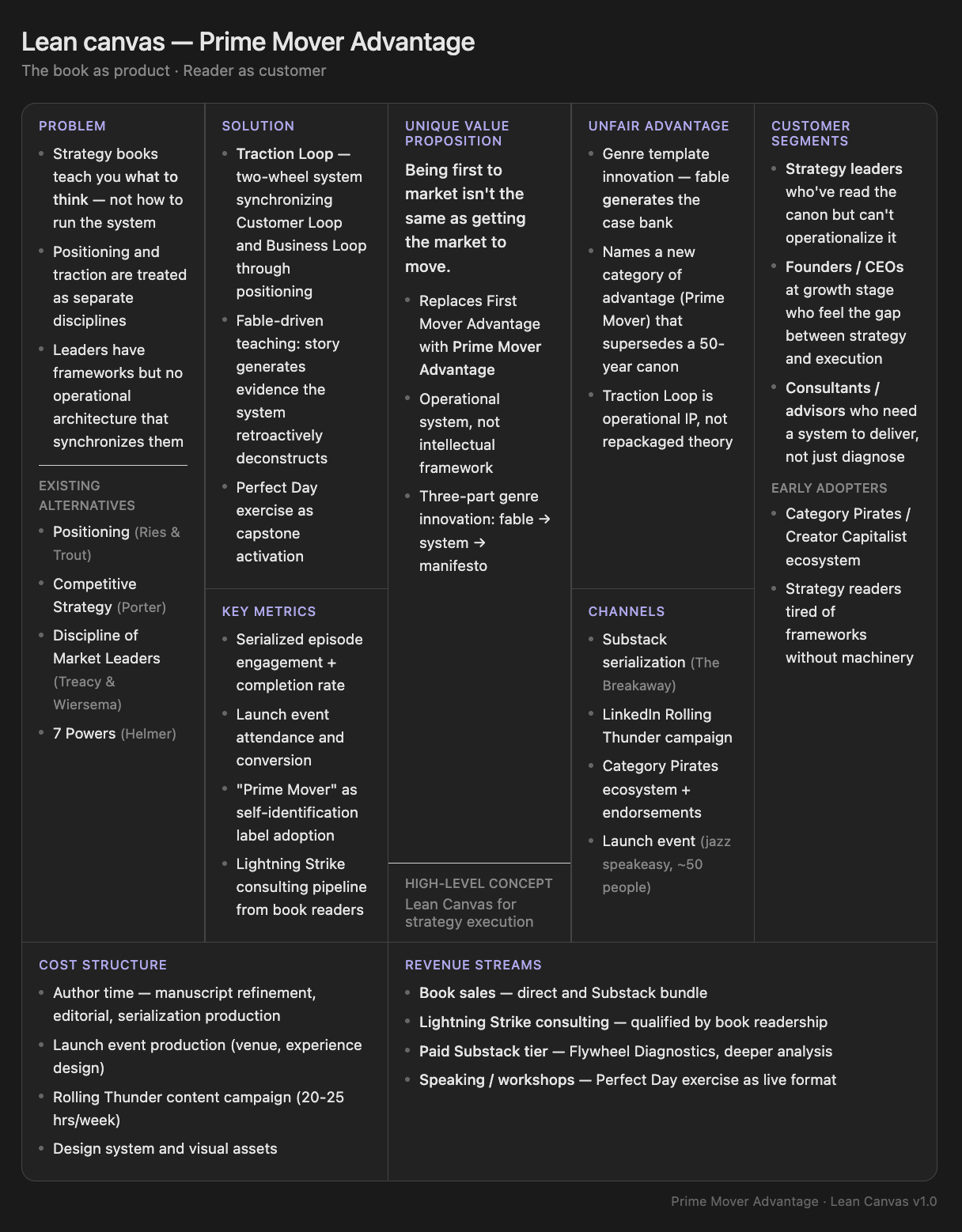
Say you want to write a book about strategy.
Start in existing alternatives. Pull the top-selling strategy books. Then go straight to the one- and two-star reviews.
Those reviews are signals. They tell you what readers wanted and didn’t get, which gives you problems to solve. They tell you who the reader is, because the complaints come from a specific kind of person in a specific situation. They point to your promise: the gap you can own.
The only change in the canvas was the entry point.
To build this for yourself, start with the box you know best and draw the lines outward. Write down why you started there. Not the cleaned-up reason you’ll use later. The real reason that was true in the moment. That “why behind the why” is what disappears first—and it’s the part someone else would need to learn how you think.
Then keep it alive. Fill the canvas. Let reality push back—customers do not respond the way you expected, or a channel you were counting on starts to fade. Update it. Return every month and ask: what shifted, what held, what broke? The model stays useful because you keep running it.
The canvas is the tool. The skill is making your reasoning visible. Capture the thinking, not just the boxes. Name the signals you trusted. Name the ones you ignored.
Judgment feels like instinct because the steps happen fast. Slow them down enough to see them, and other people can learn them.
You’ve built the model step by step.
The fastest way to test it is to work backward from something real.
Your last big decision is the fastest place to start.
Start with the last outcome you drove—something you’d defend under pressure.
Then work backward.
What model were you using when you made the call? How did the pieces connect?
What scripts did you run—what repeatable moves did you rely on?
What signals were those scripts responding to? What did you watch, and what did you ignore?
What domain were you operating in? Name it as specifically as you can.
If you can answer all four, your reasoning is visible. It’s no longer trapped in your head.
If you can’t name the signals, or you can’t explain how the pieces connected—that’s where your judgment is still instinct. That’s where the design work starts.
If someone can walk backward from an outcome through trade-offs and constraints, they have something they can explain and repeat.
If all they can say is “it worked out,” they don’t.
And transfer runs both ways.
When someone on your team has a visible model—domain clear, signals named, scripts running, connections mapped—they can bring that structure back to you.
They can say: here’s what I’m seeing, here’s why I trust it, and here’s what it means for us.
You’re building a room that can think back.
With that, your thinking stays in the room, even when you’re not.
P.S. Two pieces this builds on: Decision Architecture Manifesto (the bigger frame) and The Context Pyramid (the structure).