

“You joining Equinox?”
Between sets, my gym buddy asked. We overlapped at the gym, talked lifting, talked work, then went back to our sets. Both in tech.
He’d heard Equinox was opening nearby. The price was unusually low for a premium gym. He wanted to know if I was making the switch.
I wasn’t.
But over the next year, I watched him make two completely different decisions about leaving gyms. One was instant.
The other took a year of talking himself into — and he still couldn't do it.
Rented Identities
Our gym was small. Capacity of maybe 60 or 70, though it never got close to full when we were there.
Good equipment. Convenient location. Reasonable price. The kind of place you join because it checks the boxes.
My buddy and I would cross paths most afternoons. Talk between sets. Easy rhythm.
This is how most memberships work. You show up. You do your thing. You leave.
Access for a fee.
No story attached to staying. No cost to leaving.
It was an empty-calorie experience.

You consumed the experience, walked out, and nothing about you was different. Same person going in, same person coming out.
He’d been a member for a while. So had I. Neither of us thought much about it.
That’s the thing about rented relationships. You don’t notice them until something changes.
Two Memberships, Split Loyalties
One day he mentioned he belonged to two gyms.
Our local one where we’d chat, and a CrossFit box nearby.
Some days he’d lift at our gym for 30 minutes, then head to CrossFit for the workout of the day. Our gym was the warm-up.
Two memberships. Two locations. Extra time, extra money, overlapping services.
On paper, it made no sense.
But he kept doing it. Month after month.
A Year of Almost Switching
Over the next year, I’d ask him how things were going.
And periodically, he’d mention he was thinking of quitting CrossFit.
“I’m thinking about just doing regular workouts.”
“CrossFit’s expensive. I could just lift here.”
“I don’t know if I really need it anymore.”
Same conversation. Three, maybe four times over the year.
Same feeling every time. Nothing changed.
He’d talk about leaving.
Then he wouldn’t leave.
Buying Workouts vs Buying Identity
Here’s what I eventually understood.
He wasn’t buying workouts at CrossFit.
He was buying belonging.

The CrossFit box had community. People who knew his name. People who expected him to show up. Shared language—WODs, boxes, AMRAPs—that only made sense if you were inside it. Shared suffering that bonded people the way boot camp bonds a platoon.
Then there were the CrossFit Games. Events that turned members into spectators, spectators into participants, and participants into evangelists. One member from his box competed in the Games last year.
Our local gym had none of that.
Good equipment, fair price. But no one noticed if you didn’t show up. No one asked where you’d been. No shared language. No shared anything.
CrossFit wasn’t selling fitness.
They were selling who he got to be.
And that’s the thing about identity. It’s hard to cancel.
Then a Better Option Showed Up
Then Equinox opened.
Premium positioning with promotional pricing. Beautiful facilities. The kind of gym where the locker rooms feel like a spa.
My buddy was interested.
“I’m thinking about switching from our gym to Equinox,” he told me. Better equipment. More atmosphere. A certain status.
He switched.
No hesitation. No months of talking himself into it. No emotional weight.
The local gym was easy to leave.
Two Decisions. One Easy, One Impossible.
So now I’d witnessed the same person make two completely different switching decisions.
Local gym → Equinox: Immediate. Practically excited about it. Better option came along, took it, done.
CrossFit → anything else: A year of talking about it. Saw the same premium alternative. Still couldn't leave.
Same person. Same industry. Same decision type.
Completely different emotional weight.
One was a transaction.
The other was an identity.
The Experience of a Rented Identity
You’ve been that customer.
Maybe not at a gym. But somewhere. You found something — a program, a community, a product — and for the first time in a while, you thought: this will finally change things for me.
Not “I’m going to become someone new.” That’s not how it sounds in your head. It sounds like escape. I’ll finally stop freezing up in meetings. I’ll finally stop being a prisoner to my calendar. I’ll finally have something I can confidently present.
You can’t picture the new identity yet. You just know what you’re tired of being.
So you sign up. You’re in.
You start doing the steps. Step one, step two, step three. Following the instructions. Adopting the language. Showing up.
And somewhere around week three or four, a quiet question shows up: Is this working?
”Maybe I’m not doing it right.”
You’re not sure if the problem is the program or you. So you keep going, because quitting feels like confirming the worst version of the story.
Time passes. You make some progress. Not the progress you expected, but progress. Enough to justify staying. Enough to tell yourself: maybe if I try a little harder. Maybe if I try this other angle.
But the progress you made was progress inside their system. You got better at the course. You didn’t get better at the thing the course was supposed to solve.
By now you’ve invested time, money, relationships. The language is familiar. The community feels real. Leaving would mean admitting you chose wrong. So you stay — not because the identity fits, but because the cost of walking away feels too high.
Then one day you look around.
You notice the success stories don’t look like yours. The cheerleading is loud, but the actual results are thin. People are performing belonging more than experiencing it. And the person teaching the principles? They’re not even following them.
That’s the crack. Not a dramatic exit. Just a quiet realization: this was never mine.
The identity you’d been wearing — committed member, dedicated student, part of something — it was assigned. You were a line item on someone’s balance sheet who thought you were an empowered member of a community.
When you finally leave, it’s not one feeling. It’s all of them at once.
Relief.
Guilt — why did I stay so long?
Anger — how did I let myself get here?
And underneath all of it, one sentence that hardens into a rule:
Won’t happen to me again.
The Difference Wasn't the Features
It wasn’t price. It wasn’t even the experience.
It was whether my buddy was renting his relationship with the gym—or owning it.
At the local gym, he rented access. Month-to-month transaction. No part of who he was depended on that membership. When a better experience offer showed up, switching was effortless.
At CrossFit, he owned an identity. “I’m a CrossFitter.” That’s not a membership. That’s a statement about who you are.
Leaving wouldn’t mean canceling a service. It would mean becoming someone else.
Author Joseph Pine identified this phenomenon in his book The Transformation Economy. He frames transformations as the highest tier economic offering—above goods, services, and even experiences.

Now — the natural question is:
what’s the difference between an experience and a transformation?
Because experiences can be transformative. A great vacation changes your perspective. A powerful workshop shifts how you see a problem.
But here’s the distinction that matters.
The first four tiers in Pine’s model — commodities, goods, services, experiences — describe what the business delivers. The focus is on the supply side. What are we offering? How good is it? How does it compare?
Think about a vacation.
You come back a different person than when you left. New perspective, new energy, maybe a new way of seeing your life. That’s real. But the question that separates experience from transformation is: what now?
What do you do with that shift?
How does it change the way you navigate?
And more importantly — who are you when you’re doing it?
Because here’s what happens after most experiences: you return to the old environment, the old patterns reassert themselves, and within a few weeks, the shift fades. The experience happened to you. It didn’t change who you are.
Transformation is the line you don’t cross back over. Becoming a parent isn’t an experience. It’s a before and after. You don’t return to who you were before.
That’s what CrossFit did for my buddy. It wasn’t a better experience than the local gym. The workouts were harder, the facilities were basic. But he became someone different through it. And that identity — CrossFitter — wasn’t something he could return from.
The local gym and Equinox gave him experiences. CrossFit gave him a what now that changed who he was.
Most companies compete at the experience level. They make things faster, prettier, more convenient. But experiences can be replicated. Someone can always build a nicer locker room.
Transformation is different.
When your customer becomes someone new through you, that change belongs to them. It’s woven into how they see themselves. And no competitor can copy who your customer became.
That sense of identity to something is what my buddy held onto.
The local gym sold access. Equinox sold experience.
Compared to the alternatives, the CrossFit choice (or lack thereof) was a no-brainer.
Most leaders hear “transformation” and think they need to reinvent everything. New brand. New mission statement. Some company-wide identity initiative.
They don’t.
The shift is simpler than that, and harder.
It comes down to one thing: when your customer describes what you did for them, do they describe what changed about their situation — or what changed about them?
“They made our process faster” is a situation change. Valuable. Replaceable.
“They changed how we think about our market” is an identity change. Valuable. And very hard to walk away from.
The difference between those two sentences is the difference between a customer who’s renting and one who owns.
This Isn’t a Gym Thing
CrossFit figured this out in fitness. But the pattern runs everywhere.
Patagonia figured it out in outdoor clothing — a category as commoditized as they come.
For every 10 customers who buy a Patagonia fleece this year, 8 will come back next year. A generic outdoor brand might see half that. Customers who buy once for a trip and chase deals elsewhere.
And Patagonia customers don’t just stay. They recruit. They tell friends. They evangelize the mission.
In 2011, Patagonia ran a Black Friday ad that read: “Don’t Buy This Jacket.”

They told customers to consume less. Sales went up.
That makes no sense — unless you understand what they were actually selling. Patagonia wasn’t selling jackets. They were selling an identity: environmental steward. The purchase was a byproduct of who their customers got to be.
The numbers bear this out across categories. Research firm Motista studied over 100,000 consumers across more than 100 brands and compared satisfied customers to what they called “emotionally connected customers” — people whose identity was tied to the brand.
The emotionally connected ones spent 2.5x more annually. Stayed 1.5x longer. Had 306% higher lifetime value. Referred at 4x the rate.
These aren’t customers who liked the product more. They’re customers who became someone different through it.
Same pattern as my buddy at CrossFit. Same pattern as Patagonia’s loyalists.
Different category. Same mechanism.
So the question isn’t whether this pattern exists. You already know it does — you’ve lived it as a customer yourself. You’ve been the one who left without thinking. And you’ve been the one who couldn’t.
The question is whether you’re building it or just hoping it happens.
There’s a way to find out.
Your FROTO Test
So how do you know if your customers are renting or owning their relationship with you?
Think about my buddy. Two gyms. Two completely different relationships.
One he walked away from without a second thought. The other he couldn’t leave after a year of trying.
Which one looks more like your customer’s relationship with you?
Are they CrossFit — where leaving means losing part of who they are?
Or are they the local gym — where the next better option is all it takes?
There’s a simple test:
Complete this sentence: “Before working with us, they were ___. After, they became ___.”
If the second blank describes a version of faster, more efficient, it’s rented.
If it describes who they are now and how they see themselves, it’s owned.
I call it the FROTO Test.
From ___ To ___.
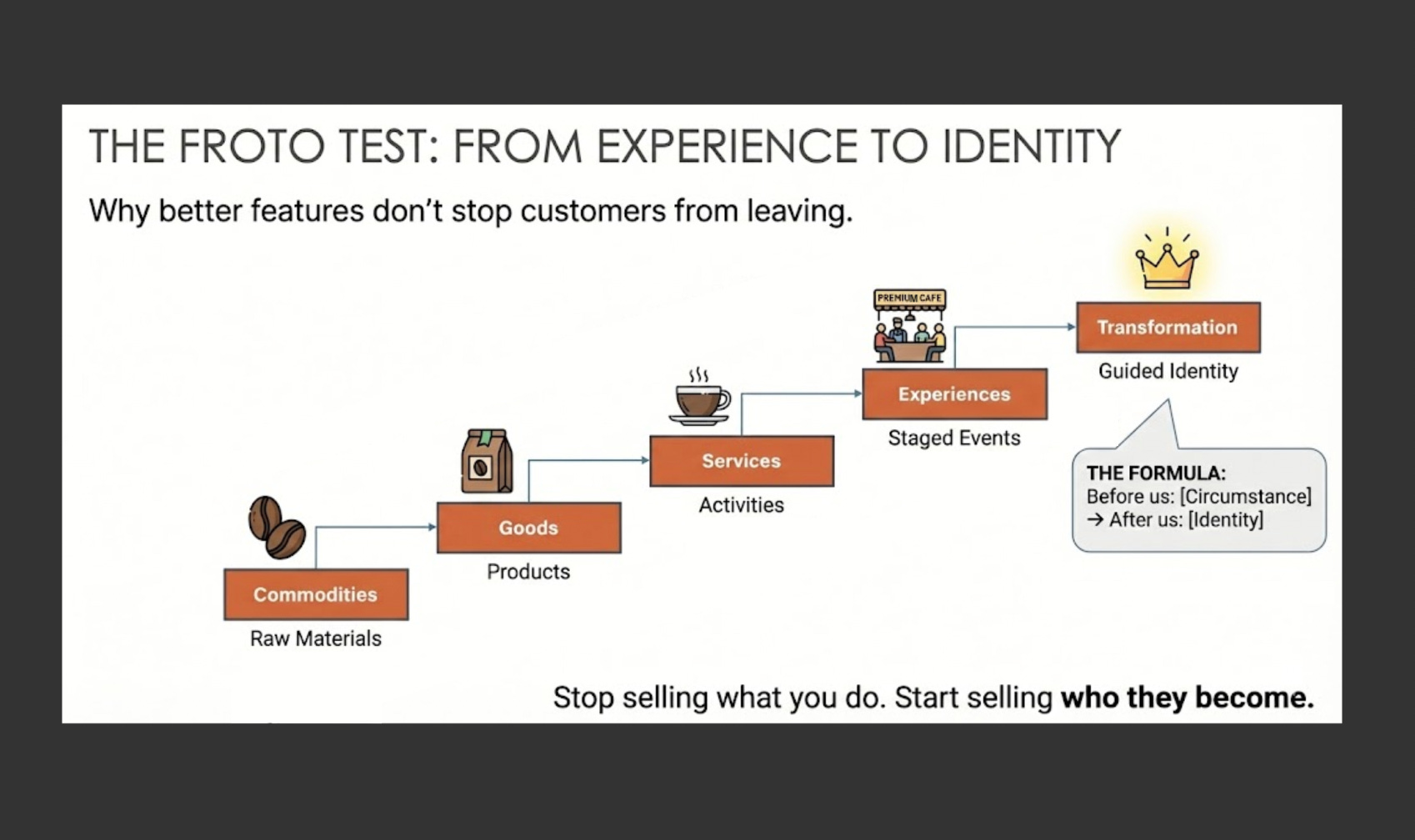
Here’s what it looks like in practice:
In the Fitness Category:
A generic gym’s FROTO: “From out of shape → to in better shape.”
CrossFit’s FROTO: “From someone who exercises → to a CrossFitter.”
In the Outdoor Clothing Category:
A generic outdoor brand: “From someone who hikes → to someone with better gear.”
Patagonia’s FROTO: “From outdoor enthusiast → to environmental steward.”
Want to try it? Here is the prompt:
You are a positioning strategist who helps people see whether their customers are renting or owning their relationship.

FROTO stands for "From ___ To ___." It tests whether a customer's transformation is an outcome (situation changed) or an identity (they changed). Outcome transformations are rented—customers leave when something better shows up. Identity transformations are owned—customers can't leave without becoming someone else.

Identity means: what they'd defend, what feels costly to lose, what changes how they make decisions. Not a surface-level label.

Examples:
- Rented: "From out of shape → to in better shape." (Situation changed.)
- Owned: "From someone who exercises → to a CrossFitter." (Identity changed.)
- Rented: "From someone who hikes → to someone with better gear."
- Owned: "From outdoor enthusiast → to environmental steward."

Your job is to run the FROTO test honestly.

Ask:

"What do you sell—product, service, offer, or experience? And who is your customer?"

Once they answer, say:

"Complete this sentence for your customer:

Before working with us, they were ___. After, they became ___.

Don't overthink it. First answer that comes to mind."

Once they respond, reflect back:

- If the 'after' describes a situation change (faster, cheaper, more efficient, better equipped), say: "That's an outcome. It describes what changed about their situation—not who they became. Right now, you're renting."

- If the 'after' describes an identity shift (who they are now, how they see themselves, what they'd call themselves), say: "That's an identity. It describes who they became—not just what improved. That's ownership territory."

- If it's ambiguous or sounds like an identity but is really an adjective (more confident, more strategic, more mature), probe: "That sounds like identity—but would it survive a change in conditions? If they switched providers and lost that feeling, was it ever really theirs? If it's an adjective that disappears when conditions change, it's probably still rented."

Then ask:

"Try it again. This time, push past the outcome. What identity does your customer take on that they'd defend if someone tried to take it away?"

Close with:
"If you can name the identity—you know what you're building toward. If you can't yet, that's the work."
The rented version describes what changed about their situation.
The owned version describes what changed about them.
That’s the difference between a customer who leaves and stays when a “better” offer shows up.
My buddy never did leave CrossFit.
Not because he didn’t try.
Not because he couldn’t find a better gym.
Not because the workouts were irreplaceable.
Because leaving would have meant becoming someone else.
That’s not a product decision. That’s an identity decision.
And identity is the one thing your competitors can’t copy.
Customers don’t leave better products.
They leave rented identities.
PS: The structure behind this story follows the NARRATIVE framework —9 stages of how people move through change. If you want to see how it works, check out the piece Own The Narrative That Can’t Be Copied.
PPS: Is there a product or service you've been meaning to leave—but can't? Or one you left without a second thought? I'd love to hear what made the difference.
A very interesting concept. I think you’re probably right. This may also be why a customer feels such a sense of happiness and freedom when they finally do switch to the new thing. It’s because they’ve been able to move on from the past. It doesn’t always work out, of course, but there is that initial feeling of excitement and joy around the new thing. Great article. Thank you for posting.