

In 2007, I was working on my first real job out of college, selling credit card machines to local small businesses.
And I spent more money trying to sell than I made selling.
In 6 months, I made just enough commissions to pay the minimum on my credit card bill for the gas money and car repairs.
But, that did not stop me from going to all the events the company held. And while those were a waste of time and money in hindsight, there were some speakers who could tell amazing stories and motivate people to do what they never thought they could.
One of the speakers was exceptionally good. To this day I remember one of the stories she told.
For example, the importance of finding your “Amy”. Amy being a woman in the small Kansas town this speaker and her husband lived in when they started their business. And Amy would spread lies about their kids, turn the town against them, call the cops on them, and make their lives a living hell. Just a nasty, jealous person in every way you can imagine.
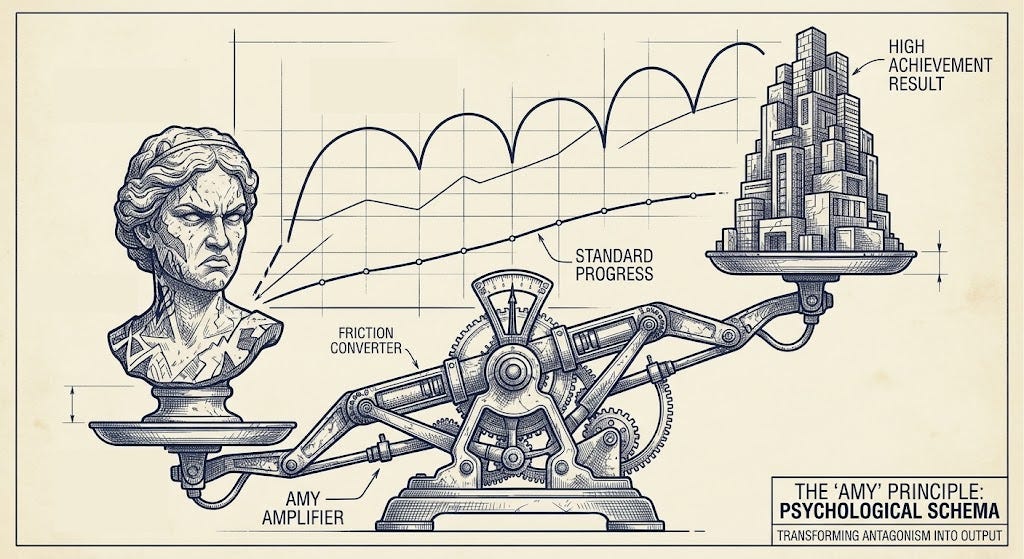
But ultimately, she was grateful for Amy. The reason: Amy became the “driving force” in their business.
Every time Amy did something new to them, she and her husband got that much more angry and determined to succeed—and ultimately their business grew to high six-figures per year. Enough to move out of the neighborhood and never see Amy again. But before they left, they made sure to get their revenge in other ways. For example, she talked about how she would go sweep Amy’s front porch wearing a fur coat, just to watch her seethe with contempt.
Anyway, at the end of the talk, she asked: “Who’s YOUR Amy?”
In other words: Who’s actively sabotaging YOU?
For me, it was a person from my past who did something similar during my younger years. And this person still has no idea how much they helped me when nothing was working.
Even today, my "Amy” sometimes eats at my psyche, and I wish it would go away. But each time this pops up, I can’t help but be grateful.
Without my Amy, I’d probably be sleeping under a bridge.
Why High-Performers Need an “Amy”
Most people are taught that high performance comes from affirmations or some “North Star” vision of the future. And while those things have their place, in my experience those fall by the wayside when you are in the trenches.
When nothing is working, and when the temptation to cut corners (or God forbid, quit) on your work is at its highest, regular motivation fails to do the job.
This is where your “Amy” becomes useful.
Why? Because as humans, we are wired to move away from pain with more force than we move towards pleasure. Psychologists call this “Loss Aversion.” We are far more motivated to escape a threat than chase a reward. If you are standing in the cold, you don’t spend time visualizing how nice the heat will feel. You move with immediate force to not freeze to death.
When someone actively sabotages you, or makes your life hell, that gives you personal fuel to prove a point. You work 10x harder to make sure that person can never, ever do it again.
I see this constantly among the high-performing marketers and businesspeople. They don’t talk about it in the open much, but many of them are fueled by the need to settle a score, show up skeptics, or dominate a game someone else started.
Take Michael Jordan, arguably the most relentless competitor in NBA history. Jordan was notorious for turning slights, real and perceived, into fuel.
Before the 1992 NBA Finals, the media had begun comparing Jordan with Portland star Clyde Drexler, who finished second to Jordan in MVP voting. During the lead-up to the series, one member of the media mentioned “Drexler is a lot like Jordan, except he’s a better 3-point shooter.”
Jordan loathed the comparison, later saying he “took it personally”. And he used that fuel to score 35 points in the first half, an NBA finals record at the time, including 6 three-pointers.
Drexler had 8 points in that same span.
The pattern followed Jordan throughout his career.
A coach called him a “con man”
A media member compared another player to him
An opposing player looked at him the wrong way
Jordan could turn almost anything into a personal challenge. And once the challenge became personal, his game rose to another level.
That‘s the real power of an Amy. It helps convert an abstract goal in the distant future to a concrete opponent, right in front of you, that you refuse to lose to.
How To Put Your "Amy" To Work
Now, you don’t need to go out looking for enemies or invite contempt by wearing fur coats in front of them. But you can still channel the anger they cause to your advantage.
1. Identify your “Amy”.
Who is the person from your past (or present) who eats at your psyche?
Write their name down. Doesn’t matter if they are a former boss, rival, or a critic. The only real requirement is that they represent an antagonist you are trying to overcome.
2. Reframe the antagonism.
Instead of letting them drain your energy, turn that frustration into a specific business goal.
Ask: “What is the one thing I can build that would make this person’s actions or words irrelevant?”
3. Use the “dark energy“ to fuel your work.
The next time you’re tempted to “skimp” on a project, pause.
Ask: Would Amy have ammunition to criticize the work? To slander your work ethic? Use that energy to push your work from good enough to unignorable.
4. Measure your output.
Success is the best revenge. Track the volume of work you produce when fueled by this specific motivation. You’ll likely find that your quantity AND quality increase significantly when you have a concrete opponent you refuse to lose to.
Having an ”Amy” is a great tool, but don’t let her consume you.
This technique is not for everyone. It’s all too easy to be consumed by anger towards an opponent and let it take over. If you aren’t careful, you end up living your life in reaction to someone else’s existence.
The key here is to take negative friction in your life and transform it into a positive forcing function.
Most of what you accomplish (especially if you have big, hairy, audacious goals) will happen when you do the work regardless of how you feel in the moment. While you likely will work anyway when you feel good, you now have a technique to channel your actions towards your goal even when you are in a more negative state.
Your Amy is just a character in your story. Make sure you’re the one holding the pen.