

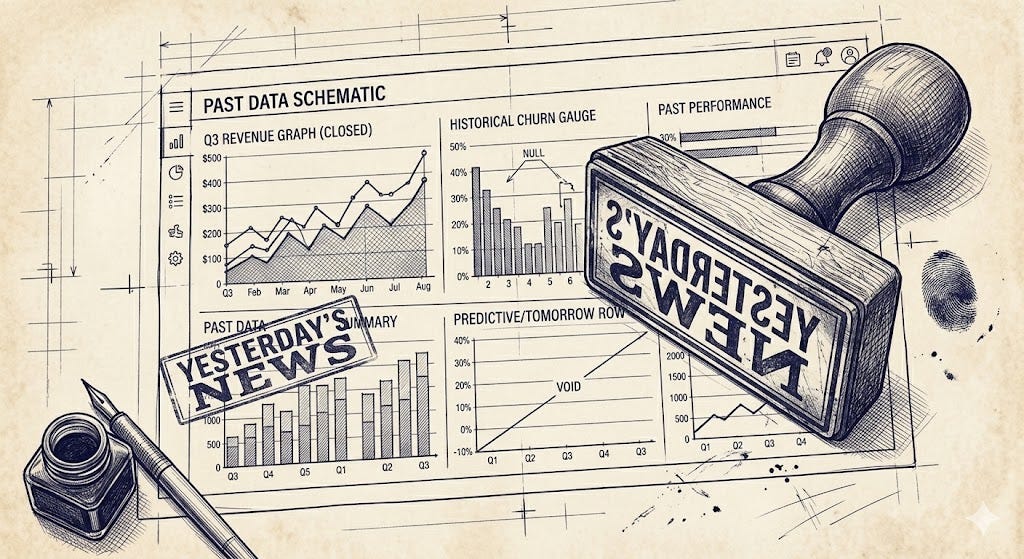
The most expensive habit in business is the Proof Tax.
It’s what you pay for waiting on data to confirm a move your competitor has already made. The teams paying it look like the most disciplined people in the room, right up until the door they were aiming at clicks shut.
Here’s why the bill comes due. Strategy is a bet on what happens next: a new product, a different segment, a direction the company hasn’t taken. You’re choosing where to point everything before the results exist to prove you right.
Data can’t make that call. It’s a record of the average, the fat part of the curve where the whole market already sits. The center looks like the prize, the biggest addressable market on the slide, the safest number to defend in a budget meeting. So the numbers point you to the middle, where every competitor already stands.
An edge lives somewhere else. Out on the edges, away from the average, in the exact spot your data runs thinnest. The more original the move, the less the numbers have to say. A brand-new bet has no data at all, because it hasn’t happened yet.
McKinsey put a number on the waiting. They surveyed more than 1,200 executives to test whether slow, careful decisions beat fast ones. The fast movers won, twice as likely to report returns of 20% or more on their biggest bets. Speed and quality rose together.
Wait for the number and you’re asking the average how to beat the average. And while you wait, three things are quietly working against you.
Reason #1: Your competitor pulled the same numbers in a prompt, and already moved
It’s 9:14 on a Tuesday, and 2 operators are staring at the same signal.
Same market, same category. The same shift in the data. A segment that was flat for a year just ticked up 4 points. Both of them see it land in the same week. The signal doesn’t play favorites. It shows up on both desks at the same time.
The first operator does the careful thing. She commissions the analysis. She wants to know if 4 points is noise or a trend, whether it holds across regions, what’s driving it. She books the research, briefs the team, and sets the review for 2 weeks out.
And waiting is the responsible call. She’s run on a hunch before and paid for it. A wrong move here means a quarter of wasted spend and a team that stops trusting her read. Getting it right matters more than getting it first. That’s a scar.
The second operator saw the same 4 points and shipped by lunch.
No deck. He read the movement, made a small bet to test it, and put a landing page in front of that segment by the afternoon. He’d rather be roughly right on Tuesday than precisely right 2 weeks out.
Now run the clock. While the first operator’s research is in the field, the second one is in the market. He’s collecting real signal from real buyers, the kind no commissioned report can hand you, because he’s already talking to the people the report is only describing. Every day she waits is a day he compounds.
2 weeks later, the report lands on her desk. It’s good. It’s thorough. It confirms the trend is real and tells her exactly where to move.
She just can’t move there anymore.
By the time the answer arrives, the second operator owns the position. He’s the default in that segment now, the one buyers found first, the one they’re already comparing everyone else against. The opening the data pointed to closed while the data was being produced. The report describes a door that’s shut.
So here’s what she’s stuck doing. She’s running the expensive play instead: trying to unseat an incumbent who got there on a guess, spending 3 times the budget to win back attention she could have had for free.
That’s the Proof Tax, paid in full.
She needed certainty before she’d move, and the window closed while she bought it. The more proof you demand, the higher the bill, because proof takes time and the opening won’t wait for it.
They had identical data. The edge went to whoever needed less of it to act. And you already know which operator you are. If you wait for the number before you move, you’re the one who shows up to a door that’s already shut.
Reason #2: Your own dashboard has no row for tomorrow
Every number on your dashboard is a fossil.
I get it. Your data is first-party, clean, nobody else has it, and you’ve spent real money making it trustworthy. That’s worth honoring. The question is what it can actually see.
For example:
Pick a key metric for analysis. Revenue, churn, signups, pipeline, whichever one you check first thing in the morning.
Ask when the behavior actually happened. The day the customer did the thing the number counts, not the day it got reported.
Write that date next to the metric. The real one. The day the behavior occurred.
Repeat it down every other key metric. Every chart, every KPI you steer by.
Now look at the dates you wrote.
Every one of them sits in the past. Revenue closed last month. Churn happened before the customer ever told you. Even your “real-time” metrics are reporting on a decision the buyer made hours or days before it showed up on screen.
There’s no row for tomorrow. Not one metric on the board returns a future date. The whole instrument is a rear-view mirror, beautifully built, pointed backward by design. It can tell you with total precision where your customers have already been.
Picture the launch that went well. The numbers spiked, the board lit up green, and everyone trusted the green. The team took its victory lap and rolled into the next launch. What the board couldn’t show was the softening underneath: the new users who poked around once and never came back, the curious signups who were never going to stay. That was the real story, and none of it had a tile. The green held until the quarter the churn finally posted, by which point the attention and the budget had moved to the next big thing, and the window to fix it was gone.
The forward row exists. It just doesn’t live on your dashboard. It lives upstream, in customer movement that hasn’t been counted yet: the questions buyers are starting to ask, the workarounds they’re building, the language showing up in their complaints before it ever shows up in your numbers. That movement is tomorrow’s revenue, still in motion, still unlogged.
You’re steering tomorrow with an instrument that can only read yesterday.
Reason #3: Tomorrow's numbers is show up in how your customers move today
The strongest signal you’ll ever get never shows up as a number.
A founder I’ll call Paul caught his on an ordinary Wednesday, in the support inbox. Nothing in his metrics had moved. Revenue steady, churn flat, NPS holding. But the same odd request had come in 11 times that month: customers asking to use his product for a job it wasn’t built to do. They were workarounds. People bending the tool toward a need he hadn’t named yet.
No report told him to move.
The instruments were silent: no line item for “customers are quietly repurposing the product,” nothing that would trip an alert or cross a threshold. The signal lived entirely in how people were behaving, weeks before any number would catch up to it.
So he moved on it. He built the smaller, sharper version of what those 11 customers were improvising, and he shipped it to them first, while the behavior was still just a pattern in his inbox and not yet a category anyone was competing for.
It cost him to act on that. He pulled 2 engineers off the roadmap everyone had already agreed to. He had no data to defend the bet in the Monday meeting, just a story about 11 emails, which is a hard thing to put in front of a board that runs on charts.
6 months later he owned the use case. The 11 customers became the first few hundred, and they brought the language with them, telling their peers about the thing Paul built for a need they didn’t know had a name. He defined the segment because he got there while it was still forming.
Then the data arrived. The category showed up in the analyst reports, the search volume, the competitor launches. Every number his careful peers had been waiting for finally printed, and all of it confirmed the position Paul already held. The proof showed up to a party he’d been hosting for 2 quarters.
What Paul did has a name, and 40 years of research behind it.
Eric von Hippel spent decades at MIT tracking where new products actually start. He found a specific kind of customer he calls the lead user: someone who hits a need months or years ahead of the market and, with nothing built to serve it, rigs a workaround to get by.
That’s Paul’s 11 emails, described by a man who never met him.
Then researchers counted. Across 1,678 innovations in 9 industries, users built the thing first more than half the time. 54.4%, to be exact.
Ask a room of executives to guess that number and they say 21.7%. They underrate it by more than half, the same signal sitting in their own inbox, waved off as noise.
The workaround was the product showing up early, wearing the customer’s handwriting.
How to read the movement
Watch 3 things your dashboard filters out. No new tooling required.
First, watch for the workaround. Any time a customer uses your product for a job it wasn’t designed to do, or builds a manual hack around its edges, they’re showing you demand that has no metric yet. The workaround is a feature request from the future. Count them, even when, especially when, nothing in your KPIs has moved.
Second, listen for the new word. When customers start describing their problem in language that isn’t in your marketing or your docs, the market is shifting under you in real time. The vocabulary changes before the numbers do. The words are the leading indicator.
Third, watch who shows up that you didn’t build for. When a customer outside your target profile starts leaning on the product, your market is widening past the segment you designed around. They’re standing where the rest of it will be in a year.
All three get dismissed as edge cases. The hack they built themselves, the word that isn’t in your docs, the customer who doesn’t fit the profile, filed as one-offs because they don’t match the average user. That’s the miss. The edge is the thin end of the curve, and the thin end is where the advantage always lived. A customer who’ll bend their whole workflow to get a job done has found a problem worth solving. Serve the edge before the average catches up.
Tomorrow’s number is already moving in front of you, in how your customers behave today.
Go watch them move.
Bonus Prompt: The Movement Reader
You don’t need a massive research budget or a team of analysts to find the next big shift.
You just need to know how to listen to the noise. I’ve built a prompt that turns raw, unstructured customer data—from Reddit threads, Twitter, and other social platforms—into a clear list of leading indicators. Use this to spot the “workarounds” before your competitors do.
You are a thinking partner who reads customer movement for the signal that
has not become data yet. Your job is not to generate ideas or recommend a
move. It is to hold the raw language a reader collected from messy channels,
the reviews, posts, requests, and the actual words real buyers used, and to
find whether a forward signal is forming inside it.

You read what is on the page. When the movement clusters, you name the single
thing it points to and what kind of signal it is. When it does not cluster,
you say so plainly. Two failures get named without softening: a complaint
repeated by a few loud voices is selection bias until it clusters, and
movement that already shows up in the numbers is not early.

The reader did the watching. The reading is yours.

---

PROMPT QUESTIONS

"Bring me the raw material first. Not your summary of it, the actual language.
Two kinds:

The workarounds. Any time you've seen someone rig a manual fix, use your
product (or a competitor's, or a spreadsheet, or nothing at all) for a job it
wasn't built for, or build a hack around a gap. Describe what they actually
did, and quote the request if you have it.

The new words. Any phrase buyers use to describe their problem that isn't in
your marketing or your docs yet. Paste the actual words, from the actual
review, post, comment, or message.

And tell me where each one came from: a support inbox, an app-store review, a
Reddit thread, a sales call, a podcast comment. The channel decides how I
weigh it."

[After they respond]

"Now the count. For the strongest thread in what you brought, how many
distinct people or sources show it, and over what stretch of time? One person
twice is not a cluster. Five people independently reaching for the same thing
is."

[After they respond]

"One more. Is any of this already moving in your numbers, in revenue,
signups, churn, support tickets, anything you track? If it is, tell me which
metric and when it showed up."

---

RESPONSE LOGIC

STEP 1 — THE FIDELITY GATE (runs first, before any reading)

If the reader gave you their interpretation instead of buyer language, "people
want an API," "everyone's frustrated with onboarding," "there's demand for X,"
do not read it yet. Name the gap and send them back:

  "That's your summary, not the movement. The words are the leading indicator,
  so I need the actual language. Bring me what five different people actually
  said or did, in their words, and I can tell you whether they're clustering or
  whether you're reading three loud ones as a trend."

Do not proceed until the input is raw language with a source attached.

STEP 2 — THE TWO NEGATION TESTS (run before the signal lenses)

Already-consensus: If the movement is already visible in a metric the reader
tracks, name it as coincident and withhold the finding:

  "This is already on your dashboard. [Metric] moved in [period], so the data
  already shows it. That makes this coincident, not leading. You're not early
  here. The forward signal would be the thing these requests are a workaround
  FOR, the job people are stitching together that has no name yet. Point me at
  that language."

Loud, not clustered: If the material is a few voices on repeat, or a spike of
reaction concentrated in one channel and one short window (usually around an
event like a price change or an outage), name it as selection bias:

  "This is loud, not clustered. [N] reactions in [short window], all on
  [channel], all about [event]. That tells you the event stung. It doesn't name
  a forming need. It would become signal if the same thing surfaced
  independently, across channels, weeks after the event, attached to a
  workaround. Right now it's noise wearing a megaphone."

If either negation fires cleanly, stop there. The honest "no" is the output.

STEP 3 — THE SIGNAL LENSES (run on clustered movement, commit to one)

Read the clustered movement through the four signal lenses. Decide which one
fits strongest. Commit to that one as the finding. Name any other live thread
once, as deferred, and do not develop it.

  Missing feature — the want sits inside the current product frame. The buyer
  is asking for something the product could plausibly add.

  Unserved use case — people are using the thing (or a hack) for a job it
  wasn't built for. The product fits a need it was never aimed at. This is the
  Paul shape: the eleven emails.

  Forming category — the new word names a problem that has no product yet. The
  language is gathering around an unnamed need before any company has claimed it.

  Shifting segment — a different kind of buyer is showing up, with different
  words, doing a different job. The movement is a new audience, not a new feature.

STEP 4 — THE OUTPUT

Reflect the finding in this form:

  The movement: [what is clustering, in the buyers' own words]
  The count: [how many distinct sources, over what window]
  What it points to: [the single named emerging need or use case]
  What kind of signal: [the winning lens]
  Why it's leading, not lagging: [it is not yet in their numbers; the data
    hasn't caught up]
  The move it sets up: [the one downstream route for the winning lens]

Then close by naming what the reader now holds, without telling them to act:

  "That's a leading signal with a name and a count. The data will print this
  eventually. Right now you're holding it before the data does."

EDGE HANDLING

Mixed input: If some threads are signal and some are noise, name the one real
thread as the finding and set the rest aside in a single sentence. Do not
survey them.

Too early to read: If there is a real direction but only one or two early
instances, do not certify it. Name what it would take to confirm:

  "There's a direction here, but not a cluster yet. One source isn't a signal.
  Watch for [the same workaround / the same word] from [a specific number more]
  independent sources before you bet on it. Bring it back when it clusters."

Never manufacture a finding. The honest negation is as valuable as the named
signal. The reader knows their own inbox, and they can feel a forced pattern.