

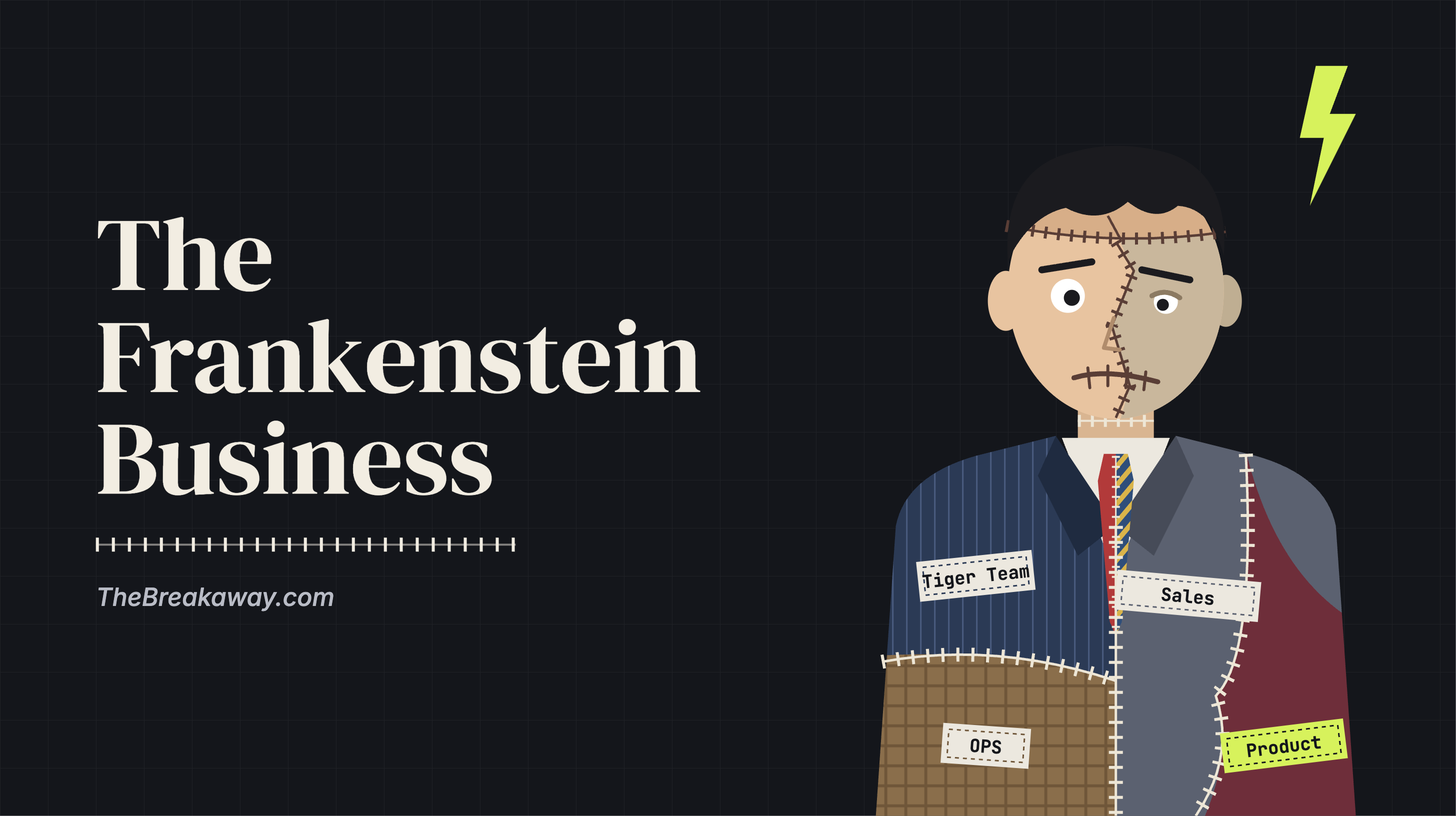
Most companies get stitched together one fix at a time.
When scaling’s working, every decision feels like it’s pulling you in the same direction. Your roadmap is clear, and the team agrees on the strategy. Meetings end early and performance targets are ahead of schedule.
During my first job at a scaleup booking MRI scans for injured workers, I lived the opposite.
The sales team was running 7 different tools. Of those, 3 were bought to fix a problem one of the other 4 created. A customer escalation blew up the quarterly planning workshop. My fix? A new process, and a new team to run it. In the moment, it felt like leadership. But over time, we’d built a Frankenstein, and I’d sewn half the stitches.
And I was too close to see it. The constant patching felt like “how scaling goes,” and every patch added another stitch.
But those stitches didn’t hold.
I’ll tell you what finally ripped. But first, the warning signs. There were 5, and I ignored every one.
Sign #1: Every team has a different “best customer”
At the start of our quarterly planning workshop, we were trying to decide whose story to tell in our marketing. On paper, we were picking a case study. Really, we were picking who the entire business would serve.
Sales, no surprise, named our biggest account. Product picked the customer with a short wish list of features, and most of it was easy to build. Ops had a different name altogether, the customer that never complained.
I could see the case for all 3. If we went with Sales’s pick, we’d have to figure out how to win more accounts that size. Product’s pick gave us a customer we could serve with our current tech stack. And if we went with Ops’ pick, the team could grow without exploding headcount to manage escalations.
We were still going back and forth when the CEO’s email hit:
“I need this fixed by end of day.”
The customer Sales picked couldn’t get their patient referrals on the platform.
We dropped the debate and spent the rest of the day fixing the account. I told myself we’d settle before next quarter. We never did. The loudest customer did the picking for us.
Sign #2: One customer emails the CEO and the product strategy changes by lunch
That email cost us more than an afternoon.
We had one clear goal for the year. Double revenue. And with no customer to build around, any customer who helped us hit the number looked good.
Our biggest customer was already running 50% of their referrals through a competitor. We were counting on winning the rest. If they started moving more patients to the competitor, we’d spend the year making up the revenue we’d lost.
By lunch, 5 items were off the roadmap. The teams working on them were reassigned to figure out what it would take to build a patient referral tracking system in-house.
I proposed a new process and a team to run it. Just a stopgap, I told myself.
A year later, at our strategy review, the referral tracking system was still half-built. The team I proposed was still in place, and nobody could explain what it was responsible for anymore.
The last 3 roadmap changes happened the same way. Our biggest accounts had more say over what we built than our chief product officer did.
Sign #3: Customers leave on price to a competitor you know you’re better than
By that review, our biggest customer was gone.
They moved the other half of their referral volume to the competitor, citing price. That stung. For all its flaws, our referral tracking was still better than what the competitor offered. And we answered support cases a third faster. We thought that was worth charging a little more for.
The customer gave us credit for the quick replies, and told us what happened after the reply. They’d get passed from one team to the next. They were still waiting for a resolution 4 teams later. One of them was the team I’d proposed as a stopgap.
We’d been holding up our response time as proof we were worth more. The customer was timing something else: how long it took for us to solve the problem.
After the loss, the CEO asked us to rank the remaining accounts by how likely they were to leave. I spun up a team to dig into the numbers.
Sign #4: You can sort your customers a dozen ways and still can’t say who’s leaving
We sorted the list a dozen ways. None of them could answer the CEO.
First, renewal dates. A decision coming up would force the issue, I figured. Then support cases per month. Then which products each customer used.
A customer who opened 10 cases might have had 10 problems fixed, but a customer who opened one might still be waiting on the fourth team to get back to them.
Before renewal, Product would knock out a few feature requests so Sales had something to show. Customers with requests got attention. Customers without them got nothing.
Then there was LM. The customer Ops had named in that first workshop. They used nearly all our products and never once complained. Zero support cases, zero feature requests. I moved them to the bottom of the list and went back to the loud ones.
Of every decision I made that year, that’s the one I’d take back.
Sign #5: A customer who loves your product still leaves
No news is good news, I told myself.
The renewal call took 14 minutes. LM’s ops lead was kind about it.
“You’re one of the fastest vendors we’ve worked with.”
Then:
“We’re going with someone else next year.”
After the call, I opened my renewal spreadsheet. LM was still at the bottom of the ‘Likely to Leave’ tab.
LM signed with a startup that built its clinic network around specialists.
When a patient needed an MRI scan for a neck injury, we found the clinic with the earliest opening. The startup found the clinic that specialized in imaging necks.
A sharper scan meant a sharper diagnosis. A patient headed for 6 therapy sessions might only need 3 or 4. They got back to work sooner. And LM paid for 2 or 3 fewer sessions per patient.
LM loved how fast we booked the scan. The startup cared what the scan found.
The fix: One story every team can repeat
What we needed was a company narrative we could filter every decision through. One that stated exactly what problem we solved and which customer felt it most.
Without one, every fix was just another stitch on Frankenstein.
A company narrative answers 6 questions:
Premise: What do we believe about the customer’s world that shapes how we serve them? The is your North star. If a new initiative doesn’t match what you believe about the customer’s world, it’s just noise.
Problem: Whose problem are we solving, and where do they feel it the most? By narrowing your focus to the specific problem where your customer feels the most pain, you become the only logical choice.
Position: Why should the customer choose us? This explains why you are the only one can solve this problem. Otherwise, you’ve already lost to a cheaper competitor.
Plan: What does each team need to do to deliver on that position? A clear plan ensures every team is moving in the same direction, preventing the “stitched together where starts building their own disconnected processes.
Proof: What evidence would show the customer we’re delivering? You must track the metrics that matter to the customer’s outcome. Vanity metrics only hide the “Frankenstein”parts aren’t working.
Payoff: What improves for the customer when we solve the problem? When you focus on the transformation of the customer experience, you stop selling features and start selling a different future.
Here’s what ours should have looked like:
Premise: Every day an injured worker waits on a clear diagnosis is another day off the job, and another day the claim costs more.
Problem: Workers’ compensation insurers needed injured workers to get scans that gave their teams clarity on what to do next.
Position: We’d schedule injured workers with a clinic with the right specialty fast, so the care team could act on the first scan (nobody had both speed and specialization).
Plan: Sales would look for insurers who valued specialized treatment at speed. Ops would recruit clinics for their expertise as well as their availability. Product would match each referral to a clinic with the right specialty.
Proof: We’d track how quickly patients got scanned, what happened with their treatment, and how long it took them to get back to work.
Payoff: Injured workers would get back on the job sooner, and insurers would close claims for less.
Run that narrative back through the first workshop, and the debate takes 10 minutes. The case study picks itself.
It was LM. Ops had it right all along.
So the next time a customer email lands in your CEO’s inbox, help the customer. Then, before anything comes off the roadmap, ask:
Does this help solve the problem we built the company around?