

Everyone wants to be remembered for something.
Not just known in the moment. Remembered in a way that lasts beyond your presence, beyond the room, or beyond the conversation.
The name you choose is how that happens.
This playbook teaches you to build names that stake your claim and travel.
Names that make being remembered inevitable.
Names That Travel
When you need to explain that someone is the undisputed best at something, you say they’re “the Michael Jordan of [their field].”

Whether you're naming a category, a brand, a product, or a framework—the goal is the same. A name that stakes your claim and travels.
No explanation needed. No context required. The name does all the work.
When you need to explain a product concept quickly, you say it’s “like MyFitnessPal but for [new domain].”
When you need to describe organizational excellence, you reference “the Yankees” - a word that started as a term for American colonists, traveled through the Civil War, got claimed by a baseball team, and now means dynasty-level excellence in any context.
These names left their original territory and never stopped traveling.
Michael Jordan didn’t plan to become the universal template for greatness.
MyFitnessPal didn’t design itself to be a product explanation framework.
The Yankees weren’t trying to define what dynasty management looks like.
But these names went places their originators never imagined. They found fertile ground in conversations, industries, and contexts far from their origin.
Some names stay where you put them. They describe a thing, people understand, end of story. They hold the ground you claimed - nothing more.
Other names develop legs. They wander into adjacent territories. They get repurposed as explanatory templates. They become infrastructure for how people think about entirely different domains.
What’s the difference?
How do you build names that stake your claim AND travel into territory you never mapped?
The answer starts where most people skip: you can’t have a name that travels if you haven’t first claimed territory worth traveling across.
You Can’t Name What You Don’t Own
Most naming advice starts in the wrong place—trying to be clever.
Clever can travel. That’s the trap. The pun lands, the reference clicks, people repeat it. Feels like it’s working.
But clever is empty calories. It borrows meaning from somewhere else: the cultural moment, the wordplay, the thing it references. And when clever travels, the ownership travels too. Back to the source. Not to you.
A name that travels but isn’t yours is just free marketing for someone else’s territory.
So before a name can travel, it has to be ownable. You need territory first. Ground that’s yours to name.
Territory names compress meaning into clear claims. Three qualities make them hold:
Clear boundaries. People know what’s inside and what’s outside. “Blue Ocean Strategy” claims uncontested market space. You can visualize the territory.
Defensible position. Others can reference it but can’t claim it. “Atomic Habits” owns the intersection of tiny changes and explosive results. Try to take that ground—you can’t.
Expansion capacity. The name can travel without losing meaning. “Crossing the Chasm” started in tech adoption. Now it applies anywhere a difficult transition separates early success from mainstream breakthrough.
Compare “Prime Positioning” to “Strategic Planning Framework.” One claims the apex. The other claims nothing - it’s a description, not territory.
Here’s what makes territory names travel: they’re useful elsewhere. They solve explanation problems other people are having.
Michael Jordan’s name became synonymous with excellence because people needed a shorthand for “undisputed best.” The name traveled because it was useful in contexts Jordan never imagined.
This is the foraging principle. Names that stake clear territory get picked up and carried into new domains. Not because you pushed them there. Because others found them useful and took them.
So you need 3 things working together: clear meaning (so it holds), compressed meaning (so it's portable), and ownership architecture (so it's yours AND transferable).
Territory comes first. Now: the patterns that stake it—and make it travel.
The 9 Realms of Strategic Territory Naming
These aren’t formulas to mechanically apply. They’re lenses—recognition tools for seeing what stakes territory clearly and what gives names the capacity to travel.
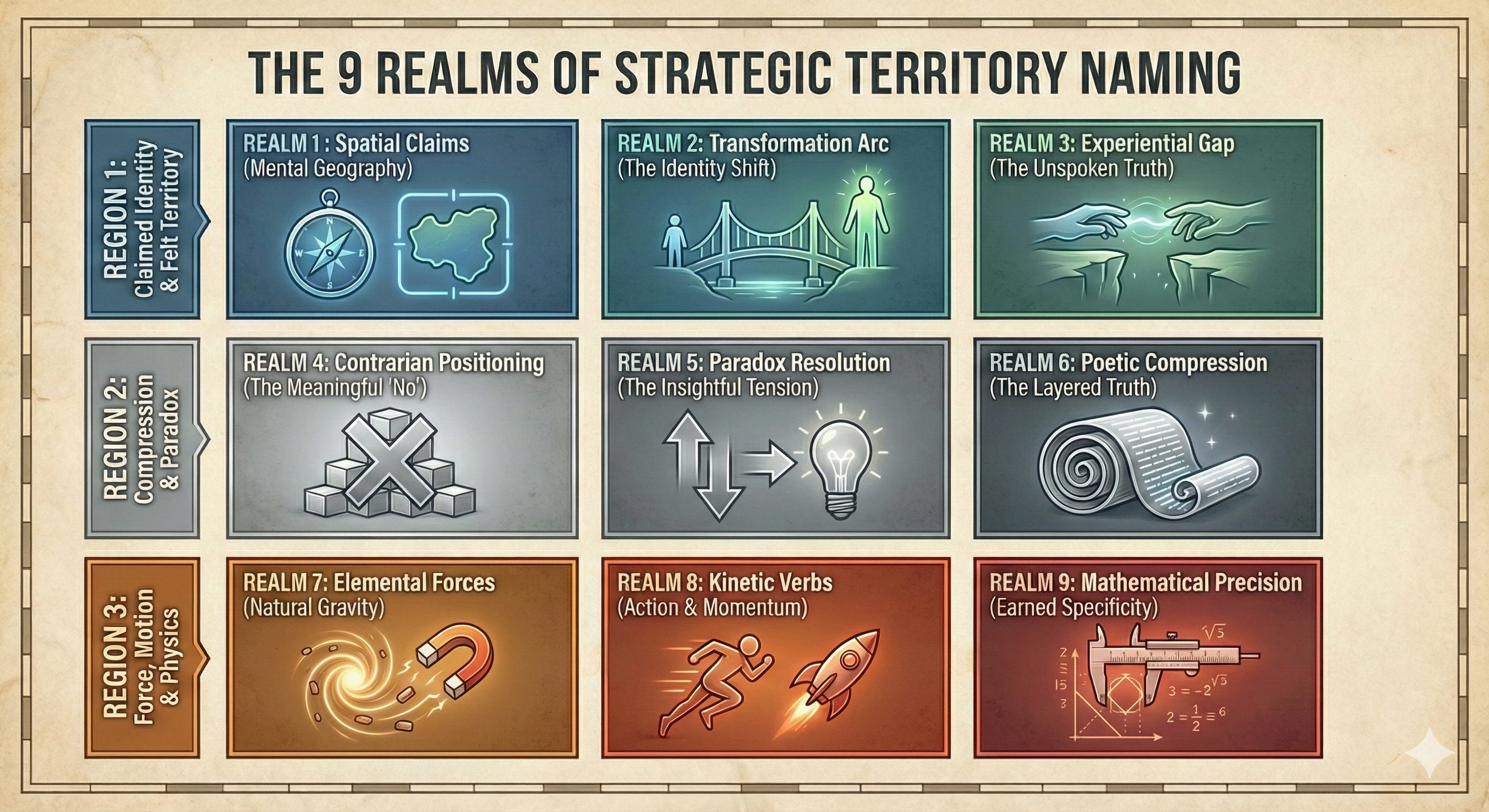
The 9 Realms organize into three regions, each serving a different function in territory naming:
Region 1: Claimed Identity & Felt Territory — Know what you’re claiming
Region 2: Compression & Paradox — Pack it tight enough to travel
Region 3: Force, Motion & Physics — Make it pull
Region 1: Claimed Identity & Felt Territory
Know what you’re claiming.
These realms establish what territory you’re staking. Before you can compress or add force, you need ground that’s yours.
Realm 1: Spatial Claims
Mental Geography
This realm claims territory by naming space people can visualize. You stake ground that others can see—and want to stand on.
Look for names that create mental geography. The territory feels real, bounded.
Examples:
“Blue Ocean Strategy” claims uncontested space you can picture.
“Category Design” stakes the meta-territory - the practice of creating categories itself.
Test: Can you see the territory being claimed?
Realm 2: Transformation Arc
The Identity Shift
This realm claims territory by naming a journey people want to take. You stake ground that transforms whoever walks it.
Look for names that put the reader on a path. The identity shift is the claim.
Examples:
“Key Person of Influence” is a definitive identity claim.
“The Hero’s Journey” gave storytellers a map they didn’t know they needed.
“From Good to Great” puts you on a path you can see yourself walking.
Test: Can people see themselves on this journey? Do they want to call themselves this?
Realm 3: Experiential Gap
The Unspoken Truth
This realm claims territory by naming what people feel but can’t articulate. You stake ground in the gap between experience and explanation.
Look for names that make people say “yes, that’s exactly what it’s like.” The felt truth is the claim.
Examples:
“Lightning Strike” captures what campaigns feel like from outside - invisible buildup, sudden appearance, concentrated impact.
“Tipping Point” names threshold dynamics that everyone recognizes but couldn’t articulate.
Test: Does it name something people feel but couldn't articulate?
Region 2: Compression & Paradox
Pack it tight enough to travel.
These realms compress meaning into dense, portable containers. Territory that’s too sprawling can’t move. These realms make it light enough to carry.
Realm 4: Contrarian Positioning
The Meaningful ‘No’
This realm claims territory by negating what everyone accepts. You clear the field before you build.
Look for names that say “not that” to established wisdom. The negation is the claim.
Examples:
“Never Split the Difference” negates 35 years of compromise-based negotiation advice.
“Zero to One” rejects incremental progress as a category.
Test: Is there widely accepted wisdom you can credibly negate?
Realm 5: Paradox Resolution
The Insightful Tension
This realm claims territory by naming a tension that resolves into insight. You stake ground in the “wait... oh” moment.
Look for names that sound wrong until they click. The resolution is the claim.
Examples:
“Structure creates speed” sounds wrong until it clicks—constraint enables freedom.
“Less is more” has survived centuries because the paradox keeps resolving in new contexts.
Test: Does it make you pause and think “oh, I see it now”?
Realm 6: Poetic Compression
The Layered Truth
This realm claims territory by packing maximum meaning into minimum words. You stake ground that reveals more the longer someone holds it.
Look for names that unfold over time. The density is the claim.
Examples:
“Thinking Fast and Slow” becomes self-referential while you read it. You’re thinking about thinking.
“Slow is smooth, smooth is fast” resolves the longer you sit with it.
Test: Does it reveal more meaning the longer you think?
Region 3: Force, Motion & Physics
Make it pull.
These realms add momentum. Territory that just sits there doesn’t travel. These realms create the pull that carries names into new contexts.
Realm 7: Elemental Forces
Natural Gravity
This realm claims territory by evoking forces people already feel. You stake ground that has gravity.
Look for names that tap natural dynamics. The force is the claim.
Examples:
“Tinder” maps completely: dry tinder, spark, flame. The entire product experience in one word.
“Firefox” compounds imagery into an ownable visual.
“Flywheel” captures momentum physics that everyone intuitively understands.
Test: Do people immediately feel the force?
Realm 8: Kinetic Verbs
Action & Momentum
This realm claims territory by putting the reader in motion. You stake ground that moves.
Look for names that make you feel capable of action. The movement is the claim.
Examples:
“Playing to Win” commits you to the game. Not being on the sidelines.
“Crossing the Chasm” puts you in motion. You’re not studying the chasm. You’re crossing it.
Test: Does it make you feel capable of doing something?
Realm 9: Mathematical Precision
Earned Specificity
This realm claims territory by naming with earned specificity. You stake ground that feels measured, not invented.
Look for names where the precision signals rigor. The exactness is the claim.
Examples:
“Atomic Habits” carries dual meaning—smallest unit AND atomic energy. Both true, both useful.
“The 48 Laws of Power” signals exhaustive research through specificity. The number feels inevitable, not arbitrary.
Test: Does the precision feel earned, not invented?
Names From Multiple Realms
The strongest territory names draw from multiple realms—often across regions. Crossing boundaries creates names that can’t be challenged from any single domain.
“Never Split the Difference” bridges Realm 4 (Contrarian Positioning), Realm 5 (Paradox Resolution), and Realm 2 (Transformation Arc). It negates orthodoxy, resolves into unexpected wisdom, and claims the “master negotiator” identity. Compression plus belonging.
“Crossing the Chasm” draws from Realm 2 (Transformation Arc), Realm 1 (Spatial Claims), and Realm 8 (Kinetic Verbs). It maps a path, claims visible territory, and puts you in motion. All three regions working together.
“Prime Positioning” combines Realm 2 (Transformation Arc), Realm 1 (Spatial Claims), and Realm 6 (Poetic Compression). It claims the apex, stakes territory, and compresses into two words that reveal more meaning over time.
When a name operates across multiple realms, it gains the power of each. When it crosses regions, it becomes very hard to displace.
Now: how to engineer territory names that travel.
How to Build Names That Travel
Most naming processes work in one direction—either systematic validation or creative ideation.
The innovation here: work both directions, then test for ownership and travel.
Four phases. Each builds on the last.
Phase 1: Stake Your Claim
Before you name anything, get clear on what you’re claiming.
What problem are you solving? What territory are you staking? What category does this live in? What’s the enemy you’re positioning against?
Then generate. Break your concept into its parts. Produce 20-50 candidate names. Don’t filter yet. Volume matters here.
Key question: What are the boundaries of your territory?
The Claim Staking Prompt:
You are a naming strategist who helps people stake territory before they name it. Your job is to get the reader clear on what they're claiming—then generate volume.

Ask:

"What are you trying to name? A category, framework, methodology, product, offer, or something else?

Before we generate names: What problem does this solve? What territory are you staking? What's the enemy you're positioning against?"

Listen for:
- A problem that's specific, not generic
- Territory with edges (what's inside, what's outside)
- An enemy or contrast (what this stands against)

If any of these are vague, probe:
- "Who has this problem most acutely?"
- "What would someone mistake this for that it's not?"
- "What's the thing you're saying 'not that' to?"

Once the territory is clear, say:

"Now let's generate. We're going to produce 20-30 candidate names. No filtering yet—volume matters. Some will be terrible. That's the point.

Give me 5 words or phrases that capture what this does, what it feels like, or what it replaces."

From their input, generate 10-15 additional candidates. Mix approaches:
- Spatial (territory they can see)
- Transformation (journey or identity)
- Compression (dense, portable)
- Force (elemental, kinetic)

Then ask: "What's missing? What hasn't shown up yet that feels closer?"

Generate 5-10 more based on their response.

Close with:
"You now have raw material. Don't pick yet. Let these sit. Phase 2 is where we filter."
Output: Clear territory definition + long list of candidates.
Phase 2: Filter Ruthlessly
Not every candidate holds ground. Now you cut.
Three tests that matter:
Durability: Will it hold in 5 years? 10?
Stickiness: Do people remember it after one hearing?
Activity mapping: Can you build around it? (Content, offers, IP)
The Borrowed Positioning check:
This is where everything earlier pays off. Ask: Is this name Owned or Borrowed?
If it depends on a competitor for meaning—it’s borrowed.
Remember: clever can travel. But the ownership travels back to the source. Not to you.
If it’s borrowed, either reframe until it stands alone or acknowledge the limitation and move on.
The Ruthless Filtering Prompt:
