

Customers are polite.
They tell you what they want in clean sentences. They answer your questions. They approve the plan.
You write it down. You build the plan. You execute.
When it ships, nothing breaks. No one complains. And nothing changes.
The ask was clear. The need wasn’t.
Customers aren't misleading you. We just don't spend much time naming our problems.
Not because we can’t, but because sitting with pain without a clear path out is its own kind of work.
So we cope. We patch over things. We adjust to the inconvenience.
And when someone asks, we give the shareable version. The answer that fits in a meeting. The one that sounds reasonable and solvable.
Customer surveys might be the clearest example. You want clean data, so you ask structured questions. Scales. Multiple choice. Ranked lists. You get numbers and dashboards and confidence. You don’t get depth.
Or you offer an open text box and get fragments. Half-thoughts. Surface complaints. Evidence of how hard it is to explain what’s wrong when no one has named it yet.
Both approaches capture what customers can say. Neither reaches what they can’t.
The stronger signal lives elsewhere.
The behavior that doesn’t match what they said in the survey. That’s where the real problem lives. Not in their words. In their patterns.
The problem isn’t your solution. It’s the problem your solution was designed for.
Problems Have 3 Levels
Every problem your customer brings you has structure underneath it.
Not just surface and depth. 3 distinct levels.
Each one produces a different kind of positioning and a different kind of solution.
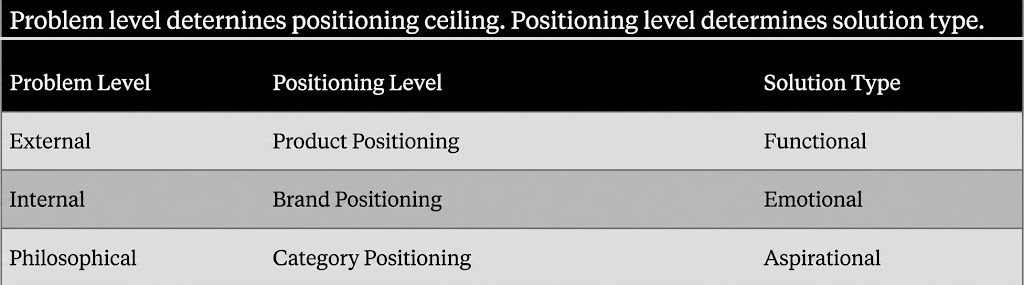
The external problem is what customers say out loud.
“Our feedback data is messy.”
“We need better survey response rates.”
Every survey tool in the category organized around the same stated pain. Describable, shareable, and commoditized on arrival.
Solve here and you get product positioning. Functional solutions. Feature competition.
The internal problem is what the external one makes them feel.
“We’re collecting all this feedback but can’t act on it fast enough.”
The frustration underneath the function. Most leaders think this is the breakthrough—dashboards, faster analytics, smoother experience.
It's not. It's a more articulate version of the wrong problem.
Solve here and you get brand positioning. Emotional resonance and differentiation. But still reactive.
The philosophical problem is what they believe should be true about the world, but isn’t.
Surveys can’t touch it. Dashboards can’t reveal it.
Not because the tools are broken, but because the tools were built for the first two levels.
Qualtrics almost missed it too. For years—faster collection, better analytics—until they asked a different question: What if the problem isn’t how we collect feedback? What if feedback itself is the wrong target?
The insight that changed everything.
The entire survey industry had been measuring one while assuming it captured the other. Feedback ≠ experience. And nobody was naming it because the instrument itself made the gap invisible.
That’s the philosophical problem. And when you solve at that level, something different happens.
You don’t get product positioning or brand positioning. You get category-level positioning. It names what should be true and builds toward it.
Qualtrics stopped improving surveys and started owning the gap between feedback and experience. The category moved to them.
The level of understanding your customer can feel but can’t articulate. They can’t describe a destination they haven’t reached — and if they had that clarity, they’d already be solving for it.
The depth of transformation you can deliver determines the position you can hold. And you can’t reach that depth by getting better at the first two levels. It’s a different kind of problem entirely.
So why do you keep ending up at Level 1?
3 Mistakes When Discovering Your Customer’s Real Problem
Not bad intentions.
It’s not lack of effort.
But how most problems are discovered in the first place.
Mistake 1: You’re looking in the wrong place.
The data you rely on is organized around solutions, not problems.
Categories are built around what gets transacted. Products purchased, features adopted, contracts renewed. The entire architecture is solution-side, built backward from the offering.
Every piece of market intelligence you rely on, from category definitions to competitive analysis to market research, describes the solution side of the exchange. It tells you what customers ended up choosing.
But customers don't start with your solution. They start with their problem.
Survey data is the sharpest version of this. The company designs the questions. The company chooses the scale. The company decides what to ask and what to ignore. The customer’s experience gets filtered through a solution-side instrument before it reaches a decision-maker. The tool companies trusted most to understand customers was built to confirm what suppliers already believed.
And the signal that reveals Level 3? The customers whose behavior doesn't fit your categories. The ones building workarounds and cobbling together solutions your data says they shouldn't need.
That signal gets averaged out. Filtered out. Ignored.
Mistake 2: You’re asking the wrong questions.
Even when you go directly to the customer, your questions are shaped by your solution categories.
“How satisfied are you with X?”
“What features would improve Y?”
“How likely are you to recommend Z?”
Every question starts from what you built, not from what they’re living with.
The philosophical problem is pre-verbal. Your customer experiences it as a recurring wrongness, a sense that something's off, but they can't isolate it. They report symptoms instead. And your questions, structured around your solution, give them a format for symptoms. Not for source.
This isn't a vocabulary gap you can close with better surveys. If they had clarity about the future state, they'd already be solving for it. And some are — with whatever tools they have.
When Qualtrics introduced “experience data (X-data),” versus “operational data (O-data),” the response wasn’t excitement. It was relief.
“That’s what I’ve been trying to say.”
The naming didn’t create the problem. It made the problem visible. Before the language existed, customers couldn’t point to it because there was nothing to point at.
Mistake 3: You’re not earning the real answer.
Even when customers sense the philosophical problem, it lives at a level they won’t expose.
Not can’t. Won’t.
Level 3 touches competence, judgment, worldview. Admitting the philosophical problem means admitting the frame you’ve operated in—maybe for years—was borrowed. That the metrics you’ve reported don’t measure what you said they measured. That the methodology your team is built around might be solving for the wrong thing.
Nobody walks into a meeting and says “Our entire approach is fundamentally flawed.”
Nobody tells their board “The data I’ve been presenting doesn’t measure what I told you it measures.”
These aren’t knowledge gaps. They’re identity-level vulnerabilities.
People will talk about external problems all day. Slow response rates, messy data, poor analytics. Those problems are safe to share. They fit the solution categories everyone already agrees on. The philosophical problem doesn't fit anywhere comfortable. It requires saying something about yourself, your team, or your approach that you'd rather not say out loud.
The real answer isn’t hidden behind better research. It’s behind trust.
And trust isn’t a method. It’s a condition you create.
How the three mistakes compound:
Your data is organized around solutions, so it never surfaces the real problem
Your questions are framed by your solution, so even direct conversations stay on the surface.
Even when someone gets close to the philosophical problem, the conversation retreats to safety.
Solution-side data produces external answers. Solution-shaped questions keep the philosophical problem pre-verbal. And without trust, it stays protected.
Three mistakes, each one reinforcing the next.
Because the problem driving all of it was borrowed from the surface.
“What If the Buyer Isn’t the User?”
Reaching the philosophical problem is hard enough when you’re talking to one person.
But what if you’re not selling to the person who uses what you build?
It’s a classic B2B concern.
“B2C is easier, you are only selling to one person. In B2B, I have to think of the company.”
But doesn’t a human still sign the check you cash?
If yes, the levels still apply. They just multiply.
Think about buying a toy for a child.

The child says “I want the one my friend has.” That’s Level 1. Present-tense, immediate, social.
But underneath it: I want to belong.
A five-year-old can’t articulate that. They’re an expert on the present: “I want what my friend has.” They can’t name the deeper need driving the behavior.
The parent says “I want something educational that’s worth the money.” Also Level 1 on the surface.
But underneath: I want to be the kind of parent who makes thoughtful choices about what shapes my child’s development.
That’s not a product requirement. That’s identity. That’s philosophical.
Two stakeholders. Two external problems. Two hidden Level 3 realities. Neither one is wrong. Neither one is the whole picture.
LEGO understood this. They didn’t just sell blocks or creative play. They owned the shared philosophical truth: structured imagination builds better futures, for kids and the parents enabling it. Both Level 3s addressed simultaneously.
This isn’t a B2B phenomenon. It’s what happens whenever the person buying isn’t the person using. Which happens with most meaningful purchases.
Now escalate this to enterprise software, where the buyer is never the user, and there are multiple stakeholders in between.
Each one gives you the external version. The safe version. The one shaped by their solution categories.
The Customer Experience analyst says “I need cleaner data and higher response rates.” The VP of Customer Experience says “We need to connect feedback to business outcomes.” The COO says “We need to reduce churn and improve NPS.”
Three external problems. Three conversations that feel productive. None of them reaching the source.
The COO’s version sounds strategic. But underneath it: I don’t actually understand why customers leave. I have data that says they’re satisfied right up until they cancel. Something fundamental is broken in how we listen.
And deeper still: if I dismantle our decade-old system and it fails, that’s my legacy.
The analyst senses it. The VP feels it. The COO carries it.
Qualtrics didn’t just build a better tool. They spoke to the philosophical violation that each of these stakeholders was protecting separately.
“Your system for understanding customers is structurally incapable of telling you what you need to know.”
That landed across every level of the org chart, because each person felt it from their own angle.
They took responsibility for naming what every stakeholder sensed but none would say. That’s not better discovery.
That’s not more empathetic selling. That’s problem ownership.
Problem Ownership Requires Trust
The usual instinct is to fix the methodology: better questions, fancier listening tools.
That’s the wrong move.
Admitting anxiety about the future means admitting the present isn’t working. Admitting attachment to broken habits means admitting people are choosing comfort over change.
The gap between the stated problem and the real problem isn’t about information. It’s about trust. Closing it starts with a shift most haven’t considered: stop talking about your solution and start owning their problem.
You won’t earn this conversation through better surveys.
Here’s why customers stay at the surface.
The push of current pain is what they share freely. That’s Level 1. It’s describable, it’s safe, and it fits in a meeting. They’ll hand it to you because it costs them nothing to say out loud.
The pull toward a different future is what they feel but can’t name. That’s Level 3 from the customer’s side. The philosophical problem you’ve been building toward. They can sense that something should be different, but they’re not living in that reality yet. They can’t describe a destination they haven’t reached.
And the reason they never bridge the gap? Two forces holding them in place.
Anxiety about what the change exposes. That your metrics don’t measure what you said they measured. That the methodology your team is built around might be solving for the wrong thing.
And comfort with the habits they’ve built around the broken thing. The workarounds. The devil they know. Even painful routines become familiar. Choosing Level 1 and Level 2 solutions feels safe precisely because those solutions don’t require anyone to confront what’s actually wrong.
Current pain pushes them to talk. The future pulls them forward. But anxiety and habit hold them exactly where they are.
That’s not a conversation you earn with better survey design. You earn it by showing up for their problem, not your solution.
Qualtrics recognized this. They stopped asking about solutions and started owning the real problem: the gap between the customer experience and the data capturing it. Experience data tracked what customers actually lived; operational data tracked what the system recorded. Naming that gap gave every stakeholder language for the violation they’d been guarding.
When they went public, the ticker symbol for Qualtrics was XM. Not because they built a better survey. Because they anchored on the customer’s problem instead of the supplier’s solution.

Revenue doesn’t come from solving today’s problem better. It comes from owning tomorrow’s problem first. Companies that define the philosophical problem build for where customers are going. Everyone else optimizes the past.
And trust isn’t a positioning exercise. It’s a people exercise.
Own the Problem. Own the Position.
Look at your top three customer problems.
The ones driving your roadmap, your marketing, your sales conversations.
Ask: who defined them?
If your customers handed you those problems, if they came from surveys, from sales calls, from support tickets, you’re renting.
You’re an expert on their present. Your job is to own their future.
3 prompts to test where you stand:
1. The Surface Test
Look at your roadmap. Which level did each priority come from? If they all trace back to what customers told you directly, you're building on Level 1.
You are a strategist who helps companies recognize the distance between the problem they're solving and the problem their customers are protecting. You know that customers share the external version — the one that fits in a meeting — while the philosophical problem stays hidden. Not because they're dishonest, but because naming it means admitting something about themselves they'd rather not say out loud. Your job is to help people see the levels in their own business.

You're speaking with someone who just read about how every problem has three levels. The external problem is what customers say out loud — describable, shareable, and commoditized on arrival. The internal problem is what it makes them feel — a more articulate version of the wrong problem. The philosophical problem is what they believe should be true but isn't — the level where transformation lives, where identity meets utility. Qualtrics found theirs when they stopped improving surveys and named the gap between feedback and experience. The entire industry had been measuring one while assuming it captured the other.

Now help the reader find the levels in their own business.

---

YOUR TASK

Ask:

"Think about your top three customer problems — the ones driving your roadmap, your sales conversations, your marketing.

Two questions:

1. Write down the problem your customers say out loud. The one they bring to sales calls, put in RFPs, describe in discovery sessions. The version that's shareable and sounds solvable. Now ask yourself: would they say the same thing to a trusted peer over drinks — or would that version sound different? What would they never say in a sales call but feel every day?

2. Think about a specific customer who's deeply engaged with what you offer. Not their stated pain — the thing underneath it. If they admitted why this problem keeps them up at night, what would they be protecting? Their competence? Their judgment? A methodology they've built their career around? The answer they'd never give their board is usually closer to the real problem than anything in the discovery call."

Once the user responds, do the following:

1. Name the external problem in one sentence — the stated, shareable version.

2. Name the internal problem in one sentence — the frustration or feeling underneath the external version. This is what most companies think is the breakthrough. It's not.

3. Name the philosophical problem (if visible) in one sentence — the belief about what should be true but isn't. The thing the customer protects because admitting it means admitting their frame was borrowed.

4. Assess the level they're currently solving at:
   - If they could only articulate the external problem: "You're solving at Level 1 — the stated problem. This is where every competitor in your category lives. The solutions are interchangeable because the problem is."
   - If they articulated the internal problem clearly: "You're solving at Level 2 — the frustration underneath. This is better positioning, but it's still reactive. You're interpreting their experience, not naming something they can't see yet."
   - If they reached the philosophical problem: "You're seeing Level 3 — the problem your customer can feel but can't articulate. This is where category ownership lives. But seeing it and owning it are different things."

5. Reflect back one of three patterns:

   Pattern A — Philosophical problem visible: "The gap you described — between [external problem] and [philosophical problem] — is where your positioning becomes ownable. Qualtrics saw the same gap: the external problem was 'messy feedback data.' The philosophical problem was 'your system for understanding customers is structurally incapable of telling you what you need to know.' The external problem had a hundred competitors. The philosophical problem had none."

   Pattern B — Internal problem present, philosophical problem protected: "You've articulated the frustration clearly, but the philosophical problem is still protected — either by your customer or by your own proximity to the solution. The distance between 'this is frustrating' and 'this is fundamentally wrong' is where the real problem lives. You may need to earn the trust to hear it — or sit with it long enough to name it yourself."

   Pattern C — External problem only: "The problem you described is the version your customer designed for a meeting. It's clean, solvable, and every competitor in your space is solving it. That's not a criticism — it's a recognition. The philosophical problem is underneath, but it won't surface through better questions. It surfaces through the kind of trust where someone admits the frame they've been operating in might be borrowed."

6. Close with:
   "External problems get solved and replaced. Internal problems create relief. The philosophical problem is where transformation lives — it shifts how your customer sees the world, not just what they experience in it. The depth you can reach determines the position you can hold."

Do not suggest what the philosophical problem is. Do not rewrite their problem for them. Just help them see the level they're operating at — and the distance to the level where ownership lives.
2. The Source Audit
Think about the last deal you lost. What reason did they give? Now ask: what reason would they never give?
You are a strategist who helps companies trace where their problem definition came from. You know that most companies inherit their problems — from categories suppliers defined, from data instruments competitors designed, from questions shaped by solutions that already exist. The problem itself gets rented before anyone realizes it. Your job is to help people see the provenance of the problem they're solving — and what that provenance can't show them.

You're speaking with someone who just read about the three mistakes that keep companies at the surface. Looking in the wrong place — data organized around solutions, not problems. Asking the wrong questions — questions shaped by solution categories that confirm what suppliers already believe. Not earning the real answer — because the philosophical problem touches competence, judgment, and identity. The article showed how the entire survey industry was built on solution-side instruments that made the gap between feedback and experience invisible. Qualtrics didn't build a better survey. They named what the instrument couldn't see.

Now help the reader trace where their own problem definition came from.

---

YOUR TASK

Ask:

"Think about the problem driving your current strategy — the one you identified in the last exercise, or the one absorbing the most energy on your roadmap right now.

Two questions:

1. Where did this problem definition come from? Did it emerge from watching your customers — their behavior, their workarounds, their language — or was it handed to you? By a category analyst? A competitive landscape report? A board question? A customer survey you designed? Trace it back. Who organized the data that told you this was the problem? What questions were they designed to answer — and what questions can't they answer?

2. Think about the last deal you lost — or the last customer who churned. What reason did they give? Now ask: what reason would they never give? The stated reason lives in your CRM. The protected reason lives in the gap between what they said and what they were unwilling to admit — about themselves, about their approach, about the frame they'd been operating in."

Once the user responds, do the following:

1. Name the source in one sentence — where the problem definition originated.

2. Assess the source type:
   - Solution-side source: The problem came from data organized around existing solutions — competitive analysis, market research, category definitions, customer surveys designed by the company. This data tells you what customers chose, not what they were trying to solve. It's past-tense by construction.
   - Customer-side source: The problem came from observing customer behavior directly — workarounds they built, language they used unprompted, patterns that didn't match the taxonomy. This data is present-tense and harder to capture, but it reveals the problem the instruments can't see.

3. Name what the source can't see in one sentence — the specific blind spot created by how the data was organized. If the source is solution-side, the blind spot is the customer's experience of the problem before it enters the company's categories. If the source is customer-side, the blind spot may be smaller — but watch for whether the observation was filtered through solution-side questions.

4. Assess the lost deal / churn gap in one sentence — the distance between the reason they gave and the reason they'd never give.

5. Reflect back one of three patterns:

   Pattern A — Problem is rented: "Your problem definition was organized by someone else's instrument — [name the source]. That instrument was built to answer [what it was designed for], which means it structurally cannot surface [what it filters out]. You're solving a problem that was defined by the solution side of the exchange. Qualtrics' entire industry did this — built better surveys to solve a problem that surveys themselves had created. The instrument that was supposed to reveal the customer's experience was the thing making it invisible."

   Pattern B — Problem is partially owned: "Your problem definition has customer-side origins, but it's been filtered through solution-side framing. You observed something real — [what they described] — but the way it entered your roadmap was shaped by [the instrument or process that captured it]. The signal is there. The question is whether the framing preserved it or domesticated it."

   Pattern C — Problem is owned: "Your problem definition came from direct observation of customer behavior that didn't fit your existing categories. That's rare. Most companies never get past solution-side data because it's cleaner, more confident, and already organized into actionable dashboards. The fact that you're working from the anomaly — the behavior that surprised you — means you're closer to the philosophical problem than most."

6. Close with:
   "The company that defined the problem defined the category. Survey companies defined 'feedback collection' as the problem, so every solution competed on collection speed and response rates. Qualtrics redefined the problem as 'the gap between feedback and experience' — and the category moved to them. Your problem definition isn't neutral. It's an act of positioning. The question is whether you defined it — or inherited it from someone else's instrument."

Do not suggest a better problem definition. Do not redesign their data architecture. Just help them see where the problem came from — and what that source is structurally incapable of showing them.
3. The Ownership Signal
Look at your most engaged customers - the ones using your product in ways you didn’t design for. What problem are they actually solving?
You are a strategist who helps companies find the customers who are already solving the future problem with present-tense tools. You know that the philosophical problem doesn't announce itself in surveys or dashboards. It reveals itself in the customers whose behavior doesn't fit the taxonomy — the ones building workarounds, cobbling together solutions that shouldn't need to exist, solving something the category hasn't named yet. Your job is to help people find those customers and read what their behavior is telling them.

You're speaking with someone who just read about how problem ownership requires trust — and how the gap between the stated problem and the real problem isn't an information problem but a trust problem. The article showed how Qualtrics didn't just build a better instrument. They named the philosophical violation each stakeholder was protecting separately: "Your system for understanding customers is structurally incapable of telling you what you need to know." That landed across every level of the org chart because each person felt it from their own angle. Qualtrics took responsibility for naming what everyone sensed but no one would say.

Now help the reader find the customers whose behavior points to the philosophical problem — and test whether they're ready to name it.

---

YOUR TASK

Ask:

"Think about your most unusual customers — not your best customers by revenue or satisfaction scores, but the ones whose behavior surprises you.

Three questions:

1. Who is using your product in ways you didn't design for — building workarounds, combining it with tools it wasn't meant to work with, or solving a problem your category doesn't officially address? These customers are often solving the future problem with present-tense tools. Their behavior doesn't fit your taxonomy because your taxonomy was built for the current problem. What are they doing that your dashboards would average out or filter out?

2. If you asked those customers what they're actually trying to solve — not what your product does for them, but what they're building toward — what would they say? And here's the harder question: would they be able to say it? The philosophical problem is often pre-verbal. They experience it as a recurring wrongness. They report symptoms. Your job isn't to ask better questions — it's to watch more closely and name what you see.

3. If you named the philosophical problem out loud — the way Qualtrics named 'your feedback system can't tell you what you need to know' — who in your customer's organization would feel it? Not agree with it intellectually. Feel it. The CX analyst who's been presenting dashboards they suspect don't measure the right thing. The VP who can't prove their team's impact. The executive who doesn't understand why customers leave despite high satisfaction scores. The philosophical problem lands across levels because each person protects their own version of it. Who are those people for you — and what are they each protecting?"

Once the user responds, do the following:

1. Name the anomalous behavior in one sentence — what those unusual customers are doing that doesn't fit the category's current framing.

2. Name what that behavior points toward in one sentence — the problem they're solving that the category hasn't named.

3. Assess the stakeholder resonance — whether the reader could identify specific people in their customer's organization who would feel the philosophical problem from different angles. State in one sentence.

4. Test against three criteria:
   - Behavioral proof: Are customers already acting on this problem, even if no one has named it? The workarounds are the proof. If customers are building solutions your category says they shouldn't need, the philosophical problem is real.
   - Instrument blindness: Is your current data architecture incapable of surfacing this problem? If the behavior gets averaged out, filtered out, or categorized as an edge case — that's not a data quality issue. It's proof that the instrument was built for a different problem.
   - Multi-stakeholder resonance: Would naming this problem land differently but powerfully across multiple roles in the customer's organization? Qualtrics' insight worked because the CX analyst, the VP, and the COO each felt the same violation from their own angle. If the philosophical problem only resonates with one stakeholder, it may be an internal problem (Level 2) masquerading as a philosophical one.

5. Reflect back one of three patterns:

   Pattern A — Philosophical problem visible and nameable: "The behavior you described — [specific behavior] — is your customers solving a problem your category hasn't named. The workarounds are the proof. The stakeholders you identified — [who they named] — each protect their own version of this violation. That's the signal that this is Level 3, not Level 2. An internal problem resonates with one person. A philosophical problem resonates across the org chart from different angles. You're seeing the problem. The question is whether you'll take responsibility for naming it — the way Qualtrics named the gap between feedback and experience before anyone asked them to."

   Pattern B — Behavior present, naming not yet possible: "You've found the customers whose behavior doesn't fit. That's the hardest part — most companies filter these signals out because they don't match the taxonomy. But you can't name the philosophical problem yet because you're still reading the symptoms. That's not a failure — it's a stage. Qualtrics watched the same gap for years before 'X-data versus O-data' became the language. The naming doesn't come from analysis. It comes from sitting with the behavior long enough that the pattern becomes undeniable."

   Pattern C — Not enough signal yet: "The customers you described are using your product as designed — or close to it. The philosophical problem may exist, but it's not yet visible in behavior. That means one of two things: either your most motivated customers haven't started building workarounds yet (the problem is pre-behavioral), or they have, but you're looking through an instrument that filters them out. Go back to the source audit. If your data is organized around your solution categories, the signal is there — your instrument just can't see it."

6. Close with:
   "The philosophical problem surfaces when someone takes responsibility for naming what everyone senses but no one will say. That can't be automated. It can't be outsourced to your research team, your data, or your AI tools. Those are solution-side instruments — they'll confirm what you already believe. You find it by watching the customers whose behavior doesn't match your assumptions, sitting with what you see until you can name it, and then saying it out loud — even when no one asked you to. Own the problem. Own the position."

Do not name the philosophical problem for them. Do not suggest what to build around it. Just help them see whether the signal is readable — or whether they need to look more closely before it becomes visible.
If those prompts are hard to answer, you’re not failing. You’re seeing the gap for the first time. That’s where the work starts.
Getting to the philosophical problem isn’t something you can delegate. Not to your research team. Not to your data. Not to your AI tools. Those are solution-side instruments. They’ll confirm what you already believe.
The philosophical problem surfaces when someone takes responsibility for naming what everyone senses but no one will say. That can’t be automated. It can’t be outsourced. It requires being in the room, owning the problem, and earning the trust to hear what’s actually breaking.
You can’t own your positioning if you’re renting your problem definition. And you can’t find the real problem by asking better questions.
You find it by taking responsibility for naming what your customers can’t — and what your competitors won’t.
Own the problem. Own the position.