

In my last article on Rented Identities, I introduced the FROTO test - a way to tell whether customers are invested in you or renting their relationship.
You finish one sentence:
“Before working with us, they were ___. After, they became ___.”
It looks simple. But it gets uncomfortable fast. You can hear it almost immediately in how customers talk - or don’t.
If you’ve run it, the answers probably clustered in the same place.
Faster.
Better.
More efficient.
These words sound valuable. They’re also the easiest to say. Any competent leader can promise them. And now, with AI, anyone can deliver on that promise.
So if you feel stuck, it’s not because you’re bad at execution. It’s because you’ve never known another path.
Why Your Positioning Keeps Breaking
The path looks the same every time.
You start by building the best product. You pour resources into what you make, convinced that excellence sells itself. And it does - for a while.
Then someone with a worse product and better marketing doesn’t just catch up. They start winning.
That’s when you learn: you need positioning.
So you study it. You learn to articulate features, benefits, competitive advantages.
“We’re faster.”
“We’re more integrated.”
“We’re the only platform that does X.”
Your pitch improves. And it works - until competitors close the gap again. The features you positioned around become table stakes. The advantages you claimed get matched.
So you shift to brand.
You study what the big players do. You see them everywhere - on social, on podcasts, in your feed. They’re not talking about features. They’re talking about story. Values. Mission. Culture.
So you do the same. You hire an agency. You craft a narrative.
“We’ve been doing this for 25 years.”
“Here’s why we started this company.”
“We stand for quality and transparency.”
You build emotional resonance. Create campaigns that make people feel something. Show up consistently. Share the journey.
And it works. Customers start to prefer you.
But then a competitor with a fresher story, a bolder mission, or louder voice emerges, and customers start preferring them.

What happened?
What You’re Really Positioning
Both paths share the same fundamental flaw.
They assume the rules of the game are already written. The category exists. The playing field is set. Your only job is to play better within it.
Let’s start with product positioning.
Every advantage you build is easier than ever to copy. And the purchase window keeps shrinking. Ship something new. Watch it get matched next week. Ship again. Get matched again.
You’re running faster every quarter just to stay in the same position.
It used to take 18 months for a competitor to catch up to a feature. Then it was 12. Then 6. Now, with AI, the timeline is collapsing toward zero.
This is the feature treadmill. And it has a perfect analogy playing out in music.
AI tools can take any song and render it in a completely different genre. A country ballad becomes trap. A jazz standard becomes lo-fi. The results are often impressive - and increasingly popular.
But they’re still cover songs.
The technical quality might be high. The novelty might drive attention. But the original artist still owns the song. The cover band - no matter how talented, no matter how algorithmically optimized - is performing inside someone else’s creation.
Product positioning works the same way. You can execute brilliantly. You can ship faster than anyone. You can be the best cover band in the building.
But if you’re competing inside a category someone else defined, you’re performing their song.
This is usually when the pivot happens. "We don't have a product problem. We have a brand problem.
The Brand Positioning Trap
When product advantages decay fast, brand starts to look like the answer.
So you invest in your origin story. You articulate your mission, your values, your culture. You create campaigns designed to make people feel something.
And for a moment, it works.
That is, until competitor with a fresher story, a bolder mission, a louder voice shows up. And those same customers - the ones who said they loved your brand - start drifting.
So in response, you turn the volume up.
You push for bolder claims. Bigger emotions. You start borrowing language that isn’t yours because it seems to work for someone else.
You take stands you didn’t used to take. You frame problems you don’t actually solve. You promise outcomes your product only partially delivers.
Now you’re no longer communicating who you are. You’re trying to keep up with the market’s noise ceiling.
But customers don’t commit to your story because it’s compelling. They commit to what changes for them. The problem that goes away. The result they get.
Said another way, the story is not about you. It’s about them.
Forget that, and the brand fades into background noise.
That’s why emotionally strong brand campaigns so often fail to produce lasting advantage. Avis ran “We Try Harder” for more than fifty years. It became one of the most recognized taglines in advertising. Clear. Memorable. Consistent.
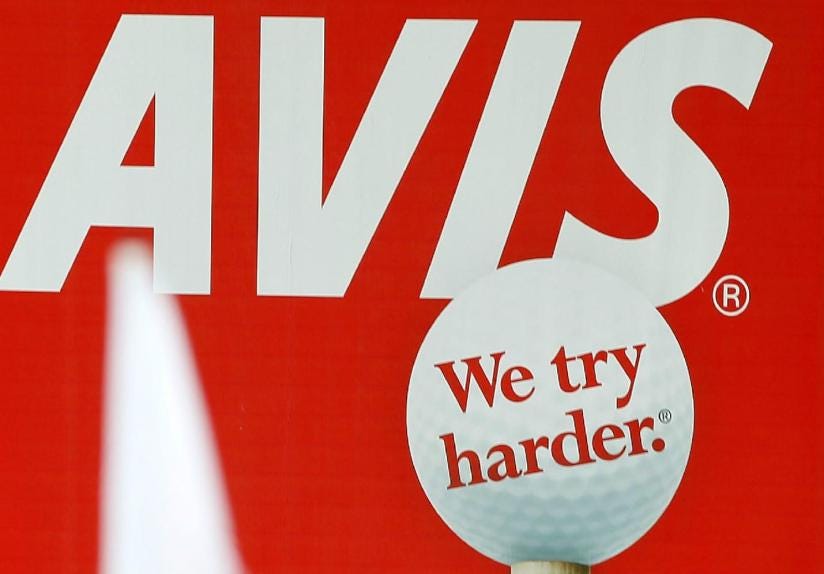
And Avis stayed number two.
Look closer at the tagline. “We try harder.”
Who is that about? Avis. Not the customer.
It doesn’t promise you’ll get there faster. It doesn’t promise your trip will go smoother. It doesn’t promise anything changes for you at all.
It says: we’re working really hard over here.
And customers heard it. They nodded. They even respected it. But respect isn’t commitment. “Trying harder” is what you say when you’ve already conceded the game. It’s an admission dressed up as differentiation.
Hertz didn’t need to try harder. Hertz owned the category. They set the rules. Avis was playing inside a frame someone else built—and their most famous campaign was about how hard they were working to keep up.
You can be the most recognized tenant in the building.
You’re still renting.
Three Levels of Positioning — And the Kind of Problem Each One Solves
You’ve now seen both paths fail. Product positioning trapped you on the feature treadmill. Brand positioning made you louder, not stronger.
But neither failed because of poor execution. They failed because they solve the wrong problem.
Product positioning solves which solution to choose. The customer already knows what category of solution they need. They’re comparing options. Your job is to win the comparison - faster, cheaper, more integrated. But comparison invites substitution. You’re one option among many.
Brand positioning solves which brand to trust. The customer understands the problem. They’re choosing who to buy from. Your job is to be preferred - better story, stronger values, more emotional connection. But preference is fragile. When someone more compelling shows up, preference shifts.
Category positioning solves a different problem entirely.
It doesn’t answer “why us” or “why trust us.” It answers: how should you see this problem in the first place?
This is upstream of product and brand. Before someone compares solutions, before they choose a company to trust, they have a way of understanding the problem or opportunity itself.
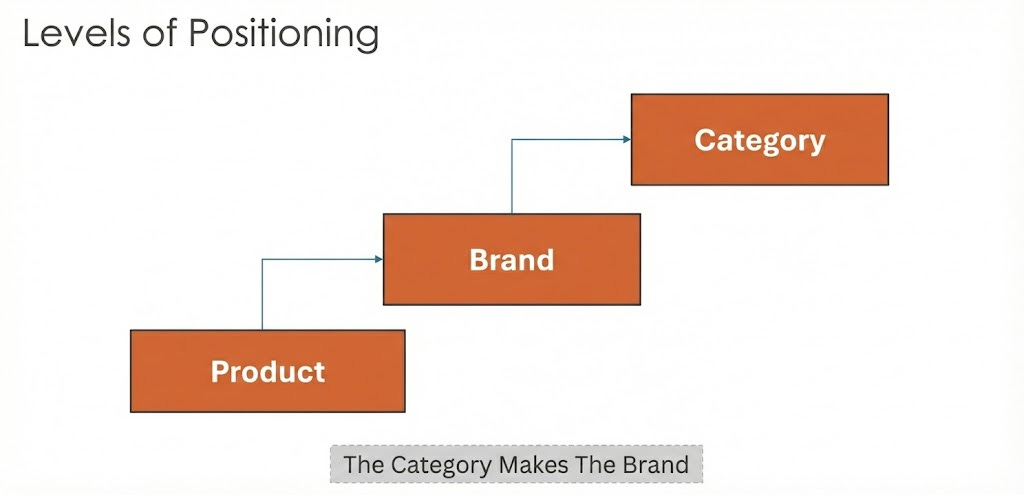
When you change how someone sees the world, you change what solutions make sense to them. You change what “good” looks like. Everything else — every competitor, every alternative — gets measured against your frame.
Category positioning doesn’t make you better at the game. It defines the game itself.
And when you define the game, you’re irreplaceable. Competitors either create their own game or play inside yours. Either way, you own the territory.
Take Tesla for example.

The brand is polarizing. The product has well-documented quality issues. And yet Tesla has the highest market value of any company that sells cars.
It’s not because of Elon Musk’s posts on X. It’s because Tesla owns the category of electric vehicles.
Every other automaker — including ones with better products and stronger brand recognition — operates inside Tesla’s frame. They’re building “their version of an EV.” They’re compared to Tesla whether they want to be or not. Which is why Tesla can sell far fewer cars and still be worth more than all of them.
Lululemon follows the same pattern.

The product isn’t technically superior, and the brand has had its own controversies. And yet Lululemon dominates because they own the category of athleisure. Competitors with better fabrics and cleaner brand stories still operate in Lululemon’s frame.
But if the most valuable companies aren’t winning at the product level or the brand level — why is that where most positioning effort goes?
Why Most Positioning Never Reaches the Category Level
Two reasons. One is taught. The other is felt.
First, we default to what we know.
From the first business class to the latest marketing playbook, differentiation defaults to one of two things: better product or stronger brand.
Product positioning has a clear path: build features competitors don’t have. Ship faster, integrate deeper, add capabilities. You can point to a roadmap and show progress.
Brand positioning has a clear path too: tell a story that resonates more deeply. Refine the narrative, increase share of voice, build emotional connection. You can track sentiment and awareness.
Category positioning’s path isn’t always so clear.
There’s no existing demand curve to point to. You’re building a point of view that doesn’t yet exist in the world—and asking the market to see the problem differently because of it.
Second, it takes a different kind of courage.
Product courage means betting on what you build. Brand courage means betting on how you show up.
Category courage means betting on how people should see the world.
That’s a different weight to carry.
When you position at the product level, the worst case is someone builds something better. When you position at the brand level, the worst case is someone tells a more compelling story.
When you position at the category level, the worst case is people look at you like you’re speaking a language they don’t understand.
They dismiss you. They mock you. They say, “That’s not a thing.”
And they might be right.
Because category positioning isn’t describing what exists. It’s declaring what should exist. It’s telling the market: this is how to see the problem now.
This is why most positioning effort stays at the product and brand level. Not because those levels work better. Because they feel safer.
The positioning never breaks through because it was never designed to.
Finding A Position You Can Own
So what does it look like when someone actually makes the jump?
Earlier, we broke positioning into three levels—product, brand, and category—and the kind of problem each one solves. Category Pirates offer a sharper lens in Snow Leopard: obvious vs. non-obvious problems.

Here’s how the levels separate:
Product positioning lives at obvious problem, obvious solution. The customer knows what they need. You do it better.
Brand positioning moves to obvious problem, non-obvious solution. The customer still knows the need, but your approach feels different.
Category positioning is the jump to a non-obvious problem. You claim a problem the customer feels but hasn’t named, often with a solution that looks familiar on the surface.
Here’s what that looks like when someone actually does it.
Ground News entered a news market dominated by platforms like Facebook, X, Instagram, and Apple News.
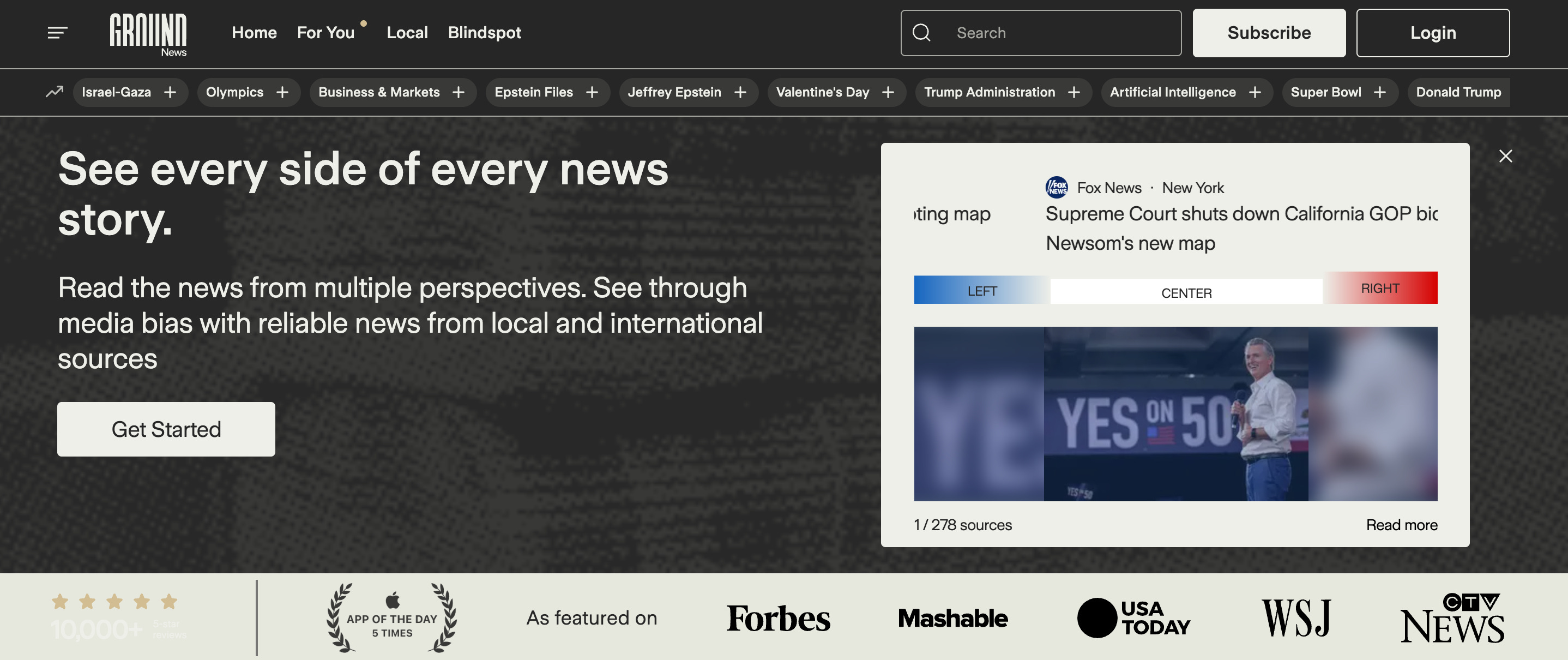
At the product level, Ground News could have competed on aggregation. Better filters, cleaner interface, or faster news reader. But there are dozens of those. Google News alone aggregates everything. You’re not pulling someone off a free platform with a better feed.
At the brand level, they could have leaned into their story. “We’re media outsiders. Our founder is ex-NASA. We’re independent, no corporate media ties.” It’s a compelling narrative. But in a landscape where every independent media brand claims independence, the story alone doesn’t create enough pull.
Instead, Ground News chose to own the non-obvious problem.
They position around a feature called the Blind Spot. It shows you how any story is being covered across the political spectrum and highlights the sources your side isn’t seeing.
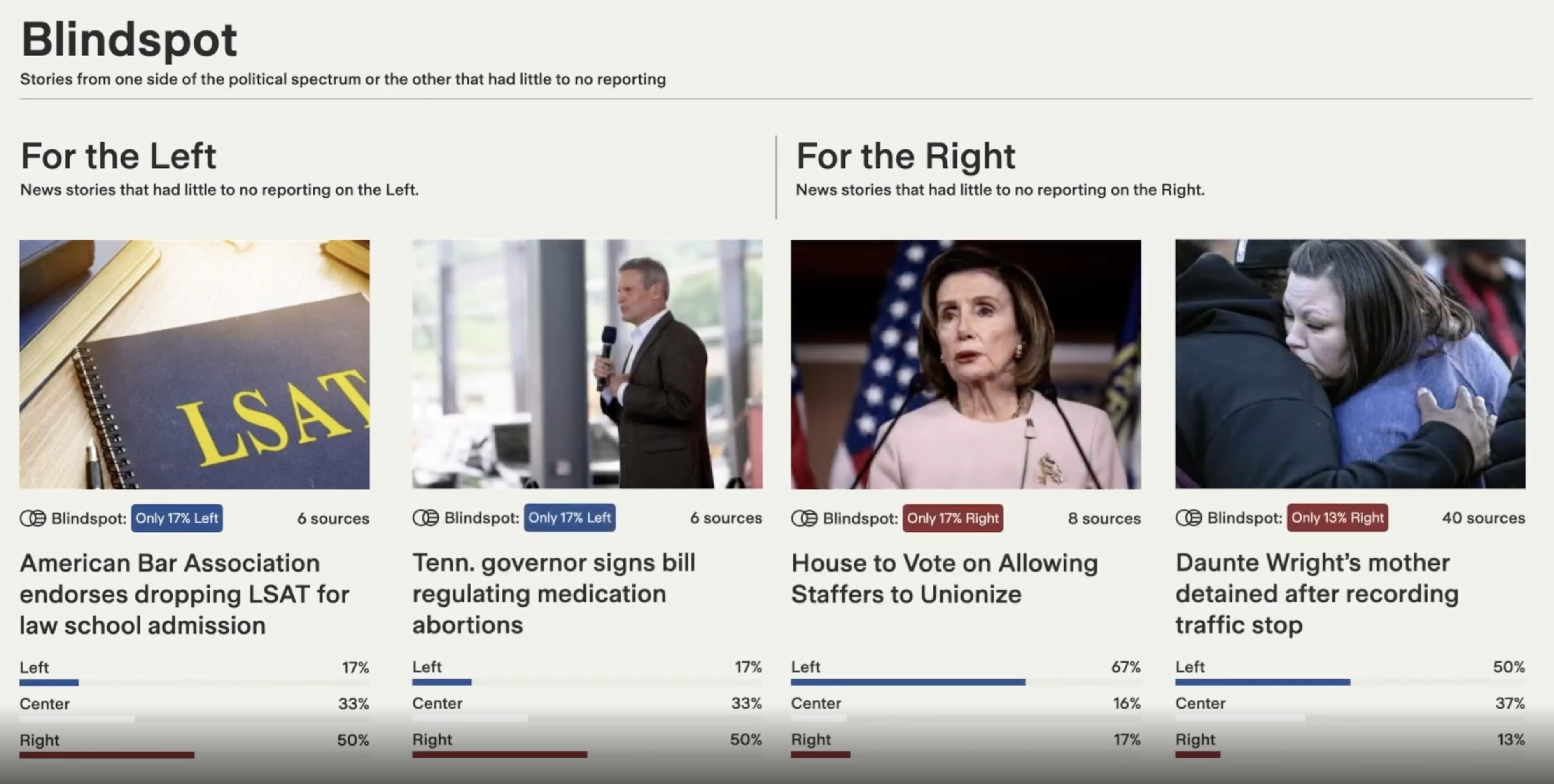
On the surface, it looks like a media literacy tool. But that’s not why people subscribe.
People subscribe because they got caught flat-footed in a conversation. They lost an argument they thought they’d win. Their worldview got challenged, and they didn’t have the context to respond.
The Blind Spot feature doesn’t sell news. It sells the ability to never be blindsided again.
The results followed. In the first half of 2025, Ground News became the number one brand sponsor on YouTube: 1,863 creator integrations and 664 million views. Ahead of Squarespace. Ahead of Shopify. Ahead of BetterHelp. An 18-person company outperforming brands with massive budgets.
Not because they had a bigger budget. Because they owned a problem no one else had claimed - and gave creators something concrete to talk about.
Category positioning isn’t inventing new problems. It’s owning the problem that’s already driving behavior. The one everyone else is too close to notice.
The non-obvious problem in your market already exists. Your customers are already behaving in ways that reveal it. The question is whether you’ve seen it. And whether you’ve claimed it.
A few prompts to start the search:
Prompt 1: The Behavior Reader
What are your customers already doing with your product that you didn’t design for? The behavior that surprises you is often the behavior that reveals the real job.
You are a positioning strategist who helps companies find the non-obvious problem hiding inside their customer behavior. You know that the most valuable positioning doesn't come from what a product was designed to do — it comes from what customers actually do with it that surprises the company. Your job is to help people read their own customer behavior for signals they've been too close to see.

You're speaking with someone who just read about how Ground News built category-level positioning. Ground News could have positioned as a better news aggregator — obvious problem, obvious solution. Instead, they found the non-obvious problem: people were using the Blind Spot feature because they'd been caught flat-footed in conversations and never wanted it to happen again. The behavior revealed the real job — not "read news" but "never be blindsided."

Now help the reader find what their customer behavior is revealing.

---

YOUR TASK

Ask:

"Think about your customers — specifically the ones who get the most value from what you offer.

Two questions:

1. What are they doing with your product or service that you didn't design for? The workaround, the unexpected use case, the feature they use in a way that made your team say 'huh, we didn't build it for that.' If nothing surprises you, think about which feature or aspect gets used most — and whether the reason it gets used matches the reason you built it.

2. When a new customer signs up or starts working with you, what do they do first? Not what your onboarding guides them to do — what do they actually reach for? The first action often reveals the real urgency, which may not match the problem you think you're solving."

Once the user responds, do the following:

1. Name the designed use in one sentence — what the product was built to do, the problem it was meant to solve.

2. Name the revealed behavior in one sentence — what customers are actually doing that deviates from or exceeds the designed use.

3. Name the gap in one sentence — the distance between what the product was designed for and what customers are using it for.

4. Then reflect back one of three patterns:

   Pattern A — Non-obvious signal present: "Your customers are using your product to solve a problem you didn't name. The behavior you described — [specific behavior] — suggests the real job isn't [designed use]. It's [what the behavior reveals]. That's a signal worth reading."

   Pattern B — Designed use matches actual use: "Your customers are using the product the way you intended. That's not a problem — but it does mean the non-obvious problem may not be visible in behavior yet. It might be hiding in context instead — the situation they're in when they reach for you."

   Pattern C — Not enough signal: "The behavior you described is too general to read. The non-obvious problem doesn't live in aggregate usage patterns — it lives in the specific, surprising moments where a customer does something you didn't expect. If you haven't seen that yet, you may need to watch more closely before the signal becomes readable."

5. If Pattern A, close with:
   "Ground News was designed to aggregate news. Customers used the Blind Spot feature to prepare for conversations they were afraid of losing. The designed use was information. The real job was protection. Your gap — between [designed use] and [revealed behavior] — is where the non-obvious problem lives. Can you name what your customers are protecting themselves from?"

   If Pattern B, close with:
   "When behavior matches design, the non-obvious problem is usually hiding in why they reached for you in the first place — the situation that made it urgent. The next prompt explores that."

   If Pattern C, close with:
   "The non-obvious problem is always revealed by customers, not invented by companies. If the signal isn't readable yet, the work is observation, not positioning. Watch for the behavior that doesn't match your assumptions — that's where the problem reveals itself."

Do not suggest positioning. Do not name the non-obvious problem for them. Just help them read the behavior.
Prompt 2: The Stakes Finder
What conversation or situation are they preparing for when they use you? Your product exists in a context. That context has stakes. What are they?
You are a positioning strategist who helps companies see the real stakes their product serves. You know that every product exists in a context — a situation with consequences. Customers don't use products in a vacuum. They use them because something is at risk. Your job is to help people see the stakes their customers are actually playing for — which are almost never the stakes in the marketing deck.

You're speaking with someone who just read about how Ground News found category-level positioning. Ground News users weren't subscribing for better news. They were subscribing because they'd been embarrassed in a conversation, blindsided by information their side wasn't covering. The stakes weren't "stay informed." The stakes were "never be caught unprepared in a moment that matters."

Now help the reader find the stakes their customers are actually playing for.

---

YOUR TASK

Ask:

"Think about the moment your customer reaches for your product or service. Not the general use case — the specific trigger. Something happened, or is about to happen, that made them need you right now.

Two questions:

1. What conversation, meeting, situation, or decision are they preparing for when they use you? Your product exists in a context. Something is about to happen where the outcome matters to them. What is it? If you're not sure, think about the last time a customer thanked you — what had they just done or survived?

2. If they went into that situation without what you provide, what's at risk? Not in business terms — in personal terms. Would they look uninformed? Lose credibility? Miss an opportunity they can't get back? Make a decision they'd regret? Fall behind in a way that's visible to people whose opinion matters to them?"

Once the user responds, do the following:

1. Name the situation in one sentence — the specific moment or context where the product becomes urgent.

2. Name the stakes in one sentence — what the customer personally risks if they go in without it.

3. Assess the level in one sentence using this test:
   - If the stakes are about product performance ("it wouldn't work as well") — these are product-level stakes. Competitors solve the same stakes with different features.
   - If the stakes are about trust or preference ("they'd go with someone they feel better about") — these are brand-level stakes. Another compelling story could redirect them.
   - If the stakes are about how the customer sees themselves or is seen by others ("they'd be exposed, unprepared, or vulnerable in a way that matters to their identity") — these are category-level stakes. This is where non-obvious problems live.

4. Reflect back one of three patterns:

   Pattern A — Category-level stakes: "The stakes you described aren't about your product working. They're about your customer's identity — how they see themselves or how others see them. [Specific stake they named] is a category-level problem. It's not 'which solution do I choose?' It's 'who am I if I don't solve this?' That's the level Ground News operates at. Not 'which news app?' but 'what kind of person gets blindsided?'"

   Pattern B — Brand-level stakes: "The stakes you described are real, but they're about trust and preference — not identity. Your customers risk choosing the wrong provider, not being exposed as the wrong kind of person. That's brand-level territory. Valuable, but copyable. A competitor with a better story could claim the same stakes."

   Pattern C — Product-level stakes: "The stakes you described are about functionality — the product working or not working. That's the most competitive level. Every competitor in your space is solving the same stakes with different features. The non-obvious problem is usually hiding beneath these stakes — there's a reason the customer cares this much about the product working, and that reason is probably personal."

5. If Pattern A, close with:
   "Category-level stakes are where positioning becomes ownable. The question now is whether you can name the problem those stakes point to — in language your customer would use, not language your marketing team would write."

   If Pattern B or C, close with:
   "The stakes you named are real — but they're not yet at the level where positioning becomes defensible. There's usually a deeper layer. Ask yourself: why does this customer care so much about [the stake they named]? What's underneath it? The answer to that question is closer to the non-obvious problem."

Do not suggest positioning language. Do not rewrite their stakes for them. Just help them see the level they're operating at.
Prompt 3: The Hidden Problem
What would embarrass them, expose them, or cost them if they didn’t have what you provide? This is where identity meets utility. The answer here is usually closer to the non-obvious problem than anything in your marketing deck.
You are a positioning strategist who helps companies find where identity meets utility — the non-obvious problem that drives customer behavior but hasn't been named, claimed, or built around. You know that the non-obvious problem is never about the product. It's about what the customer is trying to be true about themselves. Your job is to help people see the problem their customers feel but can't articulate — the one that's driving behavior from underneath.

You're speaking with someone who just read about how Ground News found the non-obvious problem in their market. On the surface: people wanted better news. One level down: people wanted to see media bias. At the deepest level: people never wanted to be blindsided in a conversation again. That last level — "never be blindsided" — is where identity meets utility. It's not about the product. It's about who the customer is when they walk into the room.

Now help the reader find the problem beneath their product.

---

YOUR TASK

Ask:

"You've been thinking about what your customers do and what's at stake when they do it. Now go one level deeper.

Three questions:

1. What would embarrass your customer if they didn't have what you provide? Not inconvenience them — embarrass them. The kind of moment that lingers. Where they'd replay the conversation afterward and wish they'd been better prepared. What specific exposure are they avoiding?

2. If your customer could describe the feeling your product eliminates — not the outcome it creates, but the feeling it removes — what would they say? 'I never have to worry about ___.' 'I'll never be the person who ___.' 'I can finally stop ___.' The sentence they'd finish isn't about your product. It's about themselves.

3. Here's the test: could a competitor who matched all your features also eliminate that feeling? Or is the feeling connected to something specific about how you frame the problem — the way you make them see their situation? Ground News doesn't have better news. They have a frame — the Blind Spot — that makes the anxiety visible and solvable. The frame is the product. Could your competitor copy the frame, or just the features?"

Once the user responds, do the following:

1. Name the exposure in one sentence — the specific embarrassment, vulnerability, or identity threat the customer is avoiding.

2. Name the feeling in one sentence — using the customer's language as closely as possible, not marketing language. The "I never have to ___" or "I'll never be the person who ___" sentence.

3. Name the non-obvious problem in one sentence — the problem that connects the exposure and the feeling. State it as the customer experiences it, not as the company would position it.

4. Test it against three criteria:
   - Behavioral proof: Are customers already acting on this problem, even if no one has named it? (Ground News: people were already anxiously checking multiple sources before the Blind Spot existed.)
   - Competitor invisibility: Are competitors solving the obvious version of this problem while the non-obvious version goes unclaimed? (Ground News: every news app solves "stay informed." None solved "never be blindsided.")
   - Identity connection: Does this problem touch how the customer sees themselves — not just what they accomplish? (Ground News: "I'm the kind of person who sees the full picture" is identity. "I read multiple news sources" is behavior.)

5. Reflect back one of three patterns:

   Pattern A — Non-obvious problem found: "The problem you've named — [state it] — passes all three tests. Customers are already behaving around it. Competitors are solving the obvious version while this one goes unclaimed. And it connects to identity, not just utility. This is the kind of problem that, if you claimed it, would change what you're compared to. You'd stop competing on [current competitive variables] and start owning [the problem]. That's what Ground News did — they stopped being a news aggregator and became the solution to a specific anxiety no one else had named."

   Pattern B — Partially visible: "You've found something real, but it's not fully formed yet. [Name which criterion is strong and which is thin.] The behavioral proof is the most important — if customers aren't already acting on this problem, it may be aspirational rather than actual. Watch for the behavior. When you see it, the problem will sharpen."

   Pattern C — Still at the obvious level: "What you've described is the obvious problem — the one your competitors are already solving. That's not wrong, but it's not ownable. The non-obvious problem is hiding underneath. It usually reveals itself in the embarrassment question — the exposure your customers are avoiding that no one in your category talks about. If you couldn't answer that question specifically, the work is getting closer to your customers, not refining your positioning."

6. If Pattern A, close with:
   "You've found the problem. Now the question is whether you'll claim it. Ground News didn't just discover 'never be blindsided' — they built the Blind Spot feature around it, named it, and made it the center of everything. The non-obvious problem only becomes a position when you build around it, not when you add it to the messaging. Own the problem. Own the position."

   If Pattern B, close with:
   "You're close. The non-obvious problem doesn't need to be invented — it needs to be observed until it becomes undeniable. Keep watching the behavior. The problem will name itself when you've seen enough customers act on it without anyone telling them to."

   If Pattern C, close with:
   "Obvious problems are crowded. Every competitor in your space is solving the same one. The non-obvious problem is already driving your customers' behavior — you just haven't recognized it yet. Go back to the first question: what would embarrass them? That's where the problem lives. Not in what they accomplish with your product, but in what they're afraid of without it."

Do not write positioning language. Do not suggest a category to claim. Just help them see the problem — or recognize they need to look more closely before it becomes visible.
Ground News could have described themselves as a news aggregator with bias ratings. Obvious problem, obvious solution.
Instead, they claimed the anxiety underneath the behavior and built their positioning around that.
If Ground News could claim ownership in a crowded category, so can you.
Own The Problem, Own The Position.
This isn’t about ignoring product or brand. It’s about changing where you start.
Conventional wisdom says build the product first, then layer on brand. We’ve already seen where that leads - improving inside a game someone else defined.
The product equity you build serves someone else’s category. The brand equity you build evaporates when the category owner redefines the space.
When product, brand, and category aren’t aligned, every investment spends instead of compounds.
This is why owning the problem matters.
Not because product and brand don’t matter. Because owning the problem is what makes product and brand build instead of spend.
When you define the problem you own, brand and product become expressions of that ownership - not disconnected efforts, but moves inside a game you defined.
Ground News didn’t ignore product. The Blind Spot feature is a product. They didn’t ignore brand. Their “media outsiders” story still exists. But product and brand serve the category position.
The position you can own exists. It’s visible in how your customers already behave. It’s hiding in the problem they’re solving that no one has named.
Your job isn’t to invent it. Your job is to claim it.