

If you've read the fable, you've watched this play out through James's story. What follows is the architecture underneath it — the instrument that makes the pattern repeatable.
First time here? Start with Episode 1: How Fast Execution Slows Growth
First mover wins a head start. Prime mover wins the rules. This manifesto shows how strategy becomes ownership: define the problem, own the language, and use sequence to take prime position.
When a founder walks into a meeting, they carry something most professional managers don’t.
They know who the customer becomes when the product works, because they watched the first transformation happen.
That context acts as a decision filter.
When everyone in the room shares transformation context, decisions don’t require triangulation. The next move is clear. The filter does the work.
Founders coordinate through clarity. Professional managers coordinate through process: alignment meetings, stakeholder reviews, follow-up sessions. They’re missing the filter that makes answers obvious.
Modern organizations are built to coordinate, not to clarify. When clarity drops, meetings multiply. Another alignment session. Another stakeholder review. The calendar fills with coordination overhead, and the shared understanding of what you’re building and why gets less clear with every meeting designed to compensate.
You can measure it.
You may already have a sense of what this looks like in practice. Decision Velocity is the rate at which an organization converts context into action. It follows a formula:
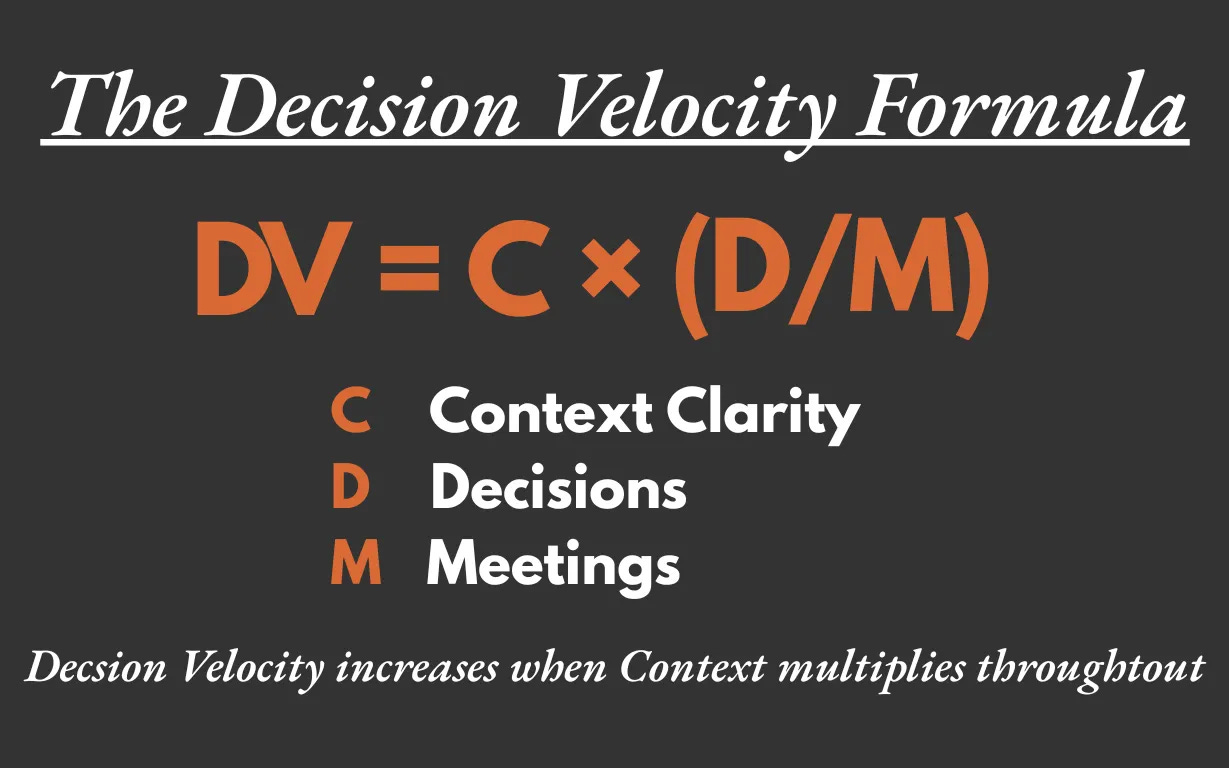
DV = C × (D/M)
C is context clarity: the number of strategic domains where the team shares understanding.
D is total decisions made.
M is total coordination meetings required to make them.
When C is high, decisions happen in hallway conversations. D climbs. M drops. Velocity compounds.
When C is low, velocity collapses. It doesn’t matter how many meetings you hold or how fast you execute. Zero context clarity means zero decision velocity.
Same meeting. Same data. Different output.
Bain & Company confirmed the pattern in 2016: founder-led S&P 500 companies delivered 3.1x higher returns across 24 years. Paul Graham named it Founder Mode. Neither identified the mechanism.
First Mover vs. Prime Mover
Most companies think advantage belongs to whoever ships first. Ship first. Capture demand. Educate the market before anyone else can.
That’s First Mover Advantage. And it’s fragile.
You ship first. Competitors follow. You educate the market; they inherit it. Product-level speed erodes with every cycle.
Electric cars existed before Tesla. Canned water existed before Liquid Death. Neither was first to market. Both were prime movers who reframed the problem. Tesla made electric a performance and status story. Liquid Death made water an identity. The product existed. The frame didn’t.
First movers ship products. Prime Movers define problems.
You don’t move first. You move the frame.
First movers win time. Prime movers win language.
First movers build on demand. Demand is shallow ground. When someone redefines the problem, the demand shifts with the new definition.
Prime movers build on understanding. Each cycle of evangelism drives roots deeper. Every time you name the problem, educate around it, articulate what others haven’t seen, the understanding accumulates. The deeper the roots, the harder you are to displace.
Prime Mover Advantage is structural. You define the problem. You name the new and different. You educate the world until your category definition tips. Until customers use your language to explain their own problem, and competitors have to answer to it.
In an era where AI executes at the speed of prompting, execution speed stops being the advantage. Judgment speed is. AI commoditizes the doing. The prime mover owns the thinking.
And when the definition tips, competitors are forced to operate inside the game you defined. Every competitive response validates the frame. Every alternative reinforces the category.
That’s not competitive advantage. That’s category gravity.
Category owners capture the majority of the economics in their category. Everyone else competes for the remainder. The market has already voted on this. The companies we now call dominant were rarely first to ship. They were first to define what the category meant.
The 3.1x isn’t a one-time win. It comes from owning the definition. Continuously.
Most leaders reading this will agree. Clarity matters. Ownership beats renting. Context is the multiplier.
Agreement is easy. It’s also worthless without the instrument to maintain it.
What Happens When You Move Without It
There are three versions of this collapse.
You may recognize them. All produce the same outcome. One is worse than the others.
You Shipped Into Demand You Didn’t Define
The pattern is predictable.
You hear about an opportunity. You see the demand forming. You build the solution, get it into the market, start iterating with customers. There are challenges — there always are — but you’re working through them. Customers are responding. The trajectory feels right.
Then something shifts.
You don’t see a competitor arrive. What you see is customers going quiet.
Deals that used to close just... don’t. Responsiveness drops. And then you realize: someone came in with a problem definition you dismissed, one you never considered, and the market reorganized around it.
All the work you did, all the iteration, all the traction — built on an assumption about what the problem was. An assumption you never questioned because the demand seemed to confirm it.
You captured demand. You didn’t define the problem.
And when someone else defined it differently, the demand moved with them.
You Scaled Coordination Instead of Context
As headcount grew, shared understanding didn’t.
Founders build context by building the company. Three people in one room, all seeing the same picture. The transformation story lives in shared experience.
None of it is written down. It doesn’t need to be. Everyone was there.
Then new people join who weren’t there for any of it. Teams stop forming around the customer and start forming around functions. And context that made decisions obvious stays trapped with the people who built the thing.
The professional manager’s problem is inheritance. They never received the context. They inherited systems optimized for coordination, not context. The capability is there. The filter isn’t.
Run the Decision Velocity Formula. C stays low because shared understanding was never distributed. D stays low with it. M climbs. More alignment meetings. More stakeholder reviews. More coordination overhead to compensate for clarity that was never built into the system.
The company grows. The context doesn’t.
Every new hire adds coordination cost without adding context clarity.
You Went Quiet — and the Category Became Available
This is the worst version. Because you know what you lost.
The founder had the context. They built it. They lived it. And they had the ability to distribute it.
To document it. To embed it in how the organization thinks. To make it travel beyond the room where it was born.
If that trade-off sounds familiar, think about when it started. You were climbing. Every conversation sharpened the position. Every deal reinforced the category.
Then you won — or won enough.
The sigh of relief. The turn inward. The fires that needed attention, the operations that needed scaling, the team that needed building. You stopped watching the category because the category seemed settled. Revenue was growing. The metrics said everything was working.
But the metrics had shifted without anyone noticing. From traction signals that measured the change you were creating to performance numbers that measured the business you’d already built.
You were optimizing supply. You’d stopped generating demand.
And the category you thought you owned was quietly becoming available.
Redefine or Be Defined
The founder, or the team that inherited the founder’s role, drifts from the customer.
By the time the messaging feels off, the real damage happened months ago.
The price of ownership is an ongoing obligation: keep evangelizing, keep defining the problem, keep educating the market.
When you stop paying, you create a vacuum. And vacuums get filled.
Not by better products. By better problem definitions.
The founder who recognizes this doesn’t try to win the old game.
They define a new one.
A new problem definition. One that reframes what customers actually need, in language that makes the competitor’s pitch sound like what it is: a product claim dressed up as a category.
Prime Mover Advantage is built by defining what comes next. Before someone else does.
You can define the category on stage and still lose it in the hallway. The gap between definition and operation is where most strategies die.
The Strategy Flywheel
Most strategy frameworks follow the same pattern.
Either:
Develop strategy with one set of tools: off-sites, consultants, planning documents.
Hand execution to a completely different set: OKRs, project management software, quarterly scorecards.
Two instruments. Two languages. Two rhythms.
It’s not a communication problem. It’s an instrument problem.
You wouldn’t write a song on piano and then perform it on drums and wonder why it sounds different.
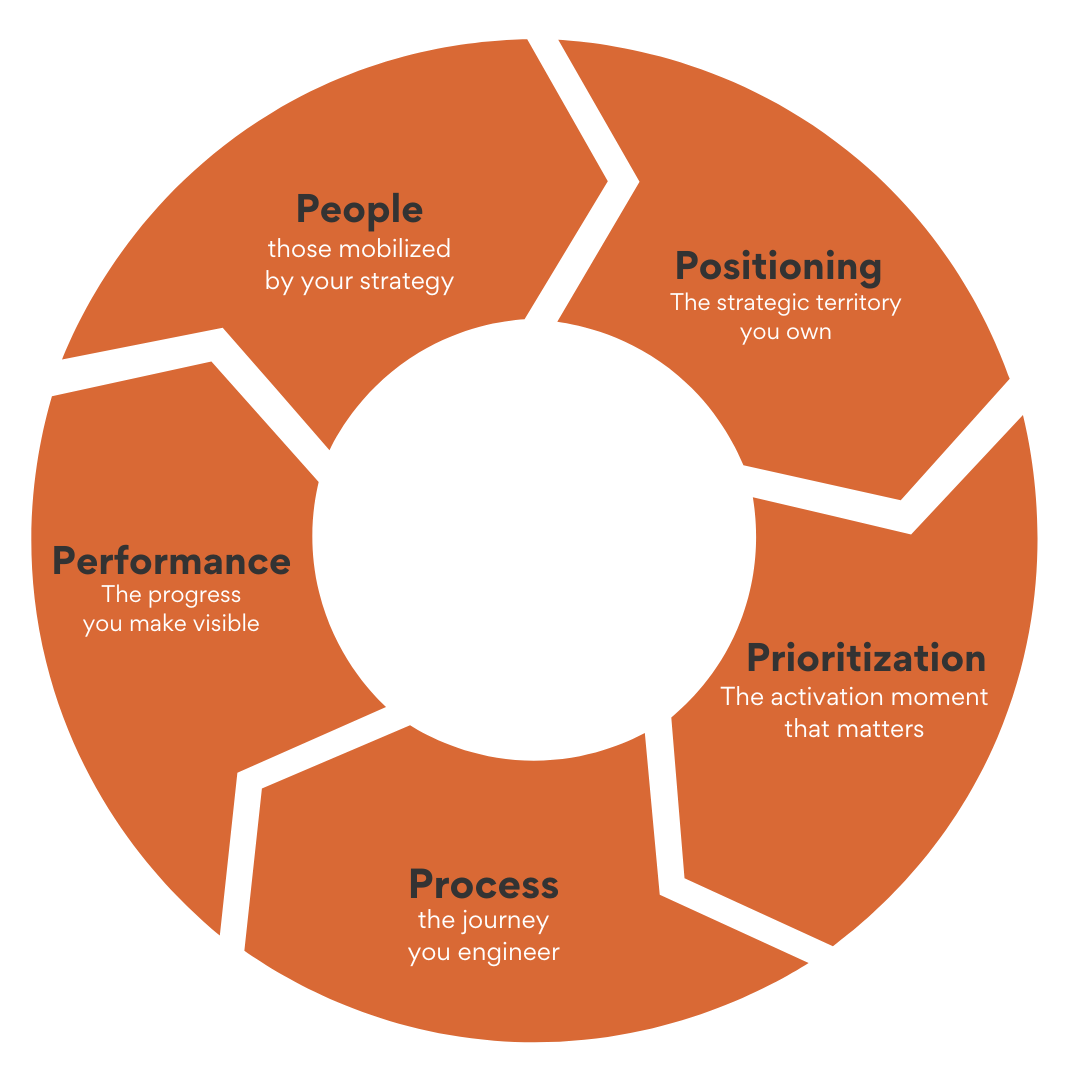
The Strategy Flywheel is one instrument. It runs in both directions. Backward to diagnose where you are. Forward to operate where you’re going. Same five elements. No translation layer. No handoff.
Five Elements, One Sequence
You’ve already watched these elements operate.
The flywheel has five elements. Each one enables the next. Skip one, and everything downstream breaks.
Transformation. What change do your customers seek that only you can deliver? The shift in their reality that they can point to and name. If you can’t articulate that change in language customers use, you’re describing capabilities, not claiming territory.
Signals. How do you know the change is actually happening? Usage metrics and satisfaction scores measure activity. Every competitor tracks those. Signals measure whether your specific transformation is occurring. If a customer had green across every dashboard and still left, you were tracking the wrong change.
Context. What shared understanding enables autonomous decisions? When the team shares transformation context, decisions don’t require alignment meetings. People make aligned choices because they see the same picture. When they don’t share that context, you compensate with coordination: review boards, stakeholder syncs, go-to-market alignment sessions. Thirty hours of meetings because the filter is missing.
Constraint. What’s the one bottleneck that, if resolved, accelerates the transformation fastest? Every system has one constraint that limits throughput. Improving anything else feels productive but doesn’t compound. The flywheel reveals which constraint to attack this quarter. The one that moves the customer’s transformation forward, not the one that feels most urgent internally.
Territory. What do you own as a result? When all four upstream elements are aligned, you don’t compete for a position. You define the category. The market organizes around your definition. Competitors respond to your frame. Every cycle of delivery strengthens the foundation.
Each element answers one question. Together, the five questions form a complete diagnostic:
What do you own at every level of your strategy?
The Ownership Check
Here’s what makes the flywheel diagnostic.
Run the five questions. For each one, ask: What do we own here?
What territory is yours. What a competitor cannot claim because you built it from the transformation out.
If the answer at any element is empty, that’s the diagnosis.
Most teams discover they can describe capabilities at every level. They struggle to name ownership at any of them. Features that any competitor could match. Metrics that any company tracks. Processes that any consultancy could install.
The empty column is clarity. It shows you exactly where to build.
And the check always starts at Signals.
Signals: The Leading Indicator
When a founder drifts from the customer, Signals is where it shows first.
The other elements may look fine. Transformation unchanged on paper. Context still running through the OKR system. Constraint metrics green. Territory numbers holding — for now.
But the human connection to the customer’s transformation is what keeps the flywheel honest. When the CEO drops below 3% customer time, when new hires never hear the transformation story, when the team optimizes dashboards instead of tracking whether customers are actually changing, the flywheel is already drifting. The numbers haven’t caught up.
Harvard research found the average CEO spends 3% of their week with customers. Less than two hours. Less than they spend with consultants.
If context clarity is the multiplier, and the source of that context is the customer’s transformation, 3% explains why the column is empty. Not at one company. Everywhere.
Signals is the canary. When it drifts, every other element starts optimizing for the wrong thing. You measure activity instead of transformation. You prioritize what’s urgent instead of what compounds. You build process around coordination instead of clarity.
By the time the messaging feels off, the real erosion happened months ago. At the Signals level.
The flywheel reveals the instrument. Keeping it in tune is a different discipline.
The Traction Loop
Quarterly reviewers see trends. Weekly practitioners see inflection points.
The founder running a twenty-minute check on Tuesday morning catches a shift that won’t show up in the competitor’s dashboard until the quarterly review. By then, it’s too late to define the response. They’re reacting to a frame someone else already set.
The Traction Loop is the operating rhythm of the flywheel. A weekly check. Twenty minutes. Five questions. Each one tests an element. It starts with Signals and works downstream.
How much time did I spend with customers this week?
Customers living inside the transformation you promised. The ones who can tell you whether the change is real. What did you hear? What changed? Is the transformation actually happening in their reality, or are you measuring proxies for a change you’ve stopped witnessing firsthand?
If Signals is healthy, check downstream. If Signals is drifting, that’s the early warning. Fewer customer conversations. The team optimizing metrics instead of tracking change.
The flywheel tells you which element to tighten this week. Not next quarter.
What Gets Written Down
When you run strategy annually, the output is a document. A deck, a plan, a set of OKRs. The thinking that generated those outputs lives in the room where the offsite happened. Six weeks later, the document exists but the thinking behind it is fading.
When you run the flywheel weekly, the answers accumulate. Each pass captures the current state. What you heard from customers this week. What signals shifted. Where the constraint moved. Written answers survive turnover. Head-carried context walks out the door.
The weekly rhythm IS context distribution. Every check embeds the founder’s thinking into a system the team can see. New hires read the accumulated answers. The transformation story lives in the system, not in one person’s head.
That’s the difference between a framework you have to look up and a mental model that travels. The weekly rhythm builds the mental model. Written answers make it portable.
Each week you run it, you deepen your understanding of the problem, sharpen your articulation, drive roots deeper. Each week you skip, the drift begins. The Traction Loop is more than a diagnostic. It’s the evangelism discipline that keeps ownership alive.
The Ownership Frame
Ownership is binary.
When you ask “how do we differentiate?” you’re already assuming the category. You’re looking for ways to stand out within boundaries someone else defined. The answers are tactical: messaging tweaks, feature comparisons, price adjustments.
When you ask “what do we own?” you’re questioning the category itself. A change your customers can point to. A shift they can name.
You either own the change or you compete in someone else’s category.
The change you create is the position you own.
This is what the flywheel produces when alignment is tight. Transformation, Signals, Context, Constraint, and Territory locked so tightly that competitors are forced to operate inside the game you defined. Every competitive response validates the frame. Every alternative reinforces the category owner’s position.
Flywheel alignment IS ownership. The weekly check IS the audit. And the Ownership Frame is the name for what you see when you look at a flywheel where every element answers the question clearly: what do we own here?
Ownership moves through three states.
Building. Aligning elements one by one, closing gaps. You don’t have Prime Mover Advantage yet. You’re constructing it. Each Traction Loop pass surfaces what’s missing and what’s next.
Cemented. All five elements lock. The alignment is tight enough that the market organizes around your definition. This is Prime Mover Advantage achieved. The moment competitors stop choosing to compete with you and start being forced to.
Drifting. An element weakens. Signals always drifts first. When customer time drops, when new hires inherit coordination instead of clarity, when the team optimizes dashboards instead of tracking transformation, the decay has already started. You just can’t see it yet.
You build it. You cement it. You maintain it. Or you lose it. All through the same instrument.
That’s what earns trust. A system honest about the full cycle. Including how you lose it and how to catch the drift before the market does.
Strategic Power That Survives Shifts
Every company fights two battles: winning customers and owning their position in the customer’s mind.
You can win the first without winning the second. That’s revenue without equity. The transaction is yours. The position isn’t.
When you own your position, activity compounds into equity. Feature advantage erodes faster with every cycle. Ownership advantage compounds.
That’s where strategic power lives. In the definition.
Apple in 1997 was 90 days from bankruptcy. Fourteen product lines. Twenty-five disconnected marketing campaigns. Jobs came back and asked one question: Who is our customer, and what change are they on?
Every decision ran through that answer as a filter. He cut 14 product lines to four. Took the Microsoft partnership. Said no to everything that didn’t advance the change they owned. From the outside, people called it genius. From the inside, it was the filter doing the work.
But Jobs never codified that filter. He carried it personally. It worked while he was in the room. Context that lived in Jobs’s head walked out the door with him.
That’s the difference between maintaining a filter and distributing one. The Traction Loop is the distribution system Jobs never built. Running the flywheel weekly externalizes the filter into a shared record that survives any single person’s departure. The written answers don’t just capture what the founder sees. They teach the organization how to see.
Strategy frameworks tell you what makes advantages durable and what disciplines to practice. None of them answer the question that matters most: Where do you start?
Transformation ownership answers the sequence question. Own the change first. Every discipline you practice and every power you build sequences from that answer.
The question isn’t what power should we build?
It’s what change should we own first?
Every cycle you deliver the promised change strengthens the next.
Every cycle spent competing on someone else’s terms strengthens theirs.
That asymmetry reveals everything.
Your Next Prime Move
Make one prime move today.
Before the strategy sprint. Before the team alignment sessions. Before any work that requires coordination you don’t yet have.
You start with yourself.
Your Perfect Day
When’s the last time you thought about your perfect day?
An ordinary Tuesday. Everything in your life exactly as you wanted it.
What time do you wake up? What’s the first thing you hear? Who’s there? What does the morning feel like before you even open your eyes?
And then: what do you actually do? How does the day unfold? What are you working on? Who are you working with? What happens by the time you go to sleep?
This isn’t fantasy. It should feel possible.
Take five minutes. Write it down — not in your head. On paper or screen where you can see what you chose and what you left out.
If that came easily, you’re warmed up.
But this isn’t just a warm-up. The clarity you build about what mobilizes you becomes the lens for reading what mobilizes your customer.
You can’t see someone else’s transformation until you’ve mapped your own.
Your Customer’s Perfect Day
Now do it again. For your customer.
An ordinary Tuesday in their life after your product has done its work.
What changed? What does their morning look like? What decisions come easier? What friction disappeared? What’s possible for them that wasn’t before?
If this feels harder, that’s the point.
Most leaders can articulate their own day with surprising clarity. The customer’s day gets fuzzy.
The transformation you’re building toward turns vague the moment you try to make it specific.
The change your entire strategy exists to deliver — you can’t put it in a Tuesday.
That gap between your clarity and theirs is the gap your strategy has to close.
If you can’t describe the change in a day-in-the-life, you can’t own it.
The Bridge Between Them
Now the hardest question. How does your product move your customer from their current
Tuesday to the one you just described?
Write it as a cascade. Five sentences. Each one builds on the last. This is the flywheel compressed into a strategic narrative:
“We serve [people] who are trying to [change].”
“We know it’s working when [traction signal].”
“We deliver that change through [mechanism].”
“We protect that position by [investment].”
“We own the territory where [transformation] happens.”
Read them back. In order.
Does each sentence earn the next? Does the fifth sentence feel inevitable after the first four, or does it feel like a leap?
If the cascade flows, you have a strategy that connects.
If it breaks, if sentence three doesn’t actually deliver what sentence two measures, you just found the structural gap your team has been working around.
Here’s what usually happens. Sentences three through five come quickly. The mechanism, the investment, the territory.
That’s the work you’re swimming in every day. The how is loud. But the first two sentences, who you serve and what change they’re actually after, those are the ones that slow you down.
And if they’re vague, everything below them is optimizing execution on an assumption about the customer that may not hold.
That’s the gap you can’t see from inside your own strategy. You’re too close to it. The how feels solid because it’s what you touch every day. The who and the why sit underneath, quietly shaping everything. They’re the hardest to pressure-test alone.
Notice what just happened. The sentences that slowed you down are the ones that determine whether you own territory or rent it.
Shallow understanding produces problem statements anyone could claim. Deep understanding produces names that stake territory. Because they capture what others haven’t named.
Your customers already carry this story in three parts. Where they were before, what shifted, and what they’d never go back to. Extracting it is its own discipline.
Use this AI prompt:
I’m going to share five sentences that describe my company’s strategy as a cascade. They follow this sequence: who we serve and what change they’re after → how we know it’s working → how we deliver that change → how we protect that position → what territory we own.

Each sentence should earn the next. Sentence 2 should measure what Sentence 1 promises. Sentence 3 should deliver what Sentence 2 tracks. Sentence 4 should protect what Sentence 3 builds. Sentence 5 should name the territory that Sentences 1-4 make ownable.

Tell me where the chain breaks — where one sentence doesn’t earn the next. Be specific about which connection fails and why. If the chain holds, say so — not every cascade is broken, and I’d rather know it’s solid than have you manufacture a problem.Paste your five sentences. Let the tool pressure-test the connections. Then rewrite the sentence that breaks.
The cascade is the flywheel in five lines. If it holds, your strategy travels without you in the room. If it doesn’t, you know exactly where to dig.
The Perfect Day is how you start. The Traction Loop is how you maintain it. The cascade is how you test whether the two connect.
Do this tonight. Start with your day. Then your customer’s day. Then the bridge between them.
The less clarity you have on Layer Three, the more you need the flywheel. And the more you’ll return to this exercise as your understanding deepens.
The Flywheel gives structure. The Traction Loop gives rhythm. Ownership gives direction. Clarity gives velocity.
That’s flywheel thinking. You get faster as you get clearer.
Keep renting. Or build something you own.
Start with your day. Then change your calendar.