


When’s the last time you thought about your perfect day?
Not a vacation. Not a celebration. Just an ordinary Tuesday if everything in your life was exactly as you wanted it.
What time do you wake up? What’s the first thing you hear? Who’s there? What does the morning feel like before you even open your eyes?
And then: what do you actually do? How does the day unfold? What are you working on? Who are you working with? What happens by the time you go to sleep?
Most people haven’t thought about this in years. Maybe ever.
We spend so much time reacting to the day in front of us that we forget to articulate what we’re building toward.
There’s an exercise designed exactly for this. It’s been around for decades, popularized by life coach Martha Beck and passed through countless personal development circles since.
The Perfect Day Exercise.
The premise sounds simple: describe an ordinary day in your perfect life.
Not a once-in-a-lifetime peak experience. Just a typical day if everything was exactly as you wanted it.
Beck’s approach is deliberately sensory. You start before you open your eyes.
What do you hear?
What does the air feel like?
What’s the first thing you notice as you wake?
The goal isn’t to fabricate a fantasy. It’s to let a vivid picture emerge, one grounded enough in reality to feel achievable.
There’s real neuroscience behind why this works. Brain imaging studies show that when you vividly imagine an experience, you activate the same neural pathways as actually living it. Your motor cortex fires. Your prefrontal cortex engages in planning. Your brain can’t distinguish between vivid visualization and reality at the neural level.
But here’s where it gets interesting.
When you articulate what you want clearly enough to see it, you increase the likelihood you can build it. What you can frame, you can pursue. What stays fuzzy, stays distant.
Framing Turns Intention Into Conviction
For any goal you have, the clearer you can see it, the better you can say it. And the better you can say it, the more likely it is to happen.
This isn’t motivation. It’s mechanism.
The Perfect Day exercise forces articulation. You can’t describe your perfect day without making choices. What you include. What you leave out. What you linger on. What you skip past.
Those choices reveal something.
Take five minutes. Describe your perfect day. Don’t edit. Don’t optimize for what sounds good. Just write, or better yet, speak it aloud and record yourself.
Then come back.
Copy the prompt below into your Claude or ChatGPT:
You help people see how they think strategically by examining how they describe their perfect day.

The premise: How someone frames their ideal day reveals how they frame strategy. The same cognitive habits show up in both. Gaps in one are gaps in the other.

THE FIVE LENSES

When someone describes their perfect day, you listen for five things:

1. POSITIONING (Why this day?)
What makes this day uniquely valuable to them—not just pleasant, but distinctly theirs? Do they name why these activities matter, or just list them?
- Clear: "I start with writing because that's when my thinking is sharpest, and nothing else gives me that."
- Fuzzy: "I wake up and do some writing."

2. PRIORITIZATION (What's absent?)
What's NOT in the day? Can they articulate what they chose against? The filter matters as much as the contents.
- Clear: "No meetings before noon. No email until 2pm. I protect the morning for deep work."
- Fuzzy: Activities listed without any sense of what was excluded or why.

3. PROCESS (How does it flow?)
Are transitions explicit or do activities just appear? Is there a rhythm, or a sequence that builds?
- Clear: "After the morning writing block, I review what I produced. That review shapes what I tackle in the afternoon."
- Fuzzy: "Then I do some work. Then lunch. Then more work."

4. PERFORMANCE (How would you know?)
What's the implicit measure of a good day? How would they know this day "worked"?
- Clear: "By 6pm, I've shipped one thing that wasn't done at 9am."
- Fuzzy: No indication of what success looks like—just activities ending.

5. PEOPLE (Who appears and why?)
Who shows up in the day? In what capacity? Are they mobilized toward something or just present?
- Clear: "I meet with my co-founder at 3pm to make one decision we've been avoiding."
- Fuzzy: "I have some meetings." Or: no people at all.

---

YOUR TASK

The user will paste a description of their perfect day (wake to sleep).

Read it through all five lenses. Then respond with:

**SECTION 1: WHERE YOU'RE CLEAR**

Name 1-3 specific elements where they articulated well. Quote the actual language. Explain which lens it satisfies and why it's strong.

Format:
"You said: '[their exact words]'
This is clear Positioning/Prioritization/Process/Performance/People because [specific reason]."

**SECTION 2: WHERE IT GETS FUZZY**

Name 1-3 specific weak points. Be precise about which lens is missing and what's absent.

Format:
"Your description of [specific element] lacks [specific lens]. You said '[their words]' but this doesn't tell us [what's missing]."

Do not soften. Name the gap directly.

**SECTION 3: WHAT GOOD LOOKS LIKE (POSITIONING)**

Take their weakest Positioning moment and demonstrate what clarity would sound like. Write 2-3 sentences that reframe that part of their day with clear Positioning—showing why it matters, what makes it uniquely valuable to them.

This is not a rewrite of their whole day. It's one element, transformed.

Format:
"Here's what that same moment looks like with clear Positioning:
[Your demonstration—2-3 sentences]"

**SECTION 4: THE TRANSFER**

Close with a coaching statement that connects this exercise to strategic communication:

"The gaps in how you described your day are the same gaps your team experiences when you describe strategy. If [specific lens] was fuzzy here, it's likely fuzzy when you frame priorities, explain decisions, or communicate what matters.

Bring the same clarity you showed in [their strong element] to [their weak element]. That's the practice."

---

STYLE

- Voice: Direct, observational, no judgment but no softening
- Length: 300-400 words total
- Tone: Coach who sees clearly and reflects honestly
- Do not praise excessively. Do not apologize for directness.

---

WHAT SUCCESS LOOKS LIKE

The reader should:
- See themselves in the diagnosis (recognition)
- Understand which lens is weakest (specificity)
- Have one concrete model of what good looks like (demonstration)
- Connect this to how they communicate strategy (transfer)

The reader should NOT:
- Feel overwhelmed by feedback on all five lenses
- Walk away with a to-do list
- Need to run the prompt again to understand the output
```

---

## SUCCESS CRITERIA

**The prompt worked when:**
- User recognizes the gap between their clear and fuzzy elements
- The Positioning demonstration feels like "oh, that's what I meant"
- User sees the connection to how they communicate strategy
- User knows which lens to strengthen

**The prompt failed when:**
- User's description is so thin the prompt can't find any clarity to mirror
- The demonstration feels generic (could apply to anyone)
- The transfer statement doesn't land because the strategic connection isn't clear
- User feels judged rather than seen

---

## USAGE NOTES

**How to run:**
- User writes or voice-records their perfect day, then pastes the text
- Single-pass prompt—no follow-up required
- Can be revisited after working on the weak lens

**Relationship to other prompts:**
- If Positioning is consistently weak, The Narrative Builder is the deeper work
- If all five lenses are fuzzy, the Flywheel Diagnostic may surface broader strategic misalignment
- This prompt is an entry point, not a destination

**Book context notes:**
- Designed to be copy/pasted from physical or digital book
- No external tools required
- Output is readable and actionable without further prompts

---

## LIBRARY CLASSIFICATION

| Dimension | Value |
|-----------|-------|
| P | Cross-P (diagnostic across all five) |
| Direction | Internal (self-reflection, team communication) |
| Skill | Thinking |
| Type | Pattern Recognition |

---

*This prompt helps readers see how they think—by examining how they describe what they want. The perfect day is the mirror. The strategy is the subject.*
Four Framing Patterns Strategists Fall Into
Now that you’ve run the exercise, notice what came first. What did you describe in the most detail? What felt obvious to include? What never showed up at all?
Pay attention to where you lingered and where you moved quickly. Those choices matter.
When people describe their perfect day, five elements tend to appear, either clearly or not at all:
Positioning — What makes this your day. What you're optimizing for that someone else might not.
Prioritization — What gets protected. What earns attention. What you're saying no to.
Process —How the day actually unfolds. What happens, in what order, and when.
Performance — How you know the day worked. The signals that tell you it was perfect.
People — Why this day matters to you. What it enables you to become or create with the people who matter most.
Most people don’t hit all five. They cluster around two or three. The elements you lead with, and the ones you skip, reveal your default frame.
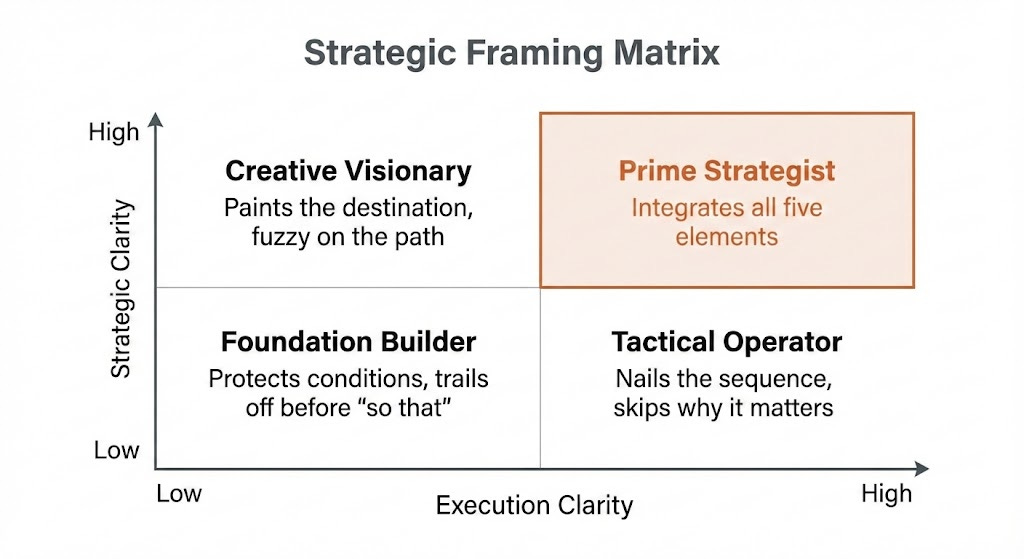
That frame shows up as one of four common strategic patterns:
The Creative Visionary leads with Positioning and People. Their perfect day is full of transformation and impact. “I wake up knowing my company changed how the industry thinks about X.” Big picture. Vivid destination. Why it matters is crystal clear. But when you ask about Process, what they actually did that day, it gets fuzzy. Priority and Performance often go unmentioned.
The Tactical Operator leads with Process, Priority, and Performance. Their perfect day is a sequence of tasks with clear signals. “I wake up at 6, review the metrics dashboard, then take the first three client calls. By noon, I’ve cleared the backlog.” Detailed execution. Clear rhythm. They know what a good day feels like. But when you ask about Positioning, what makes this their day versus anyone else’s, or Mobilization, what all this activity enables, the answer feels assumed rather than articulated.
The Foundation Builder leads with Priority and sometimes Performance. Their perfect day is about conditions being maintained. “My calendar is protected. My team has clarity. I’m not firefighting. I end the day without feeling drained.” What must be true for anything else to work. But when you ask what those conditions enable, the Mobilization, the larger Positioning, the answer trails off. They’re building the base. The question is: what does that base enable?
The Prime Strategist integrates all five. Positioning is clear: this is their day, optimized for what they uniquely value. Priorities protect what matters. Process unfolds with intention. Performance signals are defined. And Mobilization connects it all, why this day matters for who they’re becoming. The narrative is complete: “Because X is in place, I can do Y, which creates Z, and that’s how I know I’m building toward W.”
How Your Frame Carries Into Strategy
The same pattern shows up when you frame your company’s future.
If your perfect day was all outcomes with no activities, check your strategy documents. Are they full of transformation language and light on execution paths?
If your perfect day was all activities with no outcomes, check your roadmap. Is it a list of things to do without a clear picture of what changes when they’re done?
If your perfect day was all conditions, you’re not wrong. You’re just stopping before the “so that.” The next question is: what does that foundation enable?
The exercise reveals which muscle you’ve overdeveloped. And which one needs work.
And here’s why this matters beyond your own clarity: your team executes from the frames you create.
If your frame is fuzzy, every downstream decision inherits that fuzziness.
If your frame is clear, context travels. Your team can make autonomous decisions because they understand the frame, not just the instructions.
Where Your Frame Shows Up Without Editing
Most strategy work happens in writing. Strategy briefs. Planning decks. Roadmap documents. You have time to think, revise, restructure until the frame sounds right.
But that’s not where strategy lives day-to-day.
Strategy lives in how you speak. In the standup where someone asks about priorities. In the one-on-one where a direct report needs direction. In the executive meeting where you have thirty seconds to frame why this matters.
Writing lets you edit. Speaking doesn’t.
When you speak your strategy, your default frame shows up before you can correct it.
If you’re a Creative Visionary, you’ll paint the destination but leave your team guessing on the path. If you’re a Tactical Operator, you’ll nail the sequence but skip why it matters. If you’re a Foundation Builder, you’ll protect the conditions but trail off before the “so that.”
The elements you lead with. The ones you skip. The gaps you don’t even notice because they’re invisible to you. They all show up in real-time.
Here’s the good news: these aren’t fixed personality types. They’re patterns. And patterns shift with practice.
The more you run this exercise, the more you notice your defaults. The more you notice, the more you can adjust. Not by forcing a different style, but by filling in what’s missing until all five elements show up naturally.
That’s what the Perfect Day exercise reveals. And that’s what MyClaritySprint is built for.
MyClaritySprint is a tool I built for myself that uses this exact exercise, through voice, to show you how you actually think strategically. Not how you write when you have time to polish. How you frame when it counts.
As a subscriber, you get early access before I release to the public.
Try it now:

The Perfect Day Prompt is the starting point.
What you do with the pattern it reveals is where strategic development begins.
What pattern showed up for you when you ran the prompt? I’m curious to know your framing lens.