

Why your best thinking stays buried
You’re in the shower and it hits you.
Not a small thought. A real one. The kind that finally connects two things you’ve been circling for weeks.
By the time you’re toweling off, half of it is gone. So you grab your phone, record ninety seconds, and move on.
A few days later, you hit play.
A version of you is talking fast, mid-thought, referencing something you no longer remember. The note is a fragment of a fragment. What felt clear now sounds like someone trying to describe a dream.
This isn’t an idea problem. It’s a survival problem.
Your best thinking shows up in places that can’t hold it: showers, walks, the three minutes between meetings, the drive home when something someone said finally clicks. You catch it in a voice note or a half sentence in your phone and tell yourself you’ll come back.
But capture alone doesn’t give you anything you can return to. A voice note is a breadcrumb. The context that made it make sense stays behind: your mood, the conversation you just left, the connection your brain was making. None of that travels.
So you end up with a pile of recordings and notes that still might matter, but feel expensive to dig up. Replay. Rebuild the situation. Guess what you meant. Most of them just sit there.
And then there’s the journal. Your deepest thinking often lives there, not in clean paragraphs, but in the layout of ideas across a page. It has the same problem: the distance between the notebook on your desk and something you can ship to other people feels huge.
Raw material is everywhere. A way to turn it into something usable, while it’s still warm, is missing.
There’s a short window right after an idea shows up where it still has heat.
You still remember what sparked it. You can still explain the leap you just made. You can still name what it connects to.
Five minutes later, that clarity starts to drain. You’re left with the headline, not the reason it mattered.
Most people respond the same way: capture the fragment and move on. Voice note. Quick text. A line in Notes that says “REVISIT” with no other context.
It feels responsible. It’s also how the pile grows.
Because the failure isn’t the lack of capture. The failure is what happens next—nothing. No friction. No check for what’s missing. No way to come back without rebuilding the moment from scratch.
That’s what the next three mistakes have in common.
Three mistakes that keep the idea pile full
Mistake 1: Scheduling ideation
Blocking ninety minutes on Tuesday to “generate ideas” sounds responsible.
It also pushes your brain into a mode that rarely makes the good stuff. Your best ideas didn’t arrive in a calendar block. They arrived during loose, associative moments. When you force them on a schedule, you mostly get safe, obvious output.
Mistake 2: Half capturing
You record the thought, give it just enough shape to feel saved, and promise yourself you’ll test it later.
But later usually means you, alone, staring at your own idea. The feeling that it’s strong becomes a substitute for proof. Capture without testing is organized forgetting.
Mistake 3: Testing by yourself
Even when you do test, you often test alone.
You run the idea through the same lens that produced it. The blind spots in that lens are the ones that survive into the published piece.
The ideation flywheel: turn insights into workable ideas
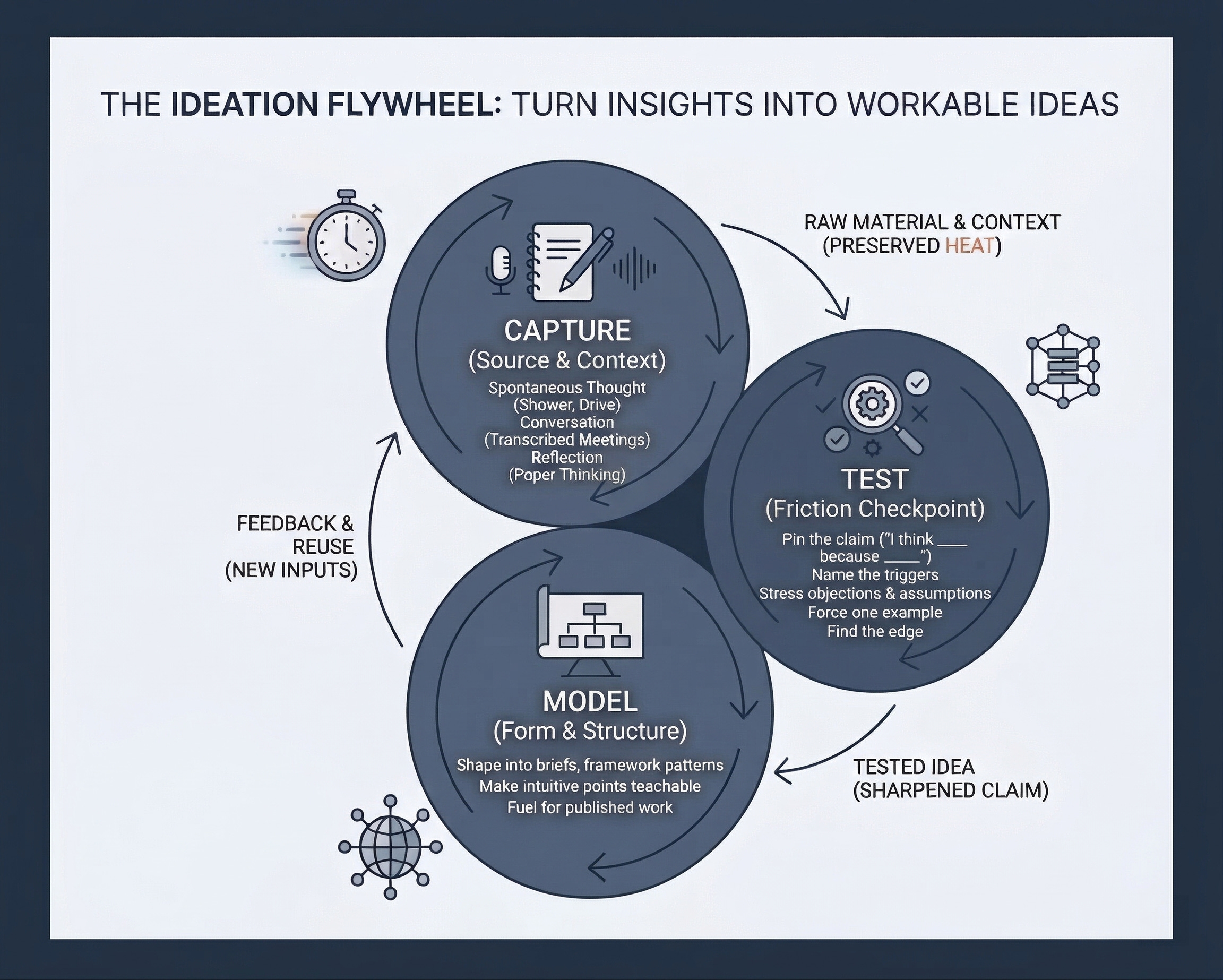
Here’s a loop that makes your thinking compound instead of evaporate:
Capture. Test. Model.
Capture, while the context is alive
The raw material comes from three places:
Spontaneous thought. The shower moment. The click between meetings. The drive-home connection.
Conversation you’re already in. Meetings and calls, recorded, transcribed, and searchable.
Deliberate reflection. Journaling and paper thinking, where you finally see the real answer after sitting with a question.
Each source gives you fragments. The loop turns fragments into something you can build on.
Test, while the thought is still fresh
Most people skip this step because it feels like extra work.
It isn’t. It’s five minutes that saves your idea.
The goal is not to “make it better.” The goal is to drag the real point out of the fog while you can still see it.
Here’s a script you can run in five minutes.
Step 1: Pin the claim (30 seconds)
Write one sentence:
“I think ____ because ____.”
If you can’t finish that sentence, you don’t have an idea yet. You have a vibe.
Step 2: Name the trigger (30 seconds)
Answer:
“What exactly set this off?”
A line from a meeting. A graph. A mistake you keep seeing. A weird example that stuck.
This is the context you lose first.
Step 3: Stress it (2 minutes)
Ask three questions:
“What would make this false?”
“What’s the obvious objection?”
“Where am I smuggling in an assumption?”
Write the answers in plain language. No defending. Just list the weak spots.
Step 4: Force one example (1 minute)
Answer:
“What happened in real life that proves this?”
If you can’t name one concrete moment, it’s still too abstract to survive.
Step 5: Find the edge (1 minute)
Answer:
“What’s my angle that isn’t already everywhere?”
Not “it’s important.” Not “it matters.”
The angle is a specific claim, tied to your work, your experience, your pattern recognition.
That’s the checkpoint.
When you come back tomorrow, you don’t need to reconstruct anything. You pick up from:
the one-sentence claim
the trigger
the objections
the example
your angle
That’s enough to write.
A tool can help here, but only if you use it like a sparring partner.
You’re not asking it to produce a finished draft. You’re asking it to push back fast.
Paste your one-sentence claim and say:
“Argue against this. Give me the strongest objection. Then tell me what evidence would change your mind.”
Or:
“Ask me ten questions until this stops being fuzzy.”
Or:
“Assume I’m wrong. What am I missing?”
The point is simple: you want friction while the idea is still alive.
Model, into something you can reuse
After testing, shape the idea into a form someone else can receive: a brief, a post, a framework, a protocol.
Not polished. Just legible.
Two examples
A shower thought becomes an argument
Raw fragment
“Batman = career.”
That’s what a voice note would have captured.
Five-minute test
Claim:
“I think career resilience looks like Batman because he builds power without backup.”
Trigger:
“I keep watching careers get reset by things people don’t control: new leaders, reshuffles, priorities changing overnight.”
Stress:
Objection: “Batman is a billionaire with gadgets. That’s the opposite of ‘from zero.’”
Assumption: “I’m assuming resilience comes from skills, not from position or network.”
What would make it false: “If the real driver is access—money, connections—then the Batman frame collapses.”
Example:
“A project you owned gets shelved. A new leader arrives. The old plan is dead. You still need to land on your feet.”
Edge:
“It’s not about ‘saving up.’ It’s about building a core set of capabilities you can carry into any room: thinking clearly, planning, learning fast, staying useful when the map changes.”
Modeled output
Batman isn’t interesting here because he wins fights.
He’s interesting because nobody is coming.
No powers. No rescue. No promised path.
So he builds what he can control: skill, judgment, preparation, range.
That’s the part that transfers to work.
Career resets happen. Leaders change. Work gets shelved. Teams get rearranged.
If your value is tied to one role, one boss, one system, a reset wipes you.
If your value is tied to what you can do anywhere—how you think, how you learn, how you build—you survive the reset.
A meeting becomes a teachable protocol
Raw fragment
“I spoke for four minutes in a thirty-minute call. They said it changed everything. Why?”
Five-minute test
Claim:
“I think the value came from how I redirected their attention, not from how much I talked.”
Trigger:
“They wanted to be seen as ‘more strategic,’ but every sentence they said was about tasks, not choices.”
Stress:
Objection: “Maybe they just needed validation.”
Assumption: “I’m assuming ‘strategy’ is mainly about framing decisions.”
What would make it false: “If they changed because of specific advice I gave, not because of a pattern I used.”
Example:
“They described ten problems. I ignored nine and asked one question that forced them to pick a lever.”
Edge:
“The move wasn’t advice. It was a repeatable sequence: detect the real goal, name the tradeoff, force a choice, tie it to how the org measures value.”
Modeled output
Here’s why four minutes can carry a thirty-minute call.
Most of the work isn’t talking. It’s listening for the lever.
A simple sequence:
Ask for the real goal in one sentence.
Name the tradeoff they’re avoiding.
Force a choice: “If you can only do one, which one wins?”
Tie that choice to how their org rewards people.
That’s not charisma. It’s a pattern.
Once you see the pattern, you can teach it. Once you can teach it, it stops living only inside your intuition.
Your first rotation: from fragment to workable idea
Pick one idea you already have.
Not the perfect one. The one that still nags at you when you scroll past it.
Open a voice note from your pile or a page from your notebook.
Then run the five-minute test once.
Write the one-sentence claim. Name the trigger. List the strongest objection. Force one real example. Find your angle.
At the end, you should have a checkpoint you can read tomorrow without cringing.
Do that once and you’ll feel the difference.
Not “I have content.”
“I know what I’m saying.”
That’s the whole point. The framework doesn’t write for you.
It keeps your thinking from dying on the way to the page.
This is part two of the Flywheel thinking series. Click here to read part one — The Insight Flywheel