

Nothing breaks on paper.
That’s why the deck looked right.
The narrative was clean. The leadership team was aligned. The budget was ready to move.
Then execution started, and something didn’t hold.
A dependency nobody named.
A phase that required a decision nobody had made.
A team that understood the direction but couldn’t see what Monday morning required.
So you went back to the deck.
Still looked right.
That was the problem.
The deck did exactly what it was designed to do. It organized the thinking, and made the strategy presentable enough to move resources.
Presentable is not the same as testable.
A testable deck would model the assumptions underneath the sequence: what phase one makes possible, what decision has to happen before phase two, what old work gets displaced, what friction will appear, and what proof tells you the strategy is moving.
Put all of that on one slide, and the slide gets too busy.
Spread it across the deck, and the slide count doubles.
The format quietly removes the very things execution later needs.
A screenplay works differently.
Scene two exists because scene one changed something. The screenplay tracks who has to move, what gets displaced, where friction appears, which decisions unlock the next move, and how you know the strategy is operating instead of just agreed with.
Each scene has to earn the next one. Remove any of that, and the narrative collapses before it reaches the audience.
Strategy needs the same discipline.
What a Strategy Screenplay Is
A strategy screenplay is a one-page script that tests whether your strategy can move a customer from problem to outcome.
A screenplay only matters if it moves its audience.
That is why studios pay for book rights. A book that has already moved its readers gives the studio evidence that the story can move an audience. The screenplay then tests whether that movement can survive a new form: scenes, actors, sequence, budget, and attention.
Strategy works the same way.
Your customer is the audience. Before the budget moves, something has to demonstrate that the customer will. If the customer does not move, the rest is production notes.
You do not need film school or years in Hollywood to write one. If you have ever planned what you would open with and how you would land the point, you have already written a screenplay.
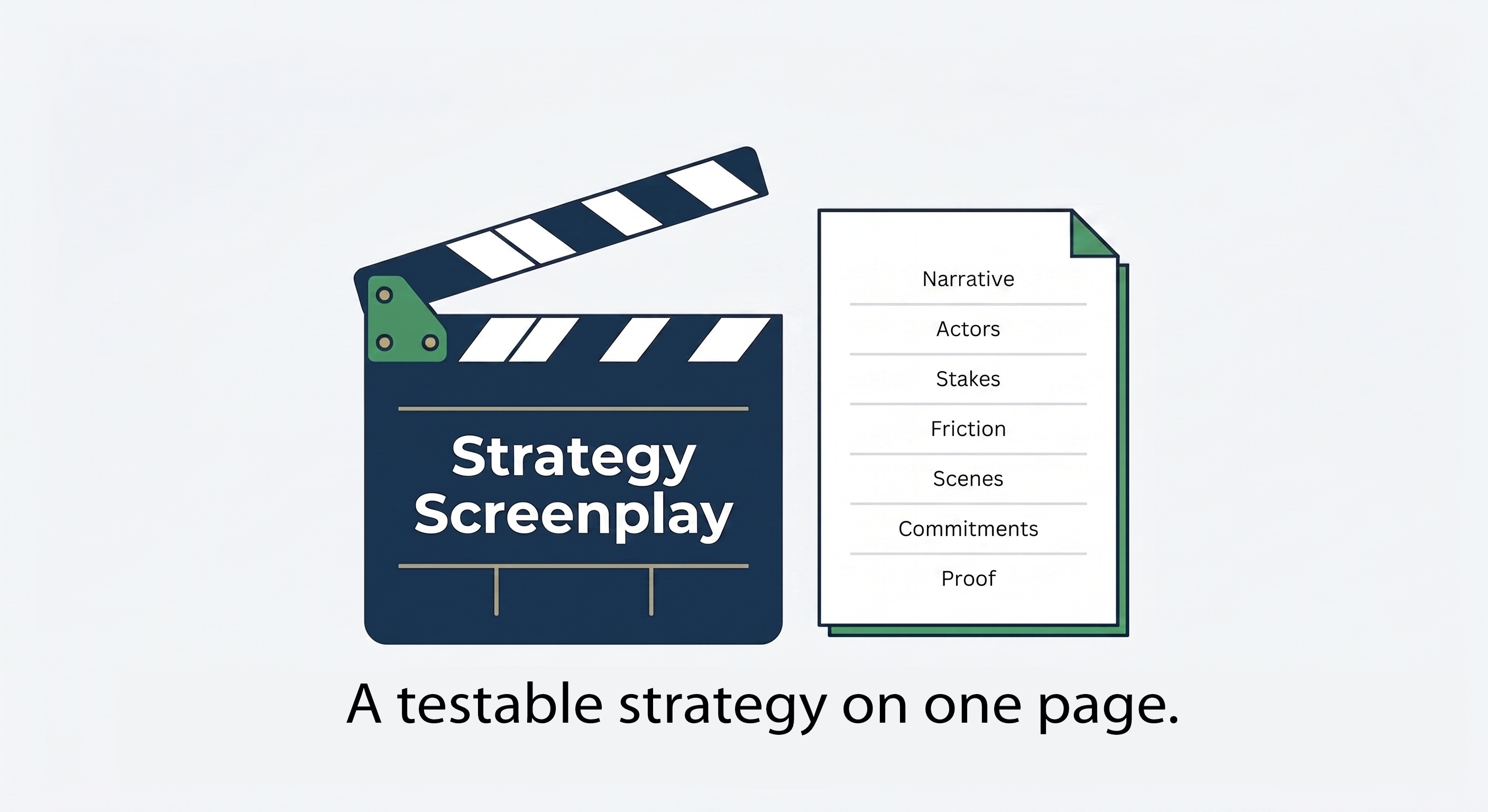
Seven elements go on the page:
The strategic narrative
The actors who have to move
The stakes if nothing changes
The friction the strategy must survive
The scenes where strategy becomes real
The commitments each scene must produce
The proof that strategy is moving
You build the screenplay backwards.
Start with the strategic narrative as a working question. Fill in the elements underneath it. Then return to the top and rewrite the narrative as a declaration.
The first draft is a hypothesis. The final version is a commitment.
To show how it works, we’ll use JudeFlow, a fictional healthcare workflow platform.
JudeFlow built its first business as a transitions-of-care point solution. Now it is repositioning around a larger category: Longitudinal Care Operations, the operational layer for healthcare organizations managing complex patients across conditions, teams, and time.
Each element below shows one part of JudeFlow’s screenplay.
By the end, you’ll be ready to write your own.
The screenplay starts as one page with seven empty slots. Each one is filled in as a draft, then revised once the others are in place.
Start with the strategic narrative
The strategic narrative sits at the top of the page.
It compresses the whole move into a sentence the team can carry, the buyer can sponsor, and a new hire can understand.
When the narrative is right, every other element on the page proves it. When the narrative is wrong, the rest of the screenplay exposes the contradiction.
The strategic narrative carries the pressure of the strategy in a single sentence. It has to do four things at once:
Name the category you are claiming
Name the customer you are claiming it for
Name the strategic move that gets you there
Name the constraint the move has to honor
If one is missing, you have not committed yet. You are still exploring.
The first version you write as a question. The question lets you test the move before you pretend it is true. After the rest of the screenplay is filled in, you return to the top and rewrite it as a declaration.
Draft your strategic narrative as a working question. Do not try to write the final version yet. The other elements will tell you what the declaration needs to say.
For JudeFlow, the strategic narrative starts as:
How does JudeFlow become a longitudinal care platform?
The draft is missing three of the four. No category, no customer, no constraint. Just a question about a move. We will come back to it.
JudeFlow Strategy Screenplay

Strategic narrative:
How does JudeFlow become a longitudinal care platform?

Actors: TBD
Stakes: TBD
Friction: TBD
Scenes: TBD
Commitments: TBD
Proof: TBD
Name the actors that have to move
Your strategy does not happen unless specific people change what they do.
An actor is a role with two distinct states:
current default state
a required behavior shift
If you cannot describe the default each person has to move off of, you have not named the actors yet.
A list of names with titles is the org chart with new vocabulary on top.
List three to five actors. Name the current default state and the required shift for each.
For JudeFlow, four actors matter first:
Chief Revenue Officer: Currently runs a point-solution sales motion through VP of Care Management buyers. Must build a platform sales motion that requires multi-stakeholder discovery and longer cycles.
Chief Product Officer: Currently ships features in 90-day cycles based on customer councils dominated by transitions-of-care users. Must commit to an 18-month longitudinal data architecture that point-solution customers will not directly benefit from for a year.
Chief Clinical Officer: Currently positions JudeFlow as best-in-class for transitions-of-care clinical communication. Must build and publicly defend the Longitudinal Care Operations thesis in rooms where the audience may be skeptical of category creation.
VP of Customer Success: Currently runs one customer tier and one expansion playbook. Must build a platform-tier expansion motion without disrupting the point-solution renewal rhythm.
JudeFlow Strategy Screenplay

Strategic narrative:
How does JudeFlow become a longitudinal care platform?

Actors:
CRO · CPO · CCO · VP CS
(each with current default and required shift)

Stakes: TBD
Friction: TBD
Scenes: TBD
Commitments: TBD
Proof: TBD
Name the stakes if nothing changes
Stakes describe where the company ends up if the customer does not move.
Strong stakes name three things:
the outcome
the timeline
the structural cause
If you cannot describe the failure with the same specificity you would use to describe success, the stakes are not clear yet.
“We lose market share” is not a stakes line. Market share is what you check after the customer has already chosen someone else.
Write the stakes as a specific, observable failure state. Name the outcome, the timeline, and the structural cause.
For JudeFlow, the stakes:
If we do not make this move, we plateau at $180–220M ARR by 2028.
The transitions-of-care category compresses by 30–40% as expanded care management modules push down-market and aggressive point-solution competitors crowd the space.
JudeFlow becomes an acquisition target at 4–6x ARR: a feature inside a larger health-tech platform someone else builds.
The category will form either way. The question is whether JudeFlow names it or becomes a feature inside the company that does.
JudeFlow Strategy Screenplay

Strategic narrative:
How does JudeFlow become a longitudinal care platform?

Actors:
CRO · CPO · CCO · VP CS
(each with current default and required shift)

Stakes:
Plateau at $180–220M ARR by 2028
Acquisition target at 4–6x ARR
Category forms with or without us

Friction:TBD
Scenes: TBD
Commitments: TBD
Proof: TBD
Name the friction the strategy must survive
Friction describes what inside the company has to give before the customer can move.
Strong friction names three things:
the person, system, or incentive in the way
what is protecting it
why the strategy threatens it
Until you can name a person who would push back specifically and what they stand to lose, the friction isn’t clear.
“Execution risk” is not friction. Real friction sounds like something someone is protecting.
Write the friction as specific constraints inside the company that will push back on the move. Name what is protected, who is protecting it, and what the strategy asks them to give up.
For JudeFlow, the friction:
The Customer Council is dominated by transitions-of-care buyers who shaped the last three product cycles. They will resist longitudinal roadmap commitments that do not immediately help them.
Sales comp rewards point-solution ACV; the platform sale takes 9–14 months across multiple stakeholders. Top-performing AEs are point-solution specialists who have not sold to Population Health buyers before.
Two of the top five customers by ARR are smaller health systems without significant Medicare Advantage exposure. The longitudinal value prop will not resonate. They will read the repositioning as deprioritization.
The Chief Clinical Officer’s reputation was built on transitions-of-care thought leadership. The platform pivot requires her to publicly defend a longitudinal care thesis that some clinical peers may read as overreach.
JudeFlow Strategy Screenplay

Strategic narrative:
How does JudeFlow become a longitudinal care platform?

Actors:
CRO · CPO · CCO · VP CS
(each with current default and required shift)

Stakes:
Plateau at $180–220M ARR by 2028
Acquisition target at 4–6x ARR
Category forms with or without us

Friction:
Customer Council weighting
Sales comp + AE skill gap
Two non-MA top accounts
CCO clinical reputation risk

Scenes: TBD
Commitments: TBD
Proof: TBD
Name the scenes where strategy becomes real
A scene is a recurring decision moment where the customer’s understanding either moves or does not.
Strong scenes make three things clear:
the room
the participants
the decision being made
A scene without a decision is just a meeting.
“QBR” is not a scene. It is a label. The scene is what gets decided inside it.
Write three to five scenes. Name the room, the people in it, and the decision the room is resolving. These are the conversations where strategy either holds or breaks.
For JudeFlow, five scenes matter:
Customer Council meetings where transitions-of-care feature requests compete with longitudinal platform commitments.
Inbound qualification calls where the lead is a VP of Care Management at a small health system asking for the point solution JudeFlow used to lead with.
Discovery and pricing negotiations with large MA-heavy health systems where the buyer is now Care Management, Population Health, and the CFO, and the deal requires platform-tier commercial terms.
Quarterly business reviews with point-solution customers deciding whether the longitudinal roadmap expands their use case or leaves them behind.
Industry conferences and analyst briefings where the Chief Clinical Officer must articulate the Longitudinal Care Operations thesis to audiences skeptical of new categories.
JudeFlow Strategy Screenplay

Strategic narrative:
How does JudeFlow become a longitudinal care platform?

Actors:
CRO · CPO · CCO · VP CS
(each with current default and required shift)

Stakes:
Plateau at $180–220M ARR by 2028;
Acquisition target at 4–6x ARR;
Category forms with or without us

Friction:
Customer Council weighting
Sales comp + AE skill gap
Two non-MA top accounts
CCO clinical reputation risk

Scenes:
Customer Council
Inbound qualification
Platform-tier negotiation
QBRs
Conferences and analyst briefings

Commitments: TBD
Proof: TBD
Name the commitments each scene must produce
A commitment is what an actor agrees to deliver when the scene arrives.
Strong commitments make three things clear:
the actor
the deliverable
the constraint
Every commitment names a behavior change tied to a specific scene. Anything that doesn’t is just intention.
“We will align,” “we will prioritize,” “we will focus” are not commitments.
They are intentions without behavior.
Write the commitments as specific actions delivered by actors, with constraints that hold when you are not in the room. Each commitment names how the strategy shows up in behavior the customer can experience.
For JudeFlow, the commitments:
CRO: Platform-tier pricing live by end of Q1 2027. Three AEs reassigned to a platform-deals pod with revised comp tied to multi-stakeholder ACV. Point-solution AEs hold their current motion and comp through 2027. Population Health buyer playbook documented and rolled out by end of Q1.
CPO: 50% of engineering capacity committed to longitudinal data architecture through 2027. Three transitions-of-care feature commitments published with 2026 delivery dates. Longitudinal-first roadmap begins in 2027 and is communicated directly to affected customers.
CCO: Longitudinal Care Operations thesis published as a clinical white paper by end of Q1 2027. Four industry conference talks committed for 2027. Internal clinical advisory board convened to pressure-test the thesis before public launch.
VP CS: Platform-tier expansion playbook documented by end of Q1 2027. Multi-stakeholder QBR motion piloted with five existing customers. Point-solution customer retention plan running with outreach to top accounts before repositioning.
JudeFlow Strategy Screenplay

Strategic narrative:
How does JudeFlow become a longitudinal care platform?

Actors:
CRO · CPO · CCO · VP CS
(each with current default and required shift)

Stakes:
Plateau at $180–220M ARR by 2028
Acquisition target at 4–6x ARR
Category forms with or without us

Friction:
Customer Council weighting
Sales comp + AE skill gap
Two non-MA top accounts
CCO clinical reputation risk

Scenes:
Customer Council
Inbound qualification
Platform-tier negotiation
QBRs
Conferences and analyst briefings

Commitments:
CRO platform pricing + comp redesign
CPO 50% capacity + roadmap shift
CCO thesis + conferences + advisory board
VP CS platform playbook + multi-stakeholder QBRs + retention plan


Proof: TBD
Name the proof that strategy is moving
Proof is the observable evidence that the strategy is working before the lagging metrics confirm it.
Strong proof makes two things clear:
what shows up in weeks
what confirms in quarters
If you only know how you’ll measure success after the quarter closes, the proof is not clear yet.
Revenue is what shows up after the customer has already moved. By the time it arrives, the strategy has already worked or failed.
Write proof as observable signals that the customer’s behavior is changing. Separate leading proof (customer-side signals like language, buyer mix, and unprompted interest) from confirmed proof (revenue, contracts, and category recognition).
The signal: whether the strategy is moving while there is still time to adjust.
For JudeFlow, proof appears in two layers:
Leading proof (Q1–Q2 2027):
Three existing customers initiate platform-tier expansion conversations without prompting.
A Population Health buyer is present in at least 30% of new platform-tier opportunities.
Net retention on transitions-of-care accounts remains above 105%.
Platform-tier pipeline exceeds $20M.
Confirmed proof (Q3–Q4 2027):
Two MA-heavy health systems sign multi-year platform-tier contracts.
A Tier-1 industry analyst names Longitudinal Care Operations as a category and JudeFlow as the company defining it.
The longitudinal care platform appears as a category line in at least three health system RFPs.
Platform-tier ARR exceeds $30M.
The Strategy Screenplay is only useful if it becomes a test.
Before the team commits, before the strategy leaves the room, ask one question:
Can this move the customer from problem to outcome?
Write yours.
JudeFlow Strategy Screenplay

Strategic narrative:
How does JudeFlow become a longitudinal care platform?

Actors:
CRO · CPO · CCO · VP CS
(each with current default and required shift)

Stakes:
Plateau at $180–220M ARR by 2028
Acquisition target at 4–6x ARR
Category forms with or without us

Friction:
Customer Council weighting
Sales comp + AE skill gap
Two non-MA top accounts
CCO clinical reputation risk

Scenes:
Customer Council
Inbound qualification
Platform-tier negotiation
QBRs
Conferences and analyst briefings

Commitments:
CRO platform pricing + comp redesign
CPO 50% capacity + roadmap shift
CCO thesis + conferences + advisory board
VP CS platform playbook + multi-stakeholder QBRs + retention plan

Proof:
Leading — customer language, buyer mix, retention stability, platform pipeline
Confirmed — platform contracts, analyst recognition, RFP language, platform ARR
Run The Table Read
You wrote the screenplay. Now you read it.
The actors read the script out loud, in sequence, in the same room. Contradictions become audible. A line that looked fine on the page sounds different when an actor has to say it in front of the people who will hold them to it.
In strategy, the table read is when each actor walks through the scenes and commitments in order.
What the table read tests is whether the sequence holds. The customer starts at a problem. The customer ends at an outcome. Everything in between — the actors, stakes, friction, scenes, commitments, and proof — is the work required to move the customer across that gap.
For JudeFlow, the dependencies become visible quickly:
“The CPO's roadmap commitment depends on the CRO's pricing timeline. The VP of Customer Success's expansion playbook depends on the CPO's longitudinal architecture. The CCO's public thesis depends on the team's willingness to protect the category narrative in customer-facing rooms.”
Surface those dependencies now or surface them later as follow-up meetings, private side conversations, delayed decisions, and quiet reversals.
The same read makes the sacrifices visible.
“The CPO is giving up 50% of engineering capacity that could have gone to point-solution features. The CRO is giving up the AE comp structure top performers were optimizing against. The CCO is giving up the safety of a clinical reputation built on a different thesis.”
Sacrifices not named in the room get reversed in the hallway after the meeting. A table read pulls those breaks into the room while the strategy is still cheap to change.
Schedule it. Walk through the scenes in sequence. Each actor reads their commitments aloud, in front of the people who will hold them to it.
You will leave the room knowing whether you had agreement on paper or a screenplay your team can execute.
P.S. The Strategy Screenplay template is a Notion page. Copy it, fill in the seven elements, and run your first table read.

Grab it here → Strategy Screenplay Template