
Flywheel Thinking Part 1: The Analog Flywheel
Most of your best thinking is buried. Here's how to surface it.

If you want to think more clearly than 99% of people, you need to think on paper.
Not type. Write.
Think about last year. The books you finished, the podcasts that felt like insight, the newsletters you actually read. How much of it do you use? Not remember — use. How many of your decisions are running on something from that consumption? How much of your thinking actually changed?
For most people who answer honestly, the number is close to zero.
That’s not an indictment of your effort. You showed up. You consumed seriously. You did what you were supposed to do. But there’s a question that matters more than “did you remember it?” Did it change how you think?
Look at the beliefs you’re operating from right now. The mental models underneath your decisions. The assumptions you haven’t examined in a while. How much of that is from the content you consumed last year, and how much is the same thinking you arrived with?
Information went in. Thinking didn’t change.
That’s not a memory problem. That’s a processing problem.
Information Doesn’t Become Wisdom on Its Own
Here’s what actually happens with information.
There’s a progression:
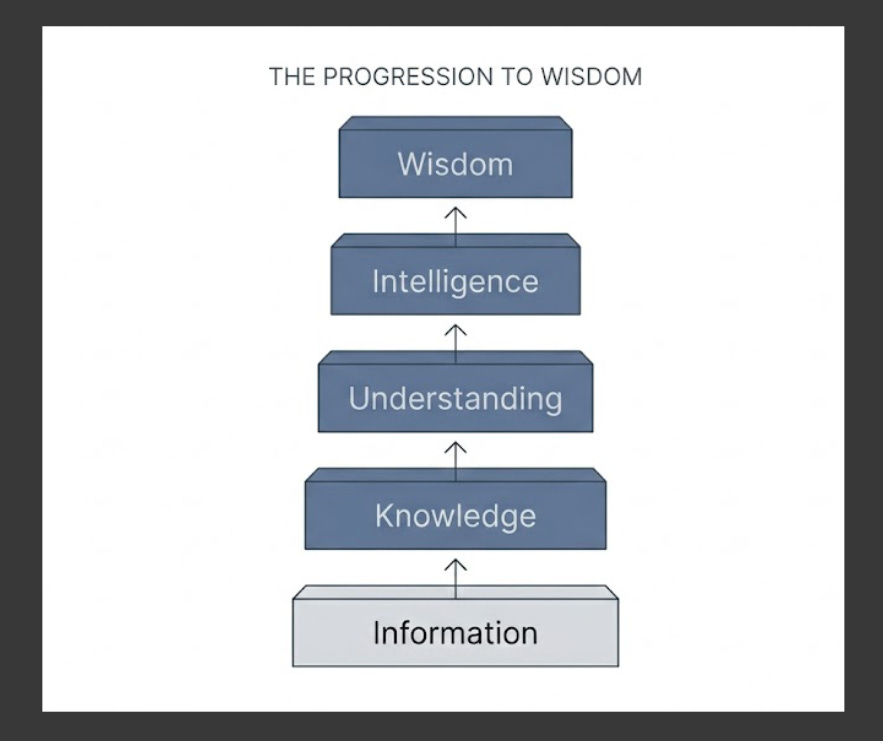
Information → Knowledge → Understanding → Intelligence → Wisdom.
Information is raw input. It enters, competes for space in working memory, and begins fading almost immediately. Most people stop here. They consume information and call it learning.
Knowledge is when information connects to something you already understand. That connection doesn’t happen on its own. It requires effort. Organization, comparison, context-setting. You have to do something with what you received. When that work happens, you can describe the idea. Explain it to someone else. The transition from information to knowledge is active.
Understanding goes deeper. It’s when you can explain not just what, but why. When you can predict: if this, then that. Understanding comes from application. From using the knowledge somewhere and watching what happens. Most people never reach this level because they never test the idea. They read it, store it, move on.
Intelligence is transfer. Taking what you understand in one context and applying it somewhere it doesn’t obviously belong. Seeing the pattern underneath the examples. This is where synthesis lives. Where two unrelated things connect and reveal something neither contained alone.
Wisdom is when the insight changes how you navigate reality. Not just what you think. How you decide. What you notice. What you do differently when it matters. Wisdom is integration. The level where knowledge stops being something you carry and starts being how you see.
Most people stop at information. Some reach knowledge. Very few reach wisdom. Not because they can’t. Because they never had a system that moves them through the progression.
Wisdom isn’t reserved for people who’ve lived long enough. It’s achievable now. Through application. Through the processing that most people skip.
The shower insight is the clearest evidence of this.
You’re standing under the water. A problem you’ve been carrying for three days suddenly cracks open. You see it completely. The connection is obvious. The path forward is clear. You feel genuinely brilliant.
Then you turn off the water.
By the time you’re dry, it’s gone. Not faded — gone. You try to reconstruct it. The outline is there but the clarity isn’t. The specific texture of the breakthrough, the way everything fit together in that moment. That’s not coming back.
That wasn’t a memory failure. That was a hardware limit.
Working memory holds about four things at once. Not seven, as we used to think. In 2001, Nelson Cowan’s research revised Miller’s “magical number 7” to closer to four chunks. In the shower, with no competing demands, your brain’s four slots were all pointed at the same problem. The insight assembled itself. The moment you stepped out and started processing other things — what’s for breakfast, where’s my phone, what do I need today — those slots got replaced.
Writing changes that equation. When you externalize a thought onto paper, you free a slot. The page holds it so your brain doesn’t have to. Which means your brain can process deeper.
Drawing fires visual, motor, and semantic processing simultaneously. Three encoding pathways at once. Writing fires two. Typing fires one. More pathways means deeper encoding — which is why the hand on paper does something the keyboard can’t.
Not because digital is bad. Because analog demands more from your brain, and that demand is what produces encoding.
This is also why AI-generated frameworks feel hollow. The framework looks right. The structure is sound. But nothing encoded. The thinking that would have happened working through it stayed with the tool, not with you.
Thinking Compounds. Here’s the System.
This isn’t a three-step process. It’s three flywheels that feed each other. Each one operates at a different level.
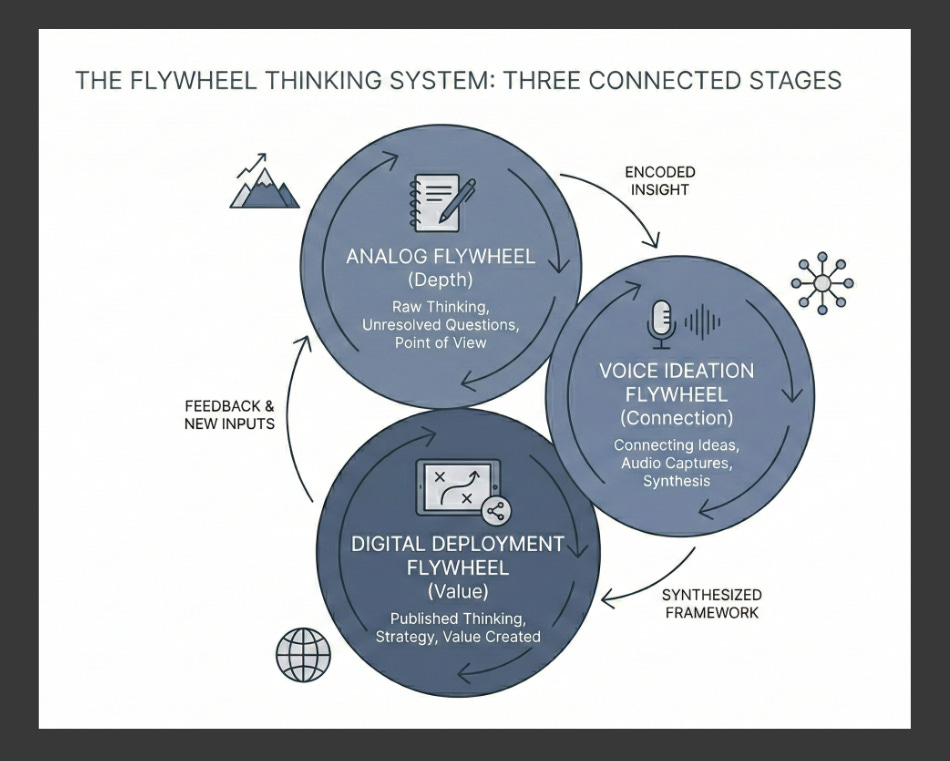
A flywheel stores rotational energy. You put energy in to get it turning. Once it’s moving, it takes less energy to keep going. Each rotation compounds.
Flywheel Thinking runs three of them.
The Analog Flywheel operates at the level of self. It surfaces what’s already in you. The thinking buried under the noise of everything you’re consuming, managing, reacting to. The raw material is your own experience, your own contradictions, your own unresolved questions. The practice excavates it. That’s this piece.
The Voice Ideation Flywheel operates at the level of connection. It catches what surfaces between sessions — the insight that sparks while you’re driving, the question that shows up in a conversation, the half-formed idea that arrives before you’re fully awake. This flywheel connects your analog depth to the world outside the notebook. That’s Part 2.
The Digital Deployment Flywheel operates at the level of audience. It takes what you’ve excavated and connected and turns it into thinking others can use — strategy briefs, content, product thinking, decisions. Anything that requires taking what’s in your head and getting it into a form that creates value. That’s Part 3.
Each flywheel’s output becomes the next one’s input. The analog practice produces raw material. The voice ideation flywheel processes it into connectable ideas. The digital deployment flywheel publishes it into the world. The system feeds itself. The thinking compounds.
You’ll start this to think more clearly.
That’s the first thing that happens, and it’s real. But you’ll keep doing it because it reveals something else. Who you actually are as a communicator. Your natural tendencies start appearing on the page. Whether you reach for frameworks first or stories first. Whether you think in questions or declarations. Whether you excavate through argument or through example.
Each flywheel has its own internal momentum.
Together, they compound into something AI can’t replicate: your original thinking, your unique voice, and the people who need to hear both.
Friction Is the Feature. The First Flywheel Stays Analog.
The first flywheel should stay analog.
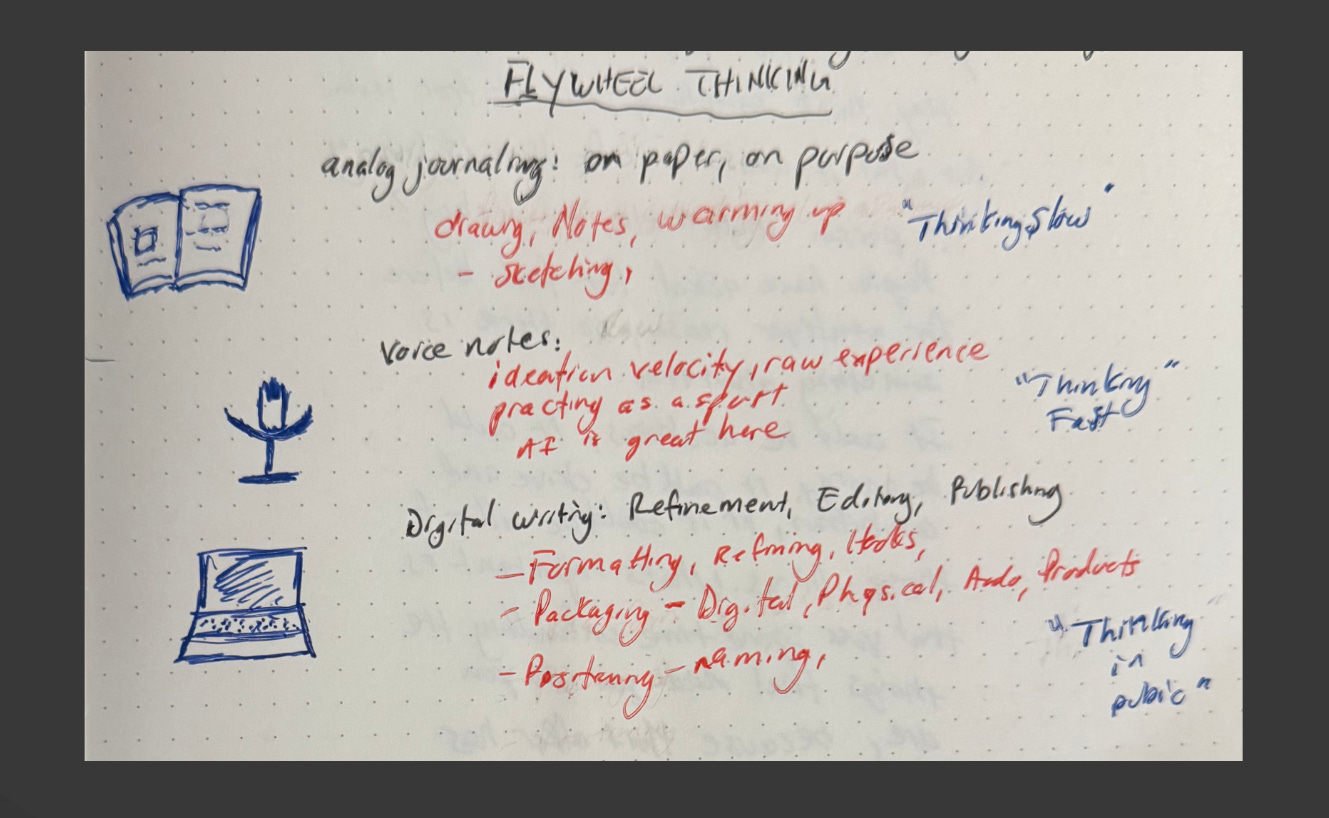
Not because I’m against digital tools. I use them heavily in the second and third flywheels. But the analog stage has a property that digital shortcuts: friction.
When your hand moves across paper, your brain encodes differently. The slowness forces a kind of attention that typing doesn’t demand. You can’t move faster than you can think. You can’t cut and paste your way around an unresolved idea. You can’t format something before you’ve understood it.
There’s a second thing the slowness produces. You become deliberate about words. When you can’t outrun your thinking, you have to choose. You can’t produce volume and sort it later. The hand on paper forces the question before the pen moves: is this what I actually mean? Typing lets you skip that question. Analog doesn’t.
That friction is what most people are trying to eliminate. Faster, smoother, less resistance.
But friction is the feature. Not the obstacle.
Here’s what happens when you skip the analog stage and go straight to digital. You open a document, you type fast, you produce something that looks organized. But the thinking is thin. You organized before you understood. You produced output before you encoded input. The structure is there. The depth isn’t.
There’s a phrase I keep coming back to: if writing feels hard, it’s working. Not because difficulty is a virtue, but because difficulty means your brain stopped skating the surface and started tunneling. The resistance you feel when you’re writing by hand about a genuinely unresolved problem. That’s not a signal to slow down. That’s encoding happening.
The analog flywheel isn’t anti-technology. It’s pro-depth. AI belongs in the second and third flywheels, where your thinking has already been processed. Deploy AI at the first flywheel, before you’ve excavated, and you’re asking someone to help you build before you’ve laid the foundation. The construction will be fast. The structure won’t hold.
That shows up in the content itself.
Without the analog flywheel, you end up publishing concepts. Structurally sound, logically coherent concepts. The same ones thousands of other people are publishing.
What stops a scroll isn’t a concept. It’s specificity. Your specific failure. Your specific lesson. The thing that only exists because you were in that situation, with those stakes, at that moment. Nobody else has that. Because nobody else lived it.
That specificity lives in the notebook — in the unresolved questions, the contradictions, the half-formed observations you haven’t examined yet. Skip the flywheel, and your content is built on borrowed ground. You have ideas. You don’t have a perspective.
The slowness isn’t a bug. It’s the mechanism.
10 Minutes a Morning. The Rest of the Day Thinks Differently.
The practice works because of what it’s actually doing.
You’re not just capturing thoughts. You’re locating yourself.
When you sit down with the notebook, the primary question isn’t “what do I know?” It’s: where am I in my thinking right now? What do I believe versus what do I assume? What have I worked through in this territory, and what am I still in the middle of?
The journal doesn’t create answers. It reveals where you are in the progression toward them. You can’t build on a foundation you haven’t located.
This is different from what most people use journaling for. Most journaling is capture. Record what happened, record what you feel, preserve the memory. That has value. But it’s not the same as locating.
Locating means: where am I in this, specifically? On this question, this problem, this decision — where am I in my own understanding of it? The journal answers that. It shows you where you are relative to where you thought you were. Sometimes you’re further along than you realized. Sometimes you’re further back. Either way, now you know. And knowing where you are is the first turn of any flywheel. Nothing moves until position is established.
Daniel Priestley calls this Pause, Reflect, Document — P-R-D. I haven’t found a better name for it.
Here’s how to run it.
The setup: Morning, before anything else. Before email. Before your phone. Before you’ve started reacting to anyone else’s agenda. Paper and pen. Ten minutes minimum.
A dedicated notebook. Not a general scratch pad. Not your work journal. One notebook. One practice. Nothing else goes in it.
A format that doesn’t impose structure — dot-grid or blank — keeps the page open to what wants to emerge, including sketches, arrows, diagrams. Some ideas have shapes that words can’t carry.
The investment is a pen and a notebook. The analog flywheel is accessible by design.
The prompt: Write about whatever is unresolved. Not structured, not pretty. Not a recap of yesterday. What’s unresolved. What’s sitting in the background of your thinking, taking up space you don’t always notice.
Pause is the hardest part. Most people skip straight to Document — they pick up the pen and try to write before they’ve stopped. Pausing means sitting for thirty seconds before the pen touches the page. It means asking: what actually occupies my thinking right now? Not what should — what does?
Reflect is where the work happens. You’re not journaling for therapy, and you’re not writing a strategy memo. You’re thinking out loud on paper. Externalizing the loops that are running in the background. The contradiction you noticed but haven’t resolved. The decision you’ve been deferring. The question that keeps surfacing.
Remember the shower insight? The one that was perfectly clear and then gone? This is how you catch it before it disappears. The analog session is the capture that happens before the shower ends. Before the insight gets replaced by the next demand on your working memory.
Document is the output — not a polished summary, but a record of where you are in your thinking today. It becomes the input for tomorrow. And that’s where the flywheel starts turning.
Here’s what will happen if you do this consistently.
First, something will clarify that was fuzzy. Not because you thought harder. Because you externalized it. The act of writing about an unresolved problem surfaces resolution that wasn’t available when it was just running in your head. You’ll write three sentences and suddenly know what you think.
Second, you’ll contradict yourself. You’ll write something, and four sentences later, write something that doesn’t match it. It’s synthesis waiting to happen. The contradiction means there’s a layer underneath that you haven’t reached yet.
Third, one insight will surprise you. Priestley uses the phrase “mountain of value.” The buried wealth of thinking, experience, and connection that exists in you, unexcavated. At some point in the first few weeks of this practice, something will surface from that mountain. An idea you didn’t know you had. A connection between two things that didn’t seem related. That moment is the flywheel catching.
Day one feels forced. You’re asking a part of your brain to do something it hasn’t been trained for. Write anyway. It doesn’t have to be good. Good isn’t the point.
By the end of the first week, patterns start showing up. The same themes reappear. The same questions resurface. That repetition isn’t a failure of the practice. It’s signal. The things that keep coming back are the things that actually need attention.
By the end of the first month, revelations happen. Something you wrote two weeks ago connects to something you wrote yesterday. You didn’t see the connection in the moment; the journal held both pieces until you were ready to put them together.
By month three, connections appear that would have been invisible before. You’re not starting from zero each morning. You’re starting from a progressively higher floor.
Your natural tendencies start appearing on the page. Some people, when they write freely, reach for frameworks first. Structure arrives before story. Others reach for story first. The example surfaces before the principle. Some think in questions. Some think in declarations.
But they’re all yours. And the notebook is where you discover which one you are.
You’re not deciding your voice. You’re discovering it was already there.
Voice is how you communicate. Point of view is what you see.
Ideas follow logic — pattern recognition, connecting concept A to concept B, extrapolating from what you’ve read. Anyone with strategic thinking can generate ideas. That’s real. It’s also replicable.
Point of view follows experience. Your specific wins. Your hard-fought losses. The lesson that only exists because you were in that situation with those stakes. Nobody else has that combination. It can’t be borrowed. It can only be excavated.
The notebook is where point of view gets developed — not decided, excavated. The same way voice doesn’t get invented, it gets surfaced. Both were already in you. The practice finds them.
The journal starts the excavation.
The Foundation Is Set. Now the System Starts.
You have a system for surfacing insights that have been hiding. Not through consumption. Through compression.
The analog flywheel creates raw material. Your own thinking, externalized and encoded. Not someone else’s framework applied to your situation. Your experience, your contradictions, your questions, processed into a form that compounds.
There’s no AI prompt here. That’s deliberate. The analog flywheel’s value is in the friction. Protecting that friction is part of using this correctly. The moment you hand this stage to a tool, you shortcut the encoding that makes everything downstream worth doing.
Start tomorrow. Before anything else. Ten minutes. Whatever notebook you have, dedicated only to this. Write about whatever is unresolved. No structure required.
The friction is the feature. Protect it.
But that’s only the first flywheel.
You’ve built the foundation. The depth, the raw material, the self-location that makes original thinking possible. The question that comes next is what happens between sessions. The insight that sparks while you’re driving. The question that shows up in a conversation. The idea that arrives on a Tuesday morning when you’re not near your notebook.
That’s where the second flywheel turns.
The Voice Ideation Flywheel doesn’t work without what you’ve built here. The depth you created is the fuel. Part 2 shows you how to catch what surfaces between sessions and turn it into something you can use.
The hardest part isn't the morning session. It's the idea that shows up at 2pm when you're not near your notebook.
Reply and tell me how you're catching those — or whether you're losing them.